The quantization of warfare: what will future armed conflict look like? Image by Gerd Altmann, on Pixabay.
By James Myers
Major quantum computing companies like Google, IBM, Quantinuum, and others are aiming to launch industrial-scale quantum computing in four short years, by the end of this decade. In September 2024, Quantinuum announced that it “will deliver a fully fault-tolerant and universal quantum computer capable of executing millions of operations on hundreds of logical qubits,” and more recently IBM and Google have provided their targets for 2029 .
As recently as early 2024, many thought that another decade would be required for the breakthroughs in physics necessary for creating stable quantum circuits, but significant progress in 2025 has moved the quantum goalpost much closer.
Militaries around the globe are watching that goalpost closely and are actively researching ways that the tremendous speed and accuracy of quantum computers can be harnessed to advance warfare capabilities. Military uses for quantum computing are not widely publicized, but pose significant concerns because the technology’s power could give the first country that obtains it an overwhelming advantage over its adversaries.
The previous term for “quantum advantage,” when the technology was less mature than it now is, was “quantum supremacy.” “Supremacy” might remain an appropriate term for outcomes of a quantized war.
As we reported last December in the final of The Quantum Record’s six-part series on quantum ethics, China is the acknowledged global leader in financial commitments to quantum technology. The European Union and its 27 member states rank second at approximately one-half of China’s commitments, and the rest of the Western bloc countries including the United States lag far behind.
Although China has been less public about its quantum financial commitments since the following table was published in April 2024, a study by the Mercator Institute for China Studies (pdf available) demonstrates a marked increase in the frequency with which quantum technology is mentioned in Chinese government policies. Since the Chinese Politburo’s study session in 2020 on quantum science, quantum references increased from 2% of Chinese science and technology policies to 5% by 2023, clearly signalling a trend for research and development for years to come.
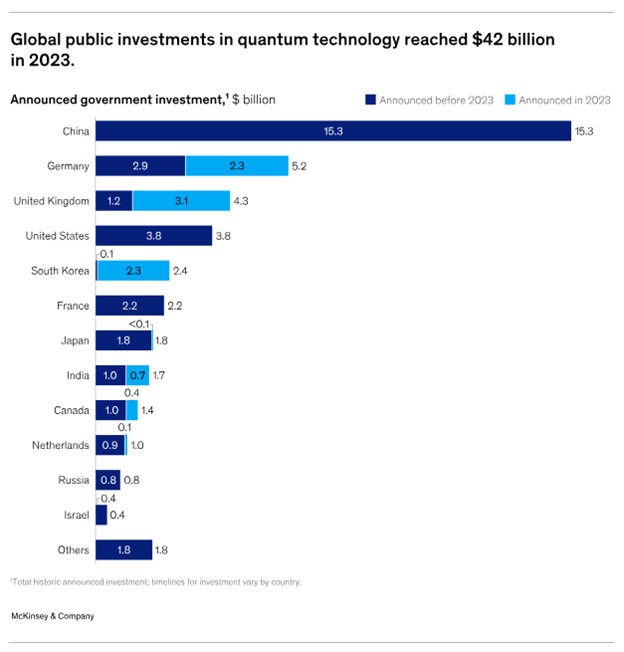
China’s lead in quantum investment has continued since this comparison by McKinsey & Company published in April 2024, although other countries, particularly Japan, have more recently announced rapid increases in quantum funding commitments. The race among nations for quantum advantage was featured in the concluding article of The Quantum Record’s six-part series on quantum ethics.
In 2025, China became the first country to deploy quantum communications by satellite, an exceedingly difficult task for today’s error-prone “noisy” quantum circuits. Once successfully implemented, quantum communications are expected to be completely secure, protecting military uses from detection and decryption while adversaries lacking the technology remain vulnerable.
What are likely first military uses for quantum technology at industrial scale?
Deploying quantum sensing technologies is among the prime goals of major military powers. Large commercial interests are also investing heavily in quantum sensing development, adding to the likelihood of significant technological breakthroughs in a matter of years or months, not decades.
Magnetic resonance imaging (MRI) machines now in wide use scan medical patients with a form of quantum sensing that could be vastly amplified and weaponized with fully-functional quantum computing. MRI’s techniques for imaging precision are being adapted for many globally beneficial uses, including early identification of weather disturbances that enable rapid response to mitigate damages. Military planners, however, are engineering the technology to locate enemy targets with precision far greater than today’s best technology can manage.
Quantum sensing uses the properties of quantum mechanics, in combination with light and other atomic properties, to provide high-resolution measurements of changes in the physical properties of any object–for example, an object’s effect on the electrical and magnetic field (electromagnetism)—with pinpoint accuracy. That’s what makes an MRI clearly beneficial to any medical patient, but its quantum sensing technology would be dreaded by an enemy targeted with the technology’s precision.

Quantum sensing is a process that measures changes in atomic “vibrations.” Image by Gerd Altmann, on Pixabay .
Rapid advancements in quantum sensing technology were featured in The Quantum Record’s December 2023 article Quantum Sensing’s Revolutionary Potential for Cancer Treatment, Navigation, and Precision Measurement. By then, scientists had already developed a quantum sensor capable of detecting any arbitrary frequency without degrading measurement, and another quantum sensor that uses infrared light on medical patients to detect cancerous cells in very early stages when their spread is far more preventable.
Two years later, quantum sensing continues to be a key military focus.
The Government of Austria funded a March 2025 study entitled An Introduction to Military Quantum Technology for Policymakers, by Michal Krelina, which reports that “Some experts think quantum devices might start yielding practical military advantages within the next few years—especially in sensing or secure communications, where smaller-scale or near-term prototypes can offer meaningful improvements. Others caution that full-scale quantum computing, capable of reshaping cryptography or real-time battle field decision-making, may be further off.”
Another report published in March, entitled “A conceptual framework for describing the future impacts of quantum sensors to national security” (pdf available), by Austin Brooksby and co-authors and published in Academia Quantum, underscores four applications of quantum sensing to advance military capabilities. These include microchip-sized clocks that reduce reliance on GPS radio signals increasingly prone to spoofing, and upgrading accelerometers and gyroscopes for inertial sensing in precision navigation and positioning. Quantum sensing will enable precise magnetometers for navigation and detection of anomalies in magnetic fields, replacing devices like compasses, and it will also increase the accuracy of gravimeters that detect masses beneath the Earth’s surface for enemy identification and navigation in environments where GPS signals cannot penetrate.
It’s impossible to predict the many probabilities of the future, but history can be a valuable guide to understanding the path we’re on.
History is an exceptionally reliable guide the closer it comes to repeating.
While allowance can be made for the uncertainty of future outcomes, history clearly shows the direction of the technological path we’re on in a world that’s divided by political polarization, vast wealth differentials, and the friction of war and tyranny that ravage millions of innocent people.
Technology plays an increasingly dominant role in wars. Piston-driven aircraft, tanks, bombs, and guns reigned In the First and Second World Wars that were only 21 years apart, whereas fighter jets and aircraft carriers re-wrote the rules of combat in the Korean and Vietnam wars of the following two decades. The trend of rapidly increasing technological power was clear to witness in the wars that later erupted in Afghanistan, the Persian Gulf, and Iraq, with the added lethality of long-range missiles targeted by satellite imaging and communication. Most recently, small but deadly drones have featured prominently in the Ukraine and Gaza conflicts.

The light shines on the Memorial to the Murdered Jews of Europe, in Berlin. In 1933, Adolf Hitler and his Nazi Party seized power in Germany and over the following 12 years triggered World War II and murdered 6 million Jews. The lessons of history are clear to see. As philosopher George Santayana wrote, those who forget the past are condemned to repeat it. Photo © James Myers
Some state-sponsored actors are already engaging in cyberwarfare to steal adversaries’ military and political intelligence and inflict economic damage with widespread cyberattacks against important public utilities, hospitals, and businesses. The present rate of damage from cyberwarfare is a clear sign that a large and very vulnerable front in a global war will be the data that’s targeted in digital battle. The damage could be more widespread than guns and soldiers could inflict, if a quantum-enabled cyberattack cripples an economy or a country’s military command and control structure.
The quantization of warfare amplifies the risks and severity of damage in a technological war.
The question is not whether quantum military technologies will prove effective in a technologically-driven war; instead, the question is how many conventional technologies of war will be made obsolete by the quantum leap.
Take, for example, guidance technologies that now deliver missiles and drones to their targets. The targeting accuracy of these weapons will sharply increase with the incredible precision of quantum sensing.
Even without quantum sensing, military operators remotely steer missiles and drones with a high degree of accuracy, often from thousands of kilometres away. While guided weapons are effective, human and technological errors can combine with devastating consequences for innocent civilians caught within the blast radius of sometimes 100 metres or more. A tragic example was the August 29, 2021 killing of 10 innocent Afghan citizens by a missile launched from a U.S. Reaper drone, a result of human failure in targeting a family travelling in a Toyota Corolla after misidentifying it as the vehicle of an important ISIS enemy.
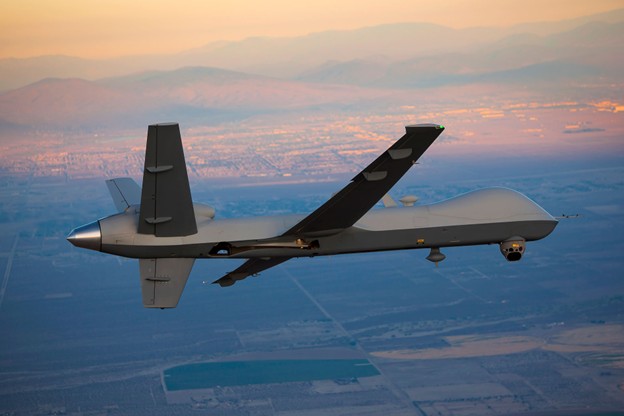
The MQ-9A Remotely Piloted Aircraft (“Reaper” drone) is powered by a 950-horsepower turboprop engine allowing it to carry 15 times more explosive payload than the earlier generation Predator drone. With a 20-metre wingspan and 20-hour flight capability when fully loaded, the Reaper carries a heat-imaging camera and other sensing devices that can reportedly read a licence plate at a distance of 3 kilometres. The drone responds to an operator’s command transmitted by satellite within 1.2 seconds. Image: General Atomics Aeronautical.
A technologically enabled operator guiding such a drone, possibly from half a world away at a military base in Nevada, would have far less information on the local context than a soldier on the road within visual range of the target. Lack of local context compounded the error that might not have occurred if the depth of human vision had been at the scene to override the drone’s cameras.
Although quantum sensing will provide pinpoint and more lethal accuracy to a long-distance weapons operator, the far more detailed information that the technology yields could also give an operator greater ability to verify targets and guard against error. Error prevention is crucial to saving the lives of innocent civilians, and perhaps is nowhere more important than in areas surrounding hospitals treating the sick and wounded.
A June 2024 analysis entitled Drone Attacks on Health in 2023 reports on the Safeguarding Health in Conflict Coalition’s identification of “2,562 incidents of violence against or obstruction of health care in conflicts in 2023, a 25% increase from 2022, and the highest ever since the coalition began reporting on attacks in 2014.” The authors note that drones were widely used in the incidents, in many cases intentionally targeting hospitals suspected of treating enemy wounded. In other cases, hospitals and health workers within the blast radius of a local missile or drone strike became collateral damage.
Breaking an enemy’s encrypted data would be an advantage only if they didn’t break your data first.
Another looming ethical issue identified in The Quantum Record’s six-part series on quantum ethics is increased exposure to something that many of us have experienced: the theft of our sensitive encrypted data and valuables by e-mail hacking and the compromising of bank accounts and credit cards. Technology has already provided many avenues for fraudsters to steal, impersonate, blackmail, and extort money from increasing numbers of victims.
Quantum computers are expected to break current encryption methods, revealing sensitive data. Image: Gerd Altmann, on Pixabay .
In April 2025, the U.S. Federal Bureau of Investigation reported that the 859,532 complaints of suspected internet crime that it received in 2024 resulted in losses of $16 billion. Investment fraud, particularly in cryptocurrencies, accounted for the largest share of the reported losses. Many other losses in the U.S. were reported to other law enforcement agencies, multiplying the losses reported by the FBI.
For years, it has been known that quantum computers will very likely be able to break existing encryption standards that we rely on to keep our bank accounts, credit cards, medical records, and other valuable data safe from loss and theft. The U.S. National Institute of Standards and Technology (NIST) has advised the public of the risks that urgently need to be addressed in the development of post-quantum cryptography. One of the highest risks is the “harvest now, decrypt later” strategy criminals are pursuing by stealing encrypted data, knowing that although they can’t break the code now they’ll very likely crack it later with the help of a quantum computer.
Data encryption typically relies on a mathematical process to factor prime numbers—which are numbers divisible only by themselves and 1—and the massive amount of variables in the process is beyond the capability of today’s most powerful computers to decrypt. The speed and accuracy of quantum computers give them the power to run far more probabilities for cracking encryption by the current prime number factoring method.
Quantum computers operating Shor’s algorithm, which uses a vastly decreased time scale called polynomial time that operates in quantum circuits, will be able to factor prime numbers far more quickly than today’s most capable computers. There’s also a concern that Grover’s algorithm, developed to search with high probability for the inputs to a quantum function, could allow quantum computers to break 256- or 512-bit key cryptography used with most of today’s computers.
In August, Microsoft’s report Progress towards next-generation cryptography highlighted the company’s estimate that in four short years the world will be confronting a high risk of quantum technology overwhelming the world’s encrypted data. The timeline coincides with the 2029 target of the major quantum computing companies for industrial-scale technological implementation.
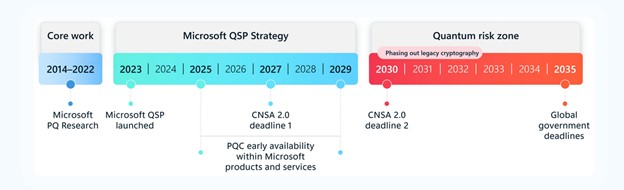
Chart from Progress towards next-generation cryptography, by Microsoft .
In 2023, NIST announced the selection of four different possible post-quantum encryption algorithms, with the goal of settling on not one but several that would provide security for quantum computers as well as “classical” computers now in widespread use. Tests of the algorithms are ongoing, and better algorithms might still be developed, but any final version could require modifications if new encryption threats emerge after many quantum computers become fully operational and networked.
Even if a quantum encryption method guarantees data security, applying it to all systems in military and other government operations as well as the private sector is not a matter of mere minutes, like updating software on a laptop or phone. The process is expected to take years to complete, because it requires that every organization first prepare a complete inventory of encrypted systems and processes–which number in the thousands for large organizations and governments–and then implement the changes together with any necessary reprogramming.
With so many legacy computing systems still in operation, it is expected that some encrypted systems will be overlooked and that some implementations and reprogramming will perform unexpectedly. Errors would quickly spread and compound in the vast numbers of globally networked systems and digital interdependencies now in place.
Researchers are investigating further military uses for quantum technologies, although they will likely require a longer time for development as tools of war.
Quantum computers excel at calculating probabilities, which is already proving to be a significant advantage in the development of new materials for both industrial and military interests.
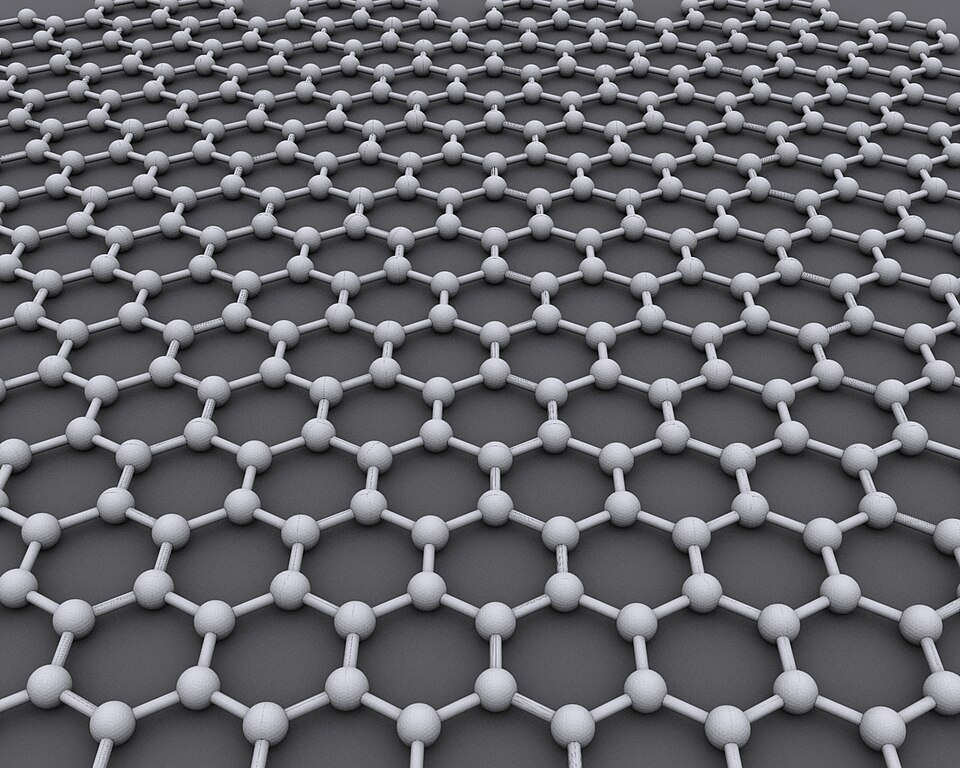
Graphene is a hexagonal lattice of carbon atoms that is only one-atom deep but exceptionally strong, electrically conductive, and transparent. Image by AlexanderAlUS on Wikipedia.
Graphene, for example, has tremendous potential for both commercial and military purposes where it could be used in manufacturing lighter, more flexible, and stronger parts. Engineering graphene is difficult – it’s a 2-dimensional hexagonal lattice of carbon molecules that’s only one-atom deep – but the accuracy and speed of quantum computing could enable industrial-scale production of graphene for increased mobility and protection to armies, air forces, navies, and space forces.
A 2020 report prepared for the NATO defence alliance, entitled Graphene Technologies and Applications for Defence – A Research Specialists’ Meeting (pdf available), highlighted graphene’s “clear potential for a wide range for military applications” that range “from corrosion protection on ships to high performance rubber tires, and from multifunctional aerospace composites to energetic materials and solid propellants.” The report notes that, “Much defense materiel in service today was built using materials developed 50 or more years ago, before the advent of graphene, additive manufacturing, electric propulsion, adaptive camouflage, high performance sensors and many of the other advanced technologies now available.”
For example, a combination of zinc oxide and graphene can produce a sensor that detects the ultraviolet signature of a missile launch without interference from the sun’s energy. The report lists other military benefits of graphene that include management of heat, ballistic protection, rocket motor insulation, aerospace structural composites, and stealth technology.
There is a large range of other exotic materials that quantum computing could help to deliver. It has been three decades since the United States introduced the B-2 Stealth Bomber that’s highly elusive to detection, and it is not difficult to imagine that secretive militaries around the globe are investing heavily in developing even stealthier materials that are undetectable to radar, satellites, and other technologies.
Quantum sensing could render existing stealth materials vulnerable to detection. Chinese researchers have recently claimed a major breakthrough in producing a detector so sensitive that it can sense a single photon (particle) of light, which would be a key component of a potential quantum radar system that could expose stealth fighter jets. There remains significant doubt, however, about the scientific and technological feasibility of quantum radar, and China is reported to be developing stealth aircraft that the U.S. military estimates could enter service in the next decade.
Miniaturizing weapons would be another likely military benefit of new materials like graphene. In the Gaza and Ukraine Wars, the world has witnessed the destructive power of drones that are difficult to intercept and deliver large numbers of bombs at relatively low expense. A small drone can carry a very powerful explosive payload, raining terror from the skies.
A report entitled Drones are Changing How Wars Harm Civilians, published in November by Just Security, indicates that “drone attacks in conflict settings increased by an astonishing 4,000 percent between 2020 and 2024, and more than quadrupled from an estimated 4,525 attacks in 2023 to 19,704 in 2024.” The report notes that “For several months in 2025, first-person view drones were the leading cause of civilian casualties” in Ukraine, where Russian forces have widely deployed attack drones.

The U.S. Defense Department’s Replicator Initiative seeks to integrate and automate technology throughout the military. Pictured are Deputy Defense Secretary Kathleen Hicks, who served in the Biden administration, and an example of automated drone at the Defense Innovation Unit in Mountain View, California. Photo by Navy Petty Officer 1st Class Alexander Kubitza, Department of Defense.
By discovering stronger materials that enable even smaller drones, quantum computing could add to the proliferation of military drones. The weapons will continue to be an attractive investment for militaries intent on inflicting widespread damage, in part because drones are far less difficult to purchase or manufacture than aircraft, missiles, and long-range artillery. Drones feature prominently in the United States Defense Department’s Replicator Initiative that aims to embed technology in every facet of military operations. (For more on the Replicator Initiative, see The Quantum Record’s July 2024 article Quantum Technologies Advance Military Capabilities, Raising Ethical Concerns).
As we reported, the Replicator Initiative aims at “integrating sensors and fusing data across every domain” of the military, as explained by Kathleen Hicks, former U.S. Deputy Defense Secretary in the Biden administration, who stated that the development of autonomous systems will counter China’s “biggest advantage, which is mass. More ships. More missiles. More people.” Noting that, “This is about mastering the technology of tomorrow,” Hicks stated, “After all, we don’t use our people as cannon fodder like some competitors do.”
Cannon fodder is a term that applies to powerless people who are forced to fight in a war with little hope for their own survival because military planners figure that if enough of those people sacrifice their lives in battle, the enemy will be overwhelmed by their number.
Deployment of large armies to battlefronts is, however, extremely costly and logistically difficult in a short time. Another benefit of quantum computing to war efforts is its ability to make cyber-warfare more cost-effective than physical combat in some cases. Launching an algorithm at an enemy could prove far less expensive than launching barrages of soldiers and missiles.
Humanity faces many great benefits from the peaceful use of quantum technology. The problem is that its powerful advantage in computation, sensing, materials development, and decryption could turn to quantum technology into an existential risk for humanity as warfare is quantized.
Is our vision of the best possible future one with quantized military power, or is our philosophy for quantum technology to build a brighter future for the world’s children and generations to follow?
Have we made a mistake?
We’d love to learn more and correct any unintentional inaccuracies we may have published in the past. Please reach out to us at info@thequantumrecord.com. Additionally, if you’re an expert in this field and would like to contribute to our future content, feel free to contact us. Our goal is to foster a growing community of researchers who can communicate and reflect on global scientific and technological developments in plain language.
Craving more? Check out these recommended TQR articles:
- Thinking in the Age of Machines: Global IQ Decline and the Rise of AI-Assisted Thinking
- Cleaning the Mirror: Increasing Concerns Over Data Quality, Distortion, and Decision-Making
- Not a Straight Line: What Ancient DNA Is Teaching Us About Migration, Contact, and Being Human
- Digital Sovereignty: Cutting Dependence on Dominant Tech Companies
We would love to know what you think about The Quantum Record and content like this. Share your thoughts in this 2-minute survey.