

A monarch butterfly wears a solar-powered radio tag weighing 60 milligrams. Called BlūMorpho, the tag is manufactured by Cellular Tracking Technologies. Image: Cellular Tracking Technologies.
By James Myers
The term “butterfly effect” describes a single event in time, such as one flap of a butterfly’s two wings, that seems completely forgettable and inconsequential when it happens. The butterfly effect occurs in the long run, when a disturbance as tiny as a bunch of air molecules tossing around an insect’s wings multiplies exponentially over time. A single wing flap could turn into a major event, triggering a chain reaction as each subsequent wing flap builds on the previous and their effects combine to the point that they shape an entirely different future for all of us.
The thought that the future could pivot on a single event like the flap of a butterfly’s wings is challenging, and not just because it would make the future seem pretty random and time seem somewhat pointless. The other problem is that we can accurately measure only the immediate effects of an event, because of the technological hurdles in tracing all of its causes and effects through time.
That’s where new technology that allows for precision tracking of butterfly movements in their annual migration could help to revolutionize our understanding of motion on a global scale.
Scientists have succeeded in developing a radio tag so tiny and weightless that it attaches to a butterfly and sends out a beacon that is picked up by people on the ground within receiving range. Crowd-sourced Bluetooth location networks add to the number of participants who can effectively track large numbers of butterflies passing within about 100 meters.

A monarch butterfly migrates annually thousands of kilometres across North America to winter in central Mexico. About three-quarters of butterflies don’t survive the journey, falling victim to birds, vehicles, and exhaustion. Image by Rhododendrites, on Wikipedia.
This year, the Project Monarch collaboration brought together citizen scientists who used radio signals to track the insects on their annual migration from Canada and the United States to central Mexico, where colonies of butterflies spend the winter months. The movements of the butterflies were correlated with weather and other conditions along their route to develop an unprecedented picture of how changes in climate affect the motions of living organisms over vast distances in a variety of regions.
The data will also advance understanding of the intricate navigation systems of butterflies, which orient themselves using polarized sunlight and, in cloudy conditions, ultraviolet light. Adjusting their flight to synchronize with the movement of the sun in relation to the Earth’s magnetic field, it remains a mystery how butterflies are able to arrive with near pinpoint accuracy at the same location where their ancestors spent the winter.
The scientific breakthrough resulted in the development of a tiny solar-powered radio tag that weighs only 60 milligrams – that’s six one-hundredths of a gram, which is about one-tenth the weight of the average monarch butterfly – and sells for around $200.
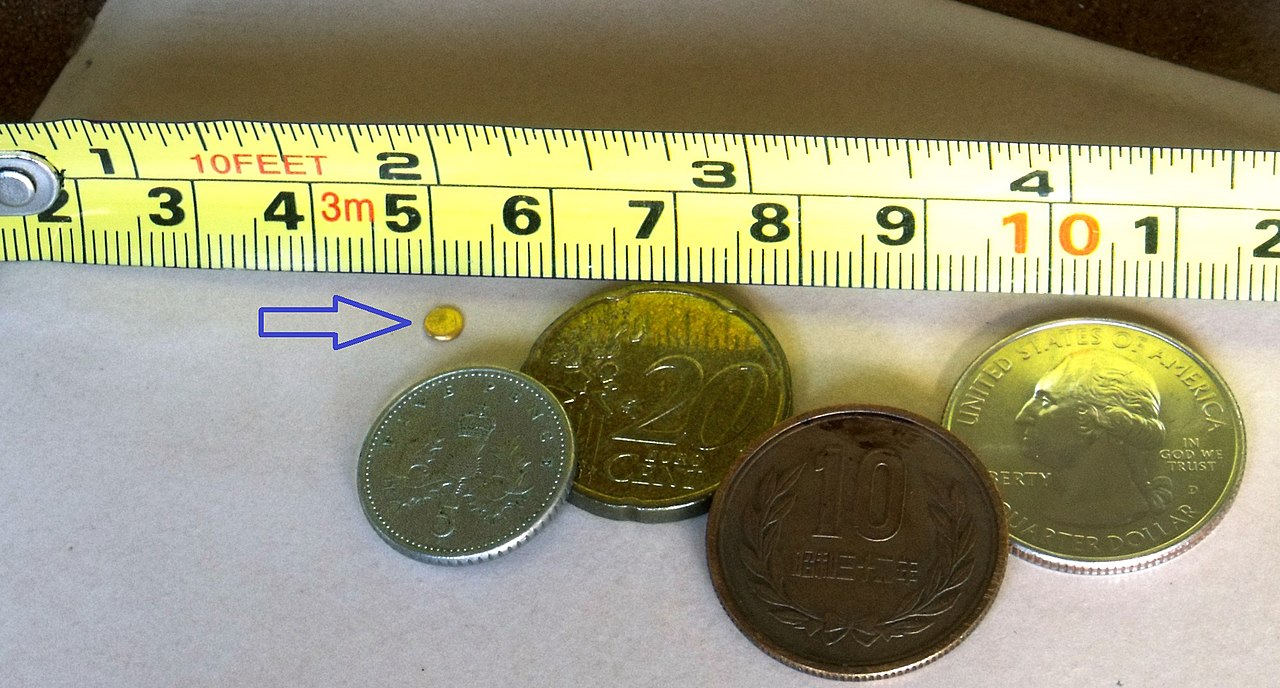
The radio tags placed on the butterflies weigh a little less than a single grain of mass, which is about 65 milligrams and just slightly larger than the small disc below the number 5 on the measuring tape in this image. The mass is tiny compared to everyday lightweight objects like an assortment of coins. Image: Ixnayonthetimmay, on Wikipedia.
Called BlūMorpho, the tag weighs just less than a single “grain” of mass, an amount so light that even a slight breath could cause it to fly away.
But the scientific achievement is truly remarkable for even more than its effectiveness in powering radio signals at such a small scale over such long distances. What’s also amazing is that the device remains attached to a butterfly, withstanding the flapping of its wings 120 times every minute on a journey that takes it thousands of kilometres over a sizeable distance within North America’s 9.5 million square mile area.
The device is attached to a butterfly’s thorax using eyelash adhesive. The tiny BlūMorpho tag features an antenna that is a bit longer than the monarch’s own natural antennae. Researchers have tagged more than 400 butterflies and follow their migration using a mobile phone-based app developed by Cellular Tracking Technologies, the New Jersey-based company that developed the tags.
The innovation for the tagging technology was provided by the Covid-19 pandemic that began in March 2020. The company states, “Due to all the issues CTT faced with manufacturing during the pandemic, the decision to bring full manufacturing processes in-house resulted in the smallest possible solar panel, and the ability to innovate with some of the tiniest components in existence. The result? The BlūMorpho.”
By 2023, the weight of the device had become small enough for a butterfly to sustain, but there remained problems with the transmitting technology. As Cellular Tracking Technologies stated in a press release last month, “Everything changed in November 2024 when a butterfly named Lionel, equipped with a new additional bit of programming code, dubbed Blū+, was released in Cape May Point. By tapping into crowd-sourced location networks, Lionel provided the first high-resolution track of monarch migration ever recorded, with hundreds of detections to St. Augustine, Florida.”
The company noted that “With hundreds of millions of devices all acting as passive receivers we were able to watch the fine-scale movements of Lionel in near-real-time.”
Before BlūMorpho, butterfly tracking relied primarily on small stickers with unique number and letter codes that were placed on the insects at the beginning of their migration and recovered in Mexico at the end of the journey. A group called Monarch Watch, which was founded in 1992, operated the largest identification operation with 100,000 stickers applied to migrating monarchs in a year. The recovery rate was typically less than 1%, however, since about three-quarters of butterflies don’t survive the full migratory journey and luck was a large factor in locating survivors with identifying stickers.
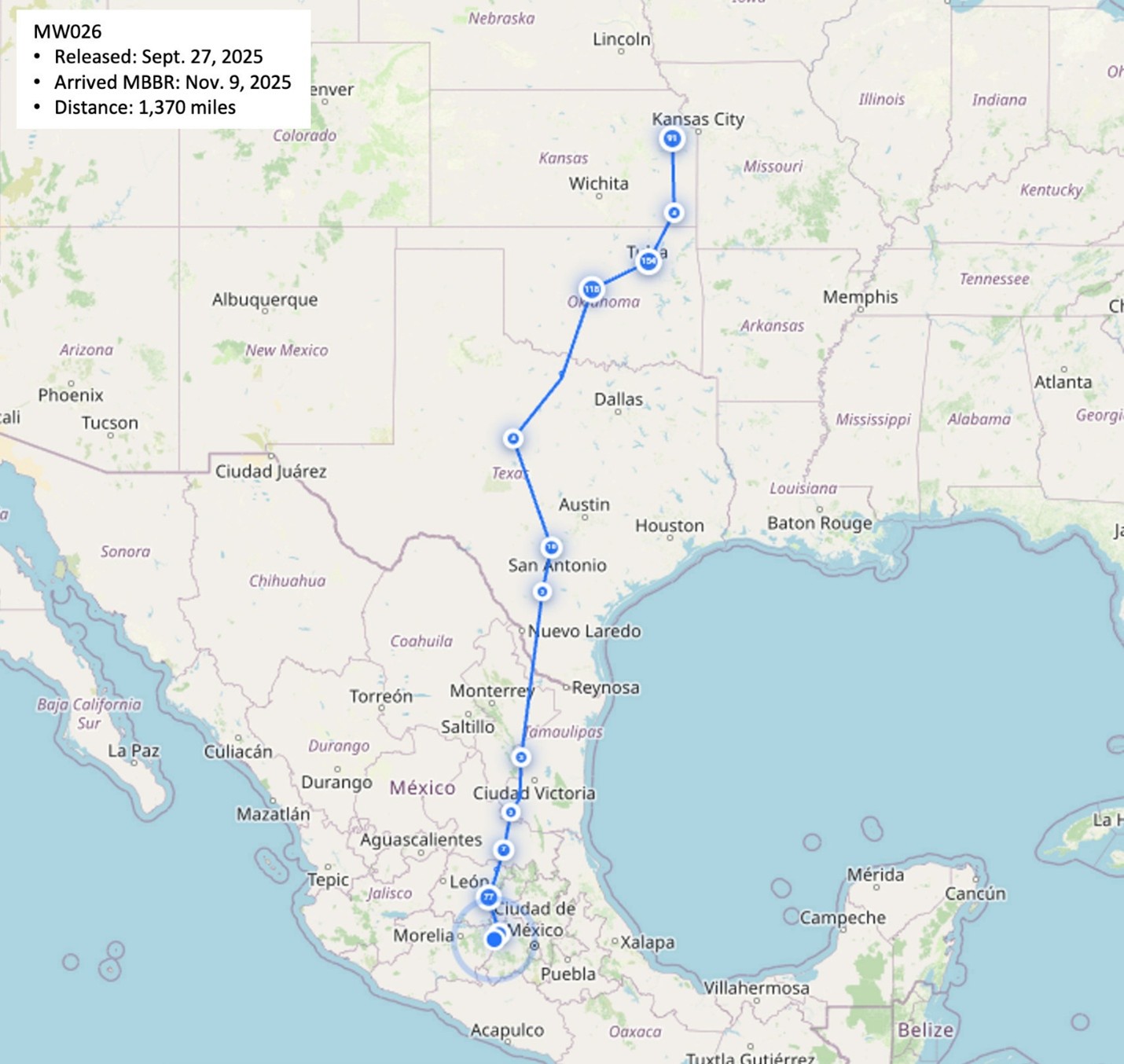
The group Monarch Watch applied BlūMorpho radio tags to 30 monarch butterflies. This map shows the route of one butterfly, labelled MW026, that began its migration in Kansas City and covered 1,370 miles (2,205 kilometres) in about six weeks. Nine of the 30 tagged butterflies survived the journey. Image: Monarchwatch.org
The new technology promises immediate benefits by helping to identify the causes of an alarming drop in butterfly populations across the United States, and likely in other areas of the world, since the turn of the 21st century.
In one study before the new tracking technology, researchers collected data on the movements of 12.6 million butterflies using 76,000 surveys from 35 citizen scientist groups across the United States. Their results were published in Science in March 2025, in a paper by Collin B. Edwards and co-authors entitled Rapid butterfly declines across the United States during the 21st century.
The movements of millions of butterflies revealed an alarmingly rapid decline in butterfly populations. Something appears to have decimated about one-tenth of most species of American butterflies in the past 24 years, and the likely culprits are humans – specifically, our use of pesticides and destruction of butterfly habitats by deforestation and drought from water diversion and overuse. In the 1990s, wintering butterflies in Mexico were estimated to number in the hundreds of millions, but by the winter of 2024 the estimated population was as low as 38 million.
“There’s nothing that’s not amazing” about the new radio tag technology, according to Cheryl Schultz, a butterfly scientist at Washington State University who was a co-author of the study and was quoted by the New York Times. With the new technology, Schultz said, “now we will have answers that could help us turn the tide for these bugs.”
When 13 species of butterflies are experiencing declining numbers for every 1 species that’s increasing in number, the decimation of butterfly populations is hard to explain away to natural causes. Imbalances like this are unsustainable, and nature always selects for balance because balance is nature’s way.
The miniature radio tag technology can be applied to a wide range of animals, including birds as well as land-based species, to monitor the effects of climate change and human activity on many species. The picture that emerges will assist conservation efforts and could help to drive regulatory changes for better protection of the environment, living organisms, and natural systems.
The technology could help to unlock mysteries about motion and thermodynamics.
An exciting prospect for the new tracking devices is their potential for combination with rapidly developing quantum sensing technologies that provide precision measurement of changes occurring at the atomic level.
Quantum sensing was featured in The Quantum Record’s December 2023 article Quantum Sensing’s Revolutionary Potential for Cancer Treatment, Navigation, and Precision Measurement, and recent developments are highlighted in this month’s feature, The Quantization of Warfare: The Technological Battlefield That Overpowers Both Sides in Human Combat. Quantum sensing uses the properties of quantum mechanics, in combination with light and other atomic properties, to provide high-resolution measurements of changes in the physical properties of any object—for example, an insect’s effect on the electrical and magnetic field (electromagnetism)—with pinpoint accuracy.

The butterfly effect is named after the work of meteorologist and mathematician Edward Lorenz, who originally used an analogy of a seagull’s wings flapping but later used a butterfly as the initial source of motion. Above is the graph of a Lorenz attractor, depicting patterns of motion that are highly dependent on the initial condition. Image: Wikipedia.
In addition to its benefits for medicine, quantum sensing is being developed for climate monitoring, with networks of sensors providing early warning of natural disasters like floods and earthquakes and allowing people to move out of harm’s way. In gauging the motion of air and water molecules, the extreme accuracy of quantum sensors is expected to help resolve questions about the causes and effects of global weather patterns that are becoming increasingly severe and damaging.
By correlating data on the effects of atmospheric motion on the motion of migrating butterflies, and adding the precision of quantum sensing, the technology behind BlūMorpho could yield a wealth of information on the mechanical and thermodynamic processes of motion on a global scale. Not all of the data, however, will necessarily be applied for the global benefit of humanity.
High-accuracy detection of enemy personnel, military equipment movement, and the thermodynamic signature of their motions ranks among the highest priorities for military development of quantum sensing technologies, as we note in this month’s feature article. Even without fully developed quantum sensors, there could be many military applications for easily concealed miniaturized radio trackers like BlūMorpho.
The technological breakthrough of 2025 that enables the tracking of individual insects across a continent could well result in its own butterfly effect on climate science, understanding of natural systems, military operations, and far more. The question, for this butterfly effect and any other, is how can we steer it toward outcomes with global benefit?
Have we made a mistake?
We’d love to learn more and correct any unintentional inaccuracies we may have published in the past. Please reach out to us at info@thequantumrecord.com. Additionally, if you’re an expert in this field and would like to contribute to our future content, feel free to contact us. Our goal is to foster a growing community of researchers who can communicate and reflect on global scientific and technological developments in plain language.
Craving more? Check out these recommended TQR articles:
- Thinking in the Age of Machines: Global IQ Decline and the Rise of AI-Assisted Thinking
- Cleaning the Mirror: Increasing Concerns Over Data Quality, Distortion, and Decision-Making
- Not a Straight Line: What Ancient DNA Is Teaching Us About Migration, Contact, and Being Human
- Digital Sovereignty: Cutting Dependence on Dominant Tech Companies
We would love to know what you think about The Quantum Record and content like this. Share your thoughts in this 2-minute survey.