

“The existence of thousands of satellites, orbiting around our planet, is threatened by an ever-increasing amount of space debris.” Credit: European Space Agency
By Mariana Meneses
When a piece of space debris re-enters Earth’s atmosphere, it does not disappear quietly. As fragments plunge through the air at extreme speeds, they generate shockwaves that propagate to the ground. In April 2024, such shockwaves were recorded by seismic stations across Southern California as debris from China’s Shenzhou-15 mission broke apart overhead, allowing researchers to reconstruct the object’s path after the fact. This event illustrates how the growing activity in low Earth orbit is increasingly detectable not only by space-based sensors, but by instruments embedded in Earth’s own monitoring systems.
The study entitled “Reentry and disintegration dynamics of space debris tracked using seismic data”, by Benjamin Fernando and Constantinos Charalambous from Johns Hopkins University, was published in January 2026 in the journal Science (not open access). The researchers used open-source seismic data with critical information about the debris, including speed, trajectory, descent angle, and fragmentation pattern.
Reporting on the study, Science explained that seismic stations can be used to accurately reconstruct the trajectories of re-entering space debris by detecting the sonic booms produced as objects fall through the atmosphere at extreme speeds. The researchers analyzed data from 126 stations in California and Nevada that recorded shock waves generated in April 2024. By comparing the arrival times of the sonic booms across the seismic network, the team was able to estimate the debris’ path, speed, and disintegration, finding a trajectory about 28 kilometers south of earlier radar-based forecasts.
The study highlights how existing seismic networks could complement radar tracking, particularly given the growing number of objects in orbit, the difficulty of modeling atmospheric drag, and the influence of variable atmospheric density driven by factors such as solar activity. While challenges remain, including accounting for wind effects and limited seismic coverage in some regions, the researchers aim to develop an automated system for near–real-time detection of re-entering space debris within the next five years, an approach that has already attracted interest from national space agencies.
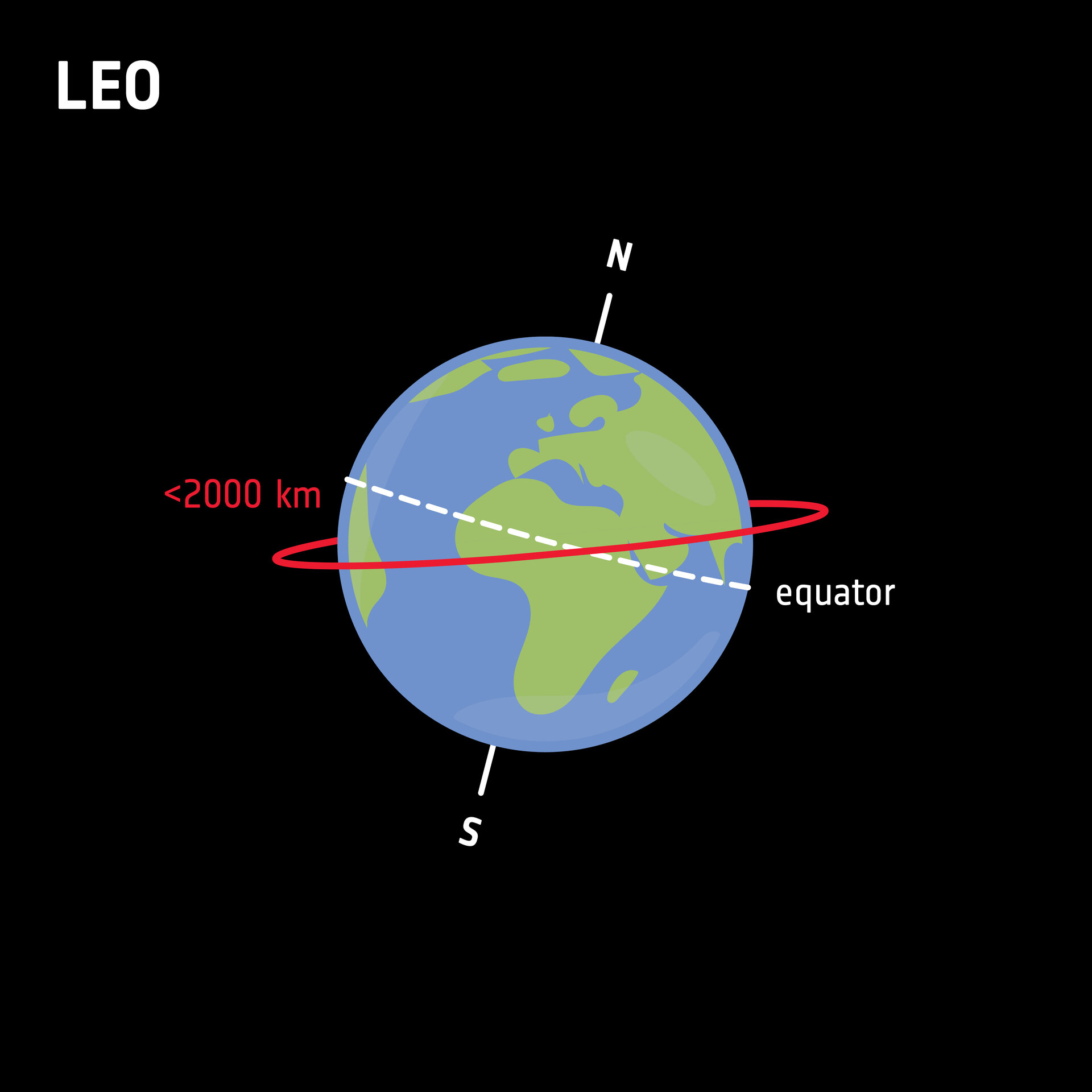
Low Earth orbit (LEO) typically extends up to 1,000 km above Earth’s surface, still vastly higher than commercial aircraft, which fly below ~14 km. Credit: ESA.
There are serious concerns among scientists that the rapid expansion of satellite megaconstellations in low Earth orbit (LEO) will affect current and future space-based astronomical observatories, concerns that have so far focused mainly on ground-based telescopes. Researchers follow this line of inquiry in a study entitled “Satellite megaconstellations will threaten space-based astronomy” (open access), led by Alejandro S. Borlaff from the Space Science and Astrobiology Division at NASA Ames Research Center, that was published in Nature in December 2025.
“Megaconstellation: group of many satellites that work together (…). Megaconstellations can comprise hundreds or even thousands of satellites. The first megaconstellation satellites were launched in 2019, and, as of 2025, more than half of active satellites are part of a megaconstellation. If proposed megaconstellations are launched or completed as planned, by the 2030s they would constitute most of the satellites in orbit.” (Britannica)
The study is motivated by the exponential growth of satellites in LEO, driven by declining launch costs and large telecommunications constellations proposed to regulatory bodies. While early research showed that satellite reflections already interfere with ground-based astronomy, the authors note that the impact on space telescopes has been comparatively underexplored.
The central research question is whether current and planned satellite megaconstellations will significantly contaminate observations from space-based telescopes operating in LEO, and if so, to what extent. The authors emphasize that the number of satellites currently in orbit represents less than 3% of those proposed for launch in the coming decades, making forecasts of growth essential.
They developed a simulation framework to predict the frequency and brightness of satellite trails crossing the fields of view of four representative LEO space telescopes: the Hubble Space Telescope, SPHEREx, the Chinese Xuntian Space Telescope, and the proposed European Space Agency (ESA) mission ARRAKIHS.
The results show that satellite trail contamination increases sharply with satellite population size and depends strongly on telescope altitude, field of view, and observation strategy. If all proposed megaconstellations are completed (corresponding to roughly 560,000 satellites) the authors predict that about one-third of Hubble images will contain at least one satellite trail, while more than 96% of exposures from SPHEREx, ARRAKIHS, and Xuntian would be affected. In these cases, individual exposures could contain from several to dozens of satellite trails, with surface brightness values well above detectability limits. The simulations are validated by comparison with existing Hubble observations, which already show satellite trails in a fraction of images consistent with model predictions.
The researchers conclude that mitigation strategies focused solely on reducing satellite visibility to the naked eye are insufficient for protecting scientific observations. They argue for coordinated measures that include limiting orbital altitudes, improving the precision and openness of orbital data, and enabling prediction, avoidance, and correction of satellite trails. Without such interventions, the rapid industrialization of near-Earth space risks fundamentally degrading the scientific return of current and future space telescopes.
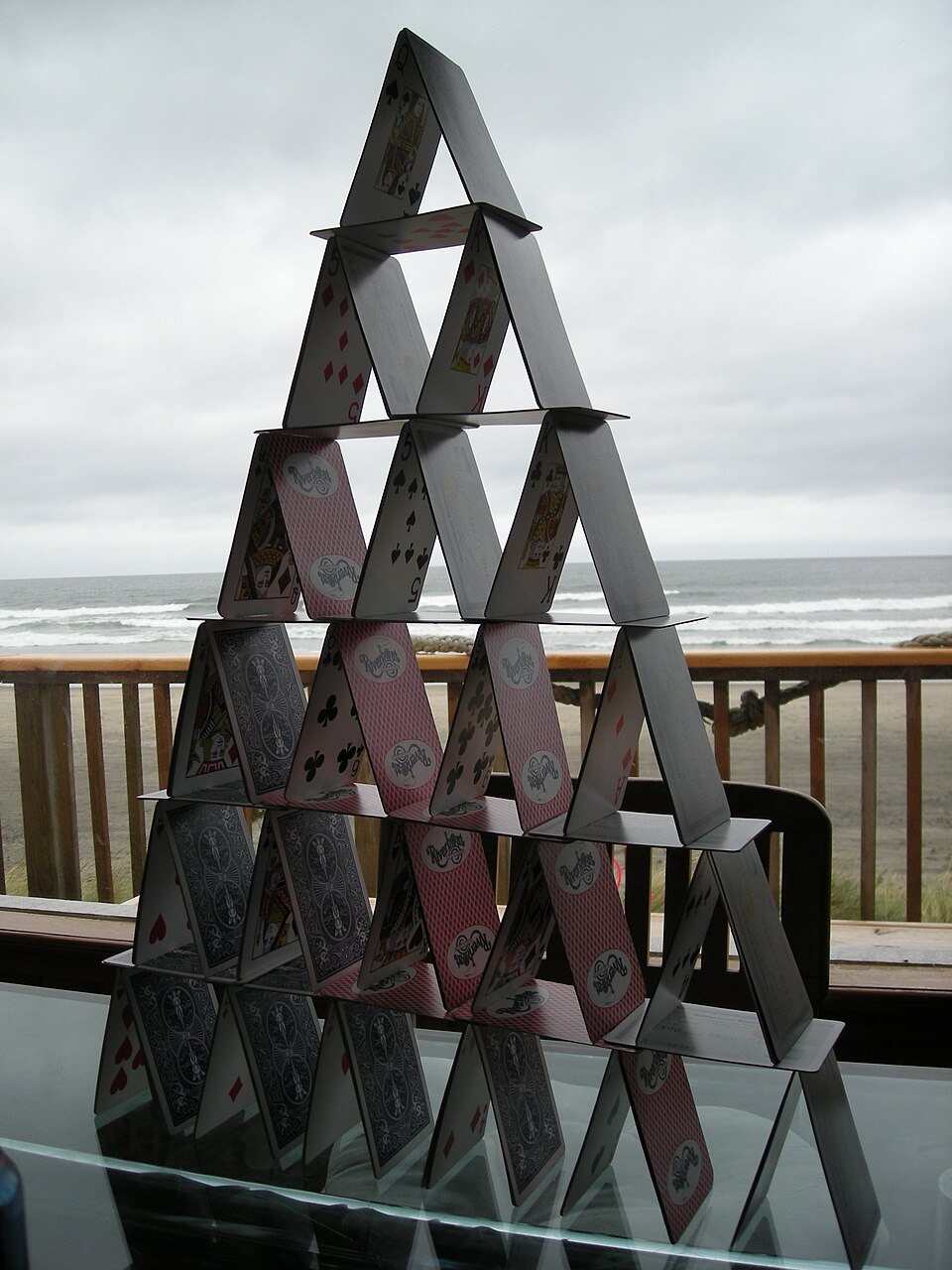
“A six-story card castle (or “House of Cards”) made from 3 1/2 decks of playing cards”. Credit: Merzperson on Wikipedia
An unstable “house of cards”, increasingly vulnerable to rapid collapse: that is how the low Earth orbit satellite environment is referred to in a study entitled “An Orbital House of Cards: Frequent Megaconstellation Close Conjunctions”, that was published as a preprint (not yet peer-reviewed) on arxiv.org by Princeton University PhD student in Astrophysical Sciences Sarah Thiele and colleagues.
Last December, Phys.org reported on this study and explained that, using orbital data, the authors show that close approaches between satellites (defined as separations under one kilometer) now occur every 22 seconds across all megaconstellations, with Starlink alone experiencing such encounters that require frequent avoidance maneuvers roughly every 11 minutes. Starlink, which is a subsidiary of Elon Musk-owned SpaceX, has over 9,400 satellites in low Earth orbit.
The Sun puts satellites at risk.
The study highlights solar storms as a critical “edge case”. Originating from disruptions in the Sun’s atmosphere, solar storms can discharge plasma or electromagnetism that heats Earth’s atmosphere. This increases drag and positional uncertainty, forcing satellites to burn fuel for corrections while simultaneously risking failures in navigation and communication systems that would prevent evasive action altogether.
To capture the immediacy of this risk, the authors introduce the Collision Realization and Significant Harm (CRASH) Clock, and in June 2025 estimated that a loss of control over avoidance maneuvers would lead to a catastrophic collision within about 2.8 days. That is down dramatically from 121 days in 2018, before the megaconstellation era. Even a 24-hour loss of control carries a 30% chance of a collision severe enough to spread large amounts of debris threatening many other satellites and raising concerns that a strong solar storm, such as a modern equivalent of the 1859 Carrington Event, could rapidly disable satellite infrastructure.
A January 2026 report in the South China Morning Post indicates that multiple Chinese companies have filed applications with the International Telecommunication Union, which is an agency of the United Nations, to deploy more than 200,000 internet satellites. This signals a rapid escalation in the global race to build megaconstellations even as China criticizes SpaceX’s Starlink for crowding shared orbital resources.
SpaceNews reports that the filings submitted to the International Telecommunication Union do not authorize launches but function as early claims on orbital and spectrum priority, illustrating how the megaconstellation race is increasingly about securing regulatory and informational territory ahead of any physical deployment.
The developments coincided with an announcement by the US Federal Communications Commission approving SpaceX to launch 7,500 second-generation Starlink satellites by 2031, bringing its authorized second-generation total to 15,000, while a separate application for an additional 30,000 satellites remains under review.
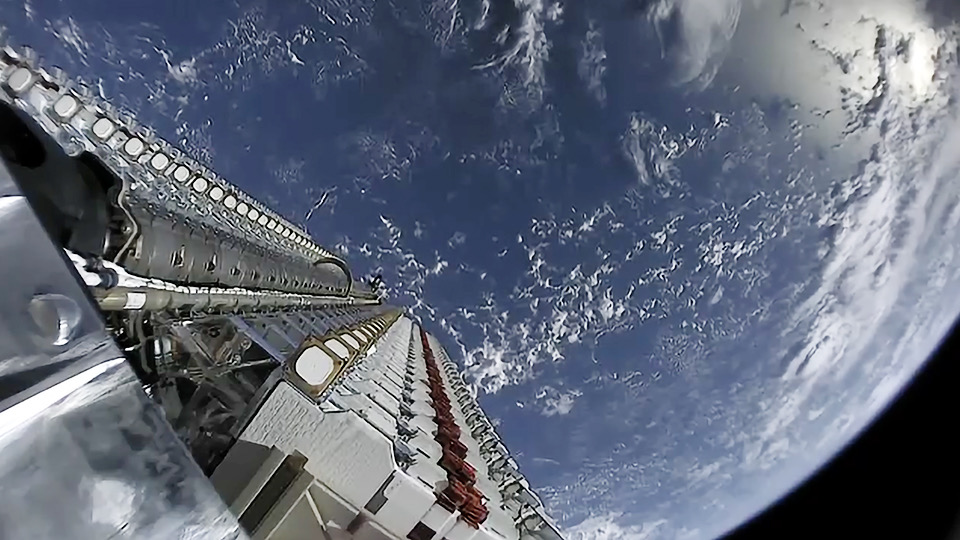
“A stack of 60 Starlink test satellites atop a Falcon 9 rocket, close to entering orbit” (2019). Credit: Official SpaceX Photos, Wikimedia Commons
Military use of satellites is increasing.
A February 2026 Reuters report says Germany is planning a major expansion of its military space capabilities under a €35 billion spending program, reflecting what it sees as a far more contested orbital environment following Russia’s invasion of Ukraine. According to Major General Michael Traut, Commander of German Space Command, Berlin aims to deploy an encrypted constellation of more than 100 satellites for secure communications, modeled on the U.S. Space Development Agency’s low-Earth-orbit architecture.
Alongside communications, Germany is considering intelligence satellites and a range of other space-based tools, including jamming, lasers, and “inspector satellites” capable of maneuvering close to another spacecraft. The strategy prioritizes domestic and European suppliers and is framed as a deterrence effort against threats from Russia and China. Commander Traut emphasized that space has become an operational, and potentially warfighting, domain requiring both protection and the ability to disrupt adversary systems, including through actions against ground-based control infrastructure.
The Quantum Feedback Loop Podcast featured issues in space governance with guest Dr. Jessica West. West is a senior researcher at Project Ploughshares and a senior fellow at the Centre for International Governance Innovation, and the topics of conversation included challenges and opportunities for humanity beyond Earth. With competing military and commercial activity in space, and large numbers of satellites and objects to track, West said that the situation is becoming tense and requires a lowering of the heat. Jessica explains the history of space governance, beginning with the United Nations’ 1967 Outer Space Treaty and its ideals, and the extent to which humanity’s presence in outer space has multiplied many times over since. As she outlines the present state of global discussions and activity at the UN, West gives a sense of hope that we are on a path toward real progress in the peaceful use of outer space.
Space Governance: The Challenges and Potential for Humanity Beyond Earth | The Quantum Feedback Loop Podcast
In “How to Win the Space Race – We rely on our satellites for everything. More weapons won’t protect them”, published in Maclean’s, West argues that although space feels distant to most people, modern societies depend deeply on satellites to function, from banking and aviation to emergency response and energy networks.
As geopolitical tensions grow, countries are preparing to spend heavily on military space capabilities, but West contends that framing space security as an arms race is misguided. Satellites are fragile, shared, and governed by physics rather than borders, and attempts to protect them with weapons risks making the orbital environment more unstable rather than safer.
West explains that the greatest threats to space systems are not dramatic acts of destruction but everyday vulnerabilities: congestion from tens of thousands of satellites, debris traveling at extreme speeds, solar storms that disrupt electronics, crowded radio frequencies, and widespread ambiguity about intent.
Many satellites serve both civilian and military purposes, making disruptions hard to interpret, while “grey-zone” actions such as jamming, spoofing, cyberattacks, or close-proximity maneuvers can easily be mistaken for accidents or preparations for attack. These uncertainties raise the risk of escalation driven by misinterpretation as small failures or anomalies cascade into larger crises.
West argues that real space security comes from stability, not weaponization. She calls for investments in resilience, which entails redundant ground stations, diversified satellite providers, backup systems for GPS-dependent services, and stronger cyber protections, alongside better monitoring, transparency, and information-sharing to clarify what is happening in orbit. In space, she concludes, good governance and cooperation are the most effective forms of defense.
“Look at the stars, look how they shine for you, and all the things that you do” (From Coldplay’s ‘Yellow’). Image: Wirestock, via Freepik
Orbital space is a tightly coupled system: satellites interact through shared altitude bands, radio frequencies, atmospheric drag, and collision risk, all of which change on short timescales. The study on seismic tracking that was published in Science in January highlights that even after a spacecraft has failed, fragmented, and fallen back to Earth, its effects can still be reconstructed through shockwaves propagating across the planet. The simulations published in Nature show that long before failure, routine satellite operations already interfere with scientific observation on scale. And the CRASH Clock analysis shows how quickly this system can tip from normal operation to catastrophic collision in a matter of days if control is disrupted.
Still, current actions focus overwhelmingly on expansion and deterrence rather than constraint and coordination.
Filings for approval of megaconstellations numbering in the hundreds of thousands aim to secure spectrum and orbital priority years or decades in advance, even as collision avoidance already requires constant maneuvering and fuel expenditure. Military investments in encrypted constellations, inspector satellites, jamming, and lasers assume that security can be maintained through active control, despite evidence that congestion, ambiguity, and debris make such control increasingly brittle. In practice, these strategies raise baseline risk by increasing density, complexity, and the number of actors capable of misinterpretation or interference, exactly the conditions under which cascading failure becomes more likely.
The central question, then, is whether low Earth orbit can remain usable without enforced limits. Stabilizing this system requires reduction of dominance by major players and more investment in shared situational awareness, redundancy, open orbital data, and enforceable norms on proximity, maneuvering, and end-of-life behavior. Without such constraints, low Earth orbit risks becoming a tragedy in which short-term strategic advantage undermines the long-term viability of the environment on which science, infrastructure, and security increasingly depend.
Craving more information? Check out these recommended TQR articles:
- Mind Reading Technology Connects Brains to Machines
- Where Do I End and Where Does the Machine Begin?
- AI and the Human Brain: From Mind-Reading AI to a Simulated Conversation with Einstein
- Restoring Hope: AI Breakthroughs Transform Lives of Paralyzed Individuals
- The Most Intimate Data: Accessing Another Human’s Thoughts
We would appreciate your feedback on The Quantum Record and similar content.
Have we made any errors?
Please contact us at info@thequantumrecord.com so we can learn more and correct any unintended publication errors. Additionally, if you are an expert on this subject and would like to contribute to future content, please contact us. Our goal is to engage an ever-growing community of researchers to communicate and reflect on scientific and technological developments worldwide in plain language.