

Image: Gerd Altmann, on Pixabay.
By Mariana Meneses and James Myers
Quantum technologies are often described in terms of speed, power, or scientific novelty. But the fundamental challenge to reaching their potential may be institutional.
Unlike many past technologies, quantum systems are not on the path to becoming widely-used products first and only later become the objects of regulation. The high cost and level of expertise required to operate quantum technologies will make it necessary to identify regulatory issues without widespread experience as a guide for mitigating potential long-term problems.
In a paper for the Stanford University Law School, attorney Eran Kahana states that quantum regulation will evolve differently from nascent efforts to regulate AI. “The regulatory principles that govern a technology are like a mirror reflecting collective fears,” Kahana observes. He notes that efforts to regulate existing AI “emerged from concerns about how AI systems affect individuals: fairness in consequential decisions, transparency in algorithmic reasoning, accountability for harmful outcomes, preservation of human judgment. Quantum AI will shatter this mirror and reassemble the pieces in an unfamiliar pattern”.
Kahana concludes that “…quantum AI regulation will emerge from fears about cryptographic collapse, weapons proliferation, and systemic vulnerability.”
When they become fully functional, the anticipated speed and accuracy of quantum computers is widely expected to expose sensitive data by breaking today’s widely-used encryption methods. This will pose a particular risk for national and international financial systems. As the Bank for International Settlements notes, “This makes quantum computing one of the most significant cybersecurity threats facing the financial system, potentially exposing financial transactions to attack.”

The world’s fifth-largest central bank, the Bank of France regulates banking in France and has recently tested its ability to transfer information that is secure from quantum decryption. Image by Boubloub, on Wikipedia.
Realizing the risk, some national financial regulators, like the Bank of France, have been acting to secure financial systems. The Bank of France announced in October 2025 that, in collaboration with global insurance company Allianz, it had successfully tested its ability to secure transfers of regulatory files against quantum decryption. “The success of this test marks a significant step forward in developing these technologies to strengthen the resilience of financial infrastructures,” the bank stated.
Writing in the European Journal of Risk Regulation, lawyer and economist Ammar Zafar highlights further serious financial regulation challenges from quantum computers. In his paper Quantum Computing in Finance: Regulatory Readiness, Legal Gaps, and the Future of Secure Tech Innovation, Ammar writes that “Quantum computing introduces a paradigm shift in market velocity, pattern recognition and data-driven arbitrage, with profound implications for the stability and integrity of global financial markets. Nowhere is this shift more consequential than in high-frequency trading (HFT), where marginal speed advantages can translate into outsized market influence.”
National quantum strategies are emerging.
While existing prototypes of quantum computers are not yet fully functional and continue to suffer circuit-breaking errors, many countries have begun preparing for the rapidly developing technology’s potential. Globally, quantum technologies are being deeply woven into national strategies, security agendas, and international governance debates while their future applications remain unsettled.
The potential future applications for quantum technologies are likely to be highly underestimated, if the history of transformative technologies like the internet is any guide. Any adult who lived through the Era Before the Internet – before the internet’s first sparks began to take hold around 1996 – can certify how unexpectedly transformative the internet’s present applications have become.
Bill Gates and David Letterman | The Quantum Record
At the same time that quantum technologies are shaping the priorities and investments of competing nations, governance efforts are emerging in a fragmented way among countries, businesses, and institutions. Among stakeholders, there are differing priorities, timelines, and definitions of what quantum development should achieve, and no general agreement about risks and how to manage them.
The Organisation for Economic Cooperation and Development explains that “Quantum technologies exploit the unique behaviours of particles at atomic scales to gather, process and transmit information,” with the potential to fundamentally reshape how information is processed, transmitted, and secured. These capabilities introduce complex security, privacy, and dual-use challenges, particularly as advances in quantum computing could undermine existing cryptographic systems while enabling new and as-yet unimagined forms of technological power.
In the judgment of the OECD, which represents 38 member nations, government support has become central to advancing fundamental research and building the infrastructure required for future applications, often positioning quantum development as a strategic priority. At the same time, the transnational nature of these technologies, including the way they will affect global financial systems, means that no one country can fully address the implications alone. International collaboration is essential to resolving emerging challenges ensuring that innovation proceeds in a coordinated and responsible manner.
National strategies and policies for quantum technologies | OECD Science, Technology and Innovation
The OECD’s December 2025 publication, entitled “An overview of national strategies and policies for quantum technologies,” notes that “Governance structures for quantum strategies vary significantly. In some cases, national strategies are embedded within broader science and technology agendas, while in others they stand alone, supported by dedicated legislation or specialized councils.”
Moreover, as concluded in a recently published study, “while national frameworks often prioritize technological development and economic competitiveness, they tend to overlook the broader implications of QTs, such as cryptographic vulnerabilities, ethical dilemmas, and societal disparities.” The study is entitled “A Quantum of Responsibility? A Comparison of National Quantum Governance Frameworks and Expert Views” and was published in June 2025 in the journal Digital Society, by Drífa Atladóttir, from the Department of Humanities, Social and Political Sciences at ETH Zurich, in Switzerland, and co-authors.
[For more on cryptographic vulnerabilities, ethical dilemmas, and societal disparities, see The Quantum Record’s 6-part series on Quantum Ethics at www.thequantumrecord.com.]

Image: Gerd Altmann, on Pixabay.
The Centre for International Governance Innovation (CIGI), in its Policy Brief No. 222 entitled “Global Quantum Governance: From Principles to Practice,” argues that as quantum technologies move toward deployment, particularly risky milestones such as post-quantum cryptography and quantum networking are creating a governance tipping point. If the tipping point is reached, risks of powerful quantum technologies may be harder to contain.
The policy brief notes that national strategies, including proposals like a potential EU Quantum Act, are necessary but insufficient, given quantum’s global reach, dual-use implications, and the potential for asymmetric capabilities. It therefore calls for an international, standards-based framework to coordinate action and balance openness with security.
In a May 2025 paper, CIGI senior fellow and technology lawyer Mauritz Kop called for action Towards an Atomic Agency for Quantum-AI. The paper suggests establishment of a worldwide agency modelled after the International Atomic Energy Agency (IAEA), with the ability to exercise strict governance over quantum technologies and avoid potential risks as serious as the world continues to face with nuclear technologies. Kop explains that the agency’s aims would include enforcing an international body of laws on quantum technologies, in order to “deter a quantum arms race, ensure non-proliferation of dual-use quantum-AI technologies via safeguards implementation (inspired by nuclear governance), and potentially oversee a global UN Quantum Treaty.”
International coordination is beginning. Will it keep pace with technological advances?
The pressures of governance risks are beginning to translate into new forms of institutional coordination. The World Economic Forum, for example, has launched a plan for Quantum Computing Governance, in a “global multistakeholder initiative to create a governance framework enabling the responsible design and adoption of quantum computing.” Rather than replacing national strategies, such initiatives attempt to connect them, reflecting a growing recognition that governance must operate across levels, linking technical standards, policy frameworks, and international coordination.
The European Commission’s Apply AI Alliance, which is a forum for many stakeholders to discuss AI’s economic and social effects, is another coordinating body. The Alliance has begun to focus on governance issues that will emerge when AI and quantum capabilities combine.
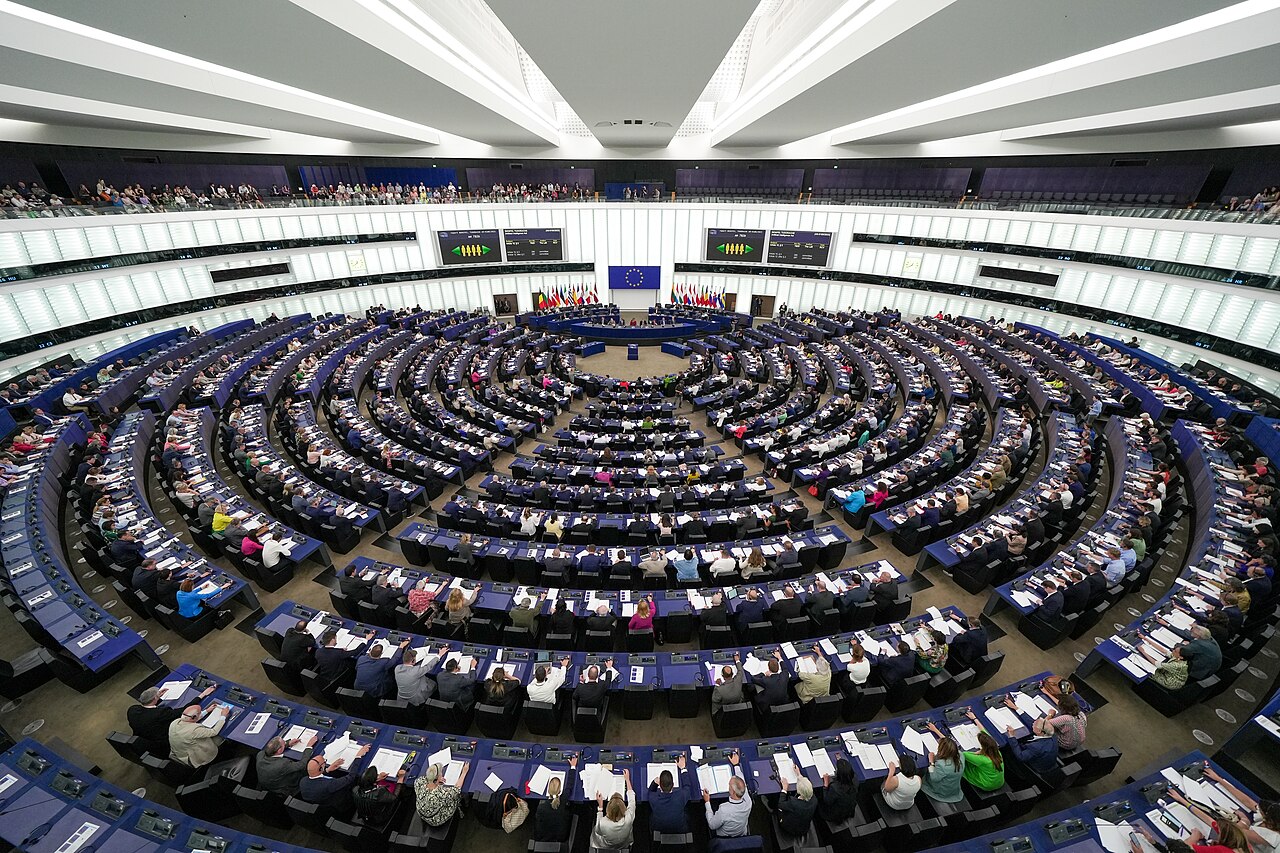
The European Commission is the executive branch of the European Union. The Commission is responsible to the European Parliament, pictured above, which coordinates regulations applicable to the EU’s 27 member states. Image CC-BY-4.0: © European Union 2023– Source: EP, on Wikipedia.
As a participant in the Apply AI Alliance, Mauritz Kop warned in June 2025 that, “It is precisely at this Quantum-AI (QAI) intersection that the ‘control problem’ becomes acutely relevant. Looking ahead, we expect AI agents not only to become smarter than us humans soon, but to become quantum-AI agents within 3 to 5 years. These agents will possess both classical and quantum capabilities—including breaking classical encryption and enabling agentic quantum simulation-driven financial forecasting—creating novel governance challenges. The prospect of an agent exponentially more intelligent than a human, wielding such hybrid power, fundamentally changes the nature of control, demanding sophisticated solutions that go well beyond simple technical alignment.”
How will coordination lead to governance?
If emerging initiatives point toward coordination, they also raise a deeper question: what form should that coordination take? A 2022 study suggests that quantum governance cannot be understood as a single set of rules, but as a structured system of interdependent layers.
The study is entitled “The Quantum Governance Stack: Models of Governance for Quantum Information Technologies” and published in the journal Digital Society, by Elija Perrier, from the Centre for Quantum Software and Information at the University of Technology, in Australia.
Perrier argues that governing quantum technologies requires moving beyond isolated policies toward a layered, system-wide approach, which the author conceptualizes as a “quantum governance stack.” Rather than a single framework, governance is understood as a hierarchy of interdependent levels, ranging from international law and national strategies to institutional practices, private sector rules, and technical standards, each involving different stakeholders, instruments, rights, and obligations.
An analogy might be made to the global financial system, which is sustained by a coordination of global, national, and sub-national laws, practices, and standards for maintaining trust.

We still have time. How much time is the question. Image: Gerd Altmann, on Pixabay.
At its core, the quantum governance model emphasizes that quantum technologies emerge within existing governance structures but also challenge them, requiring coordination across jurisdictions and sectors to balance competing goals such as innovation, security, economic interests, and ethical considerations.
The framework highlights that effective governance depends not only on formal tools like laws and treaties but also on informal mechanisms, such as standards, norms, and institutional practices, and must also incorporate deliberative processes to reconcile the diverse values and interests of stakeholders, from governments and corporations to scientists and civil society.
From Perrier’s study, it becomes clear that managing quantum technologies is less about controlling a single system and more about coordinating multiple layers of decision-making that evolve alongside the technology itself.
This perspective also reframes what is at stake. If governing quantum technologies requires coordination across multiple layers and actors, then leadership is no longer only a matter of scientific or technical capability. As Ali Ramazani, research affiliate at MIT, argues, “quantum leadership is no longer defined by who builds the fastest qubit [the information bit in quantum computers]. It is defined by who can integrate science, infrastructure, manufacturing, security, and policy into a coherent national system.”
Yet, as the governance challenges outlined here suggest, such integration cannot remain purely national. The same features that make quantum technologies strategically valuable, including their global reach and dual-use nature, also make them difficult to contain within national boundaries, pointing to a tension between competition for leadership and the need for international coordination.
Craving more information? Check out these recommended TQR articles:
- Thinking in the Age of Machines: Global IQ Decline and the Rise of AI-Assisted Thinking
- Cleaning the Mirror: Increasing Concerns Over Data Quality, Distortion, and Decision-Making
- Not a Straight Line: What Ancient DNA Is Teaching Us About Migration, Contact, and Being Human
- Digital Sovereignty: Cutting Dependence on Dominant Tech Companies
We would appreciate your feedback on The Quantum Record and similar content.
Have we made any errors?
Please contact us at info@thequantumrecord.com so we can learn more and correct any unintended publication errors. Additionally, if you are an expert on this subject and would like to contribute to future content, please contact us. Our goal is to engage an ever-growing community of researchers to communicate and reflect on scientific and technological developments worldwide in plain language.