By Mariana Meneses
Dark energy is the theorized force that drives the expansion of the universe, and analyses in March 2025 of data gathered by the Dark Energy Spectroscopic Instrument (DESI) suggested that dark energy’s expansion rate may change over time. By measuring precise distances to millions of galaxies and quasars across cosmic time, the DESI Collaboration provided early hints that the universe’s expansion history might not be fully consistent with traditional expectations. Since that initial report, the team has expanded this evidence base with additional analyses, to place new constraints on cosmic expansion and dark energy models.
“DESI is the product of an international collaboration that brings together more than 450 researchers from more than 70 institutions including Australia, Canada, China, Colombia, France, Germany, Korea, Mexico, Spain, Switzerland, the U.K., and the U.S. The collaboration is led by Lawrence Berkeley National Laboratory, which is managed by the University of California for the U.S. Department of Energy’s Office of Science. DESI is located at Kitt Peak National Observatory near Tucson, Arizona. Kitt Peak is part of the NSF’s National Optical-Infrared Astronomy Research Laboratory (NSF’s OIR Lab).” – DESI Collaboration.
In this article, we discuss and connect six recently published scientific studies (peer-reviewed and open access) from around the world that use DESI data to advance this line of research. Together, these studies show that while DESI has made it possible to test dark energy in unprecedented detail, apparent signs of change in the behavior of its force remain fragile and highly sensitive to how the data are analyzed.
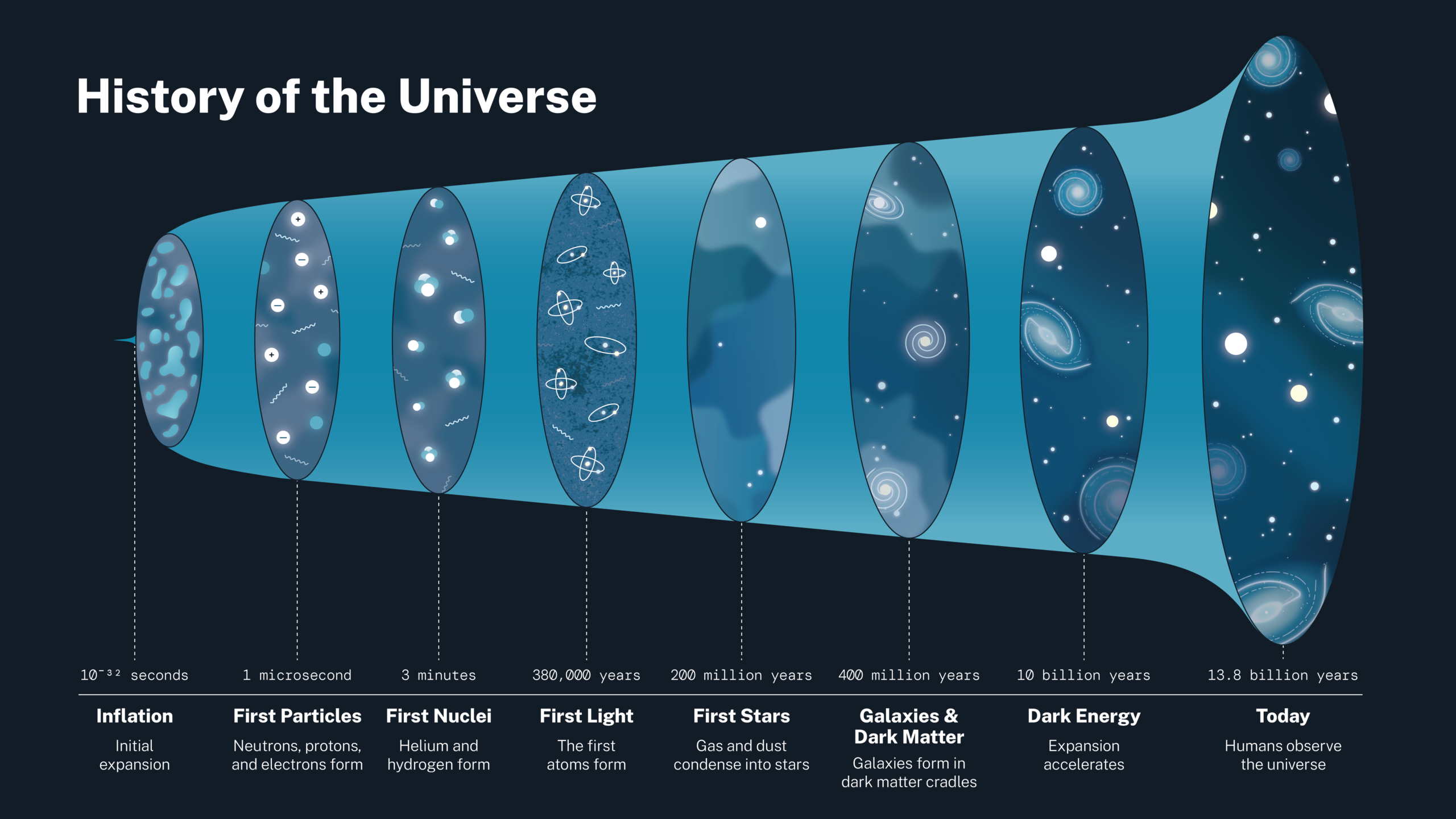
“Dark energy has been described by some as having the effect of a negative pressure that is pushing space outward. However, we don’t know if dark energy has the effect of any type of force at all.” ( NASA)
The Dark Energy Spectroscopic Instrument (DESI) sits on top of the Mayall 4-meter telescope at Kitt Peak National Observatory, and aims to perform “dark energy measurement using baryon acoustic oscillations and other techniques that rely on spectroscopic measurements.”
According to NASA, baryon acoustic oscillations are the frozen remnants of sound waves that rippled through the hot, dense plasma of the early universe, before atoms could form. When the universe cooled and these waves stopped, their imprints remained as subtle, regularly spaced patterns in the distribution of matter. Over billions of years, gravity amplified these patterns as galaxies formed, leaving a characteristic separation between galaxy clusters. Because the physical scale of this separation is well understood, astronomers use it as a cosmic “standard ruler” to measure how the universe has expanded over time.
Spectroscopic measurements make this ruler usable by measuring light from millions of galaxies to gauge how much their wavelengths increase and their frequencies decrease into the red color spectrum, in a phenomenon known as redshift that occurs as light is stretched by cosmic expansion. By combining galaxy positions with accurate redshift measurements, DESI constructs a three-dimensional map of the universe and reconstructs its expansion history, allowing scientists to test whether dark energy behaves like a constant or changes over time.
As reported by Phys.org in March 2025, the data released that month by DESI forms the largest three-dimensional map of the universe to date.
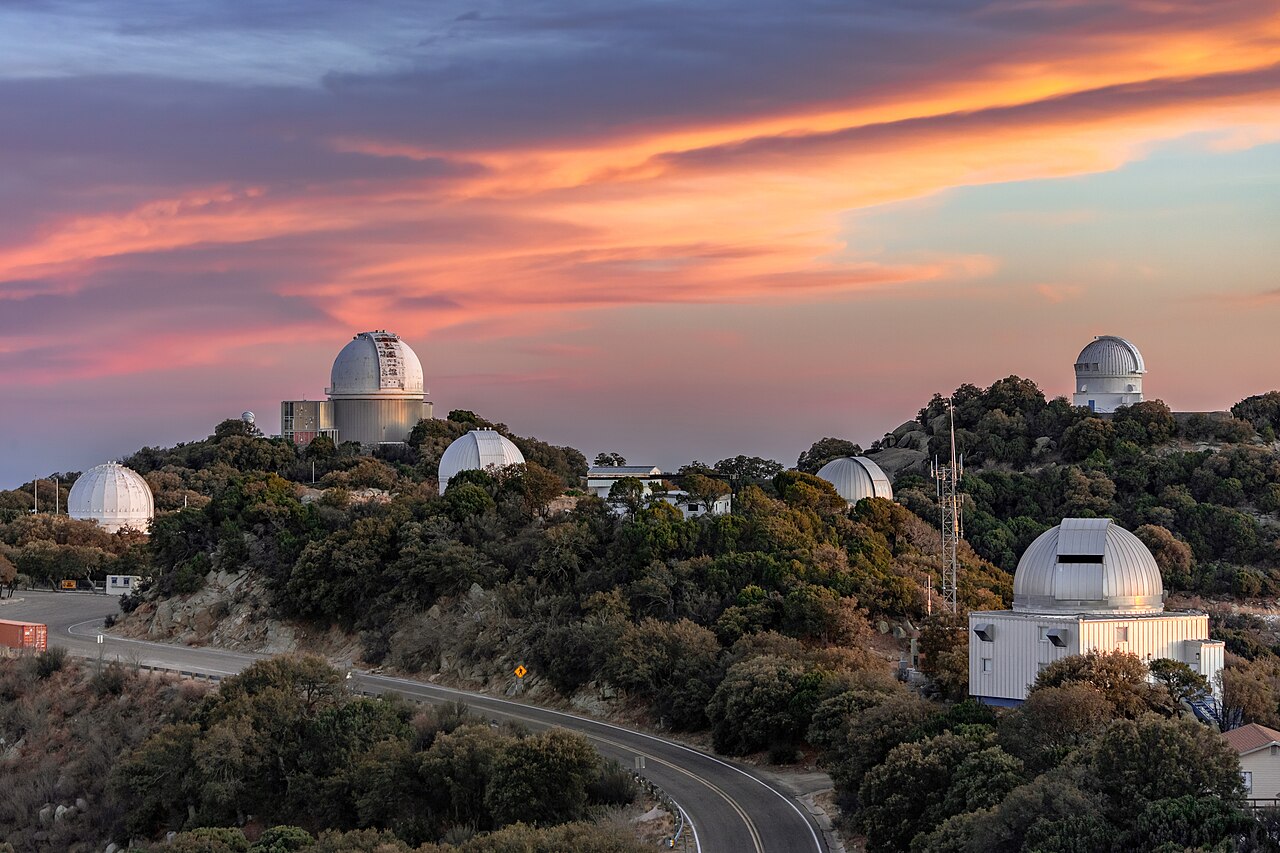
The Kitt Peak National Observatory (KPNO) is a Program of NSF’s NOIRLab in the Quinlan Mountains. “Arid deserts, like the Arizona-Sonoran Desert where KPNO is located, display a clearer array of colors than areas where rain and humid weather are almost daily features.” NOIRLab via Wikipedia.
A study entitled Evolving dark energy or supernovae systematics?, by George Efstathiou from the Kavli Institute for Cosmology at Cambridge, was published in Monthly Notices of the Royal Astronomical Society in February 2025. The author investigates whether recent hints that dark energy may evolve over time signal new physics or instead result from subtle systematic effects in measurements of supernovae, which are powerful bursts of matter, light, and energy from explosions of dying stars. The analysis shows that the conclusions are highly sensitive to the particular set of data used, raising the possibility that the apparent discrepancies stem from differences between datasets rather than from genuine cosmic change.
The paper concludes that recent claims, based on DESI results, that the force of dark energy is variable, or dynamical, are highly sensitive to small systematic effects in supernova measurement.
Differences between samples are sufficient to produce an apparent signal of evolving dark energy. The study emphasizes that existing data do not yet require departures from the standard cosmological constant model.
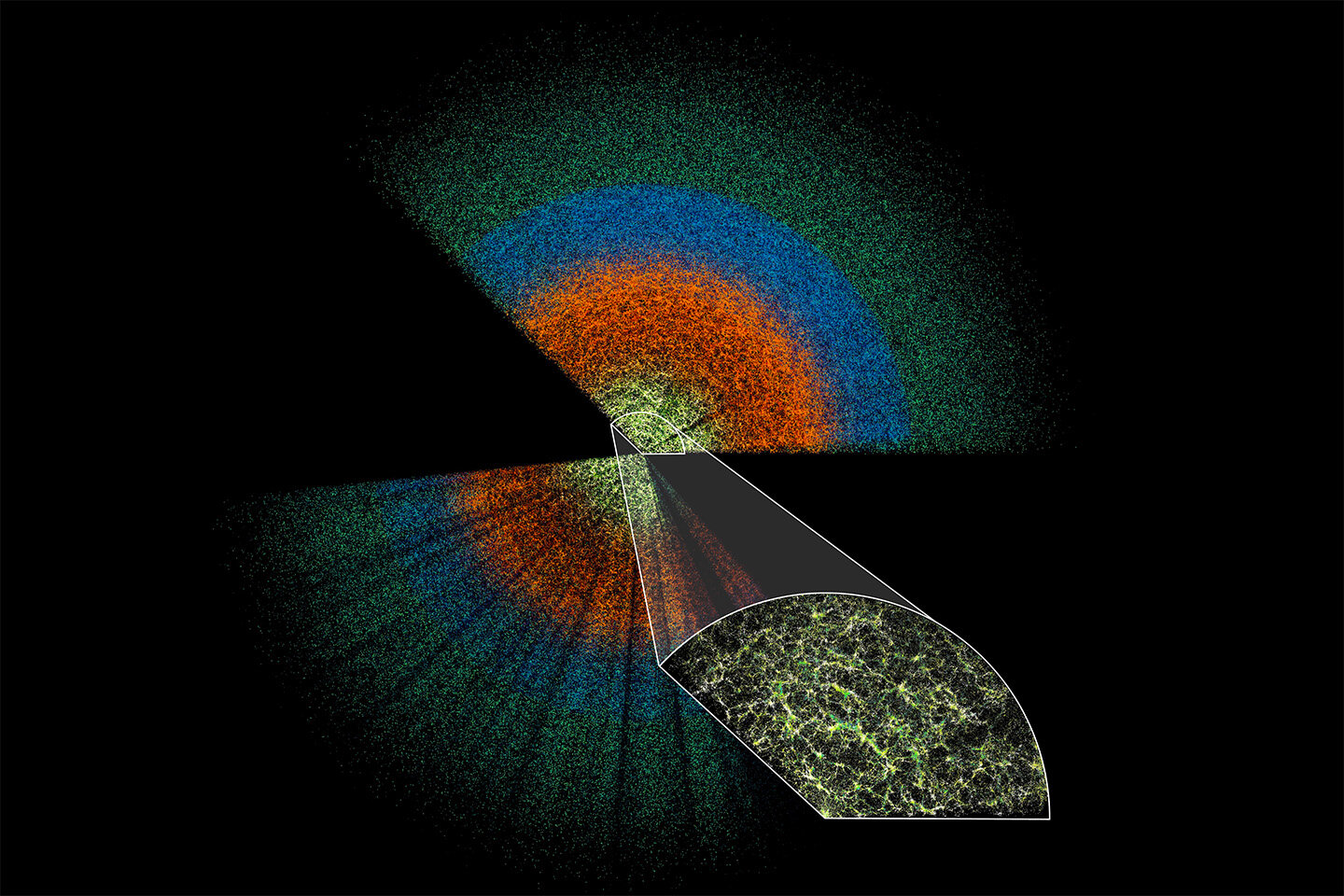
From Phys.org: “This slice of the DESI data maps celestial objects from Earth (center) to billions of light years away. Among the objects are nearby bright galaxies (yellow), luminous red galaxies (orange), emission-line galaxies (blue), and quasars (green). The large-scale structure of the universe is visible in the inset image, which shows the densest survey region and represents less than 0.1% of the DESI survey’s total volume”. Credit: Claire Lamman/DESI collaboration
Other research also shows that even when the same datasets are used, conclusions about dark energy depend on the parameters chosen to represent its behavior.
A study entitled “Robustness of dark energy phenomenology across different parameterizations” was written by William J. Wolf, Carlos García-García and Pedro G. Ferreira, from the Astrophysics department at the University of Oxford, and published in May 2025 in the Journal of Cosmology and Astroparticle Physics. In it, the researchers examine whether hints that dark energy might change over time remain consistent when different modeling choices are used.
The paper was motivated by the fact that recent cosmological datasets have become precise enough that small modeling decisions can influence results. Discussing studies which report signs that dark energy may not be constant, the authors note that these claims often rely on a single way of representing dark energy’s behavior. The main question they address is whether such conclusions reflect genuine features of the data, or whether they arise because of how dark energy is parameterized – in other words, how dark energy’s possible evolution is written into equations.
To investigate this, the authors analyze the same observational data using multiple commonly adopted descriptions of dark energy. These include approaches that focus on how dark energy’s pressure changes over time, and other approaches that focus on how the universe’s expansion rate evolves.
Data from supernova explosions, baryon acoustic oscillations, and the cosmic microwave background combine as a gauge for dark energy’s force.
The datasets used include measurements from supernovae whose light serves as “standard candles” for measuring cosmic distances, from baryon acoustic oscillations that affect the large-scale distribution of galaxies and act as a cosmic ruler for expansion, and from the cosmic microwave background, which is the faint afterglow of the early universe that carries information about its initial conditions and overall geometry. No new data is introduced; the focus is entirely on comparing modeling choices.
The results indicate that inferences about dark energy depend strongly on how it is modeled. Certain parameterizations yield statistically significant departures from a constant value, while alternative formulations applied to the same data remain fully compatible with the standard cosmological model. Overall, the study concludes that current data do not offer robust, model-independent evidence for dynamical dark energy, and that consistency across multiple parameterizations should be considered a minimum threshold before invoking new physics.

Parameters are measurable quantities used to describe and control a system’s behavior. Image: World of Instrumentation
Because conclusions can change when researchers vary the data or the mathematical description of dark energy, some have instead asked what can be learned by describing the universe’s expansion directly from observations alone.
A study entitled “Cosmographic Footprints of Dynamical Dark Energy” was led by Elisa Fazzari from the Physics Department at Sapienza University of Rome and published in The Astrophysical Journal Letters in December 2025. In it, the researchers examine whether current observations of the universe’s expansion contain signs that dark energy may be evolving over time. However, in this case, the authors rely on a descriptive approach.
The study employs a technique known as cosmography, which describes the expansion of the universe using measured distances and rates. The researchers analyzed observational data that tracks the universe’s expansion at relatively recent times, including measurements from supernovae and large-scale galaxy surveys, and were able to examine how expansion-related quantities behave at different times in the past.
The authors show that the data are broadly compatible with the standard picture of constant dark energy. At the same time, they find patterns in the expansion history that can also be explained by dark energy that changes slowly over time. These patterns are not strong enough to provide a definitive conclusion, and they depend on how much detail is extracted from the data. For the researchers, stronger observational evidence will be needed before these cosmographic signals can be interpreted as proof.
The cosmographic approach describes how the universe’s expansion changes over time without trying to explain why. But it cannot test specific ideas about changing dark energy. To do that, researchers need model-based analyses that treat dark energy as a physical component with measurable properties. One such analysis is presented in a study entitled “Dynamical dark energy in the light of DESI 2024 data”, by Nandan Roy, from the Centre for Theoretical Physics & Natural Philosophy at Mahidol University in Thailand, published in the journal Physics of the Dark Universe in May 2025.
The study analyzes several commonly used dynamical dark energy models and confronts them with DESI’s measurements of baryon acoustic oscillations, which are fluctuations in remnants of sound waves caught in the dense plasma of the early universe. These data are combined with other well-established data collections, including cosmic microwave background observations and supernova data. The analysis compares how well different dark energy models fit the combined datasets.
The authors find that DESI data are broadly consistent with the standard model and conclude that, overall, the DESI measurements tighten existing bounds on dark energy behavior by improving the precision with which dark energy models can be tested, but do not produce strong or decisive evidence in favor of time-varying dark energy.
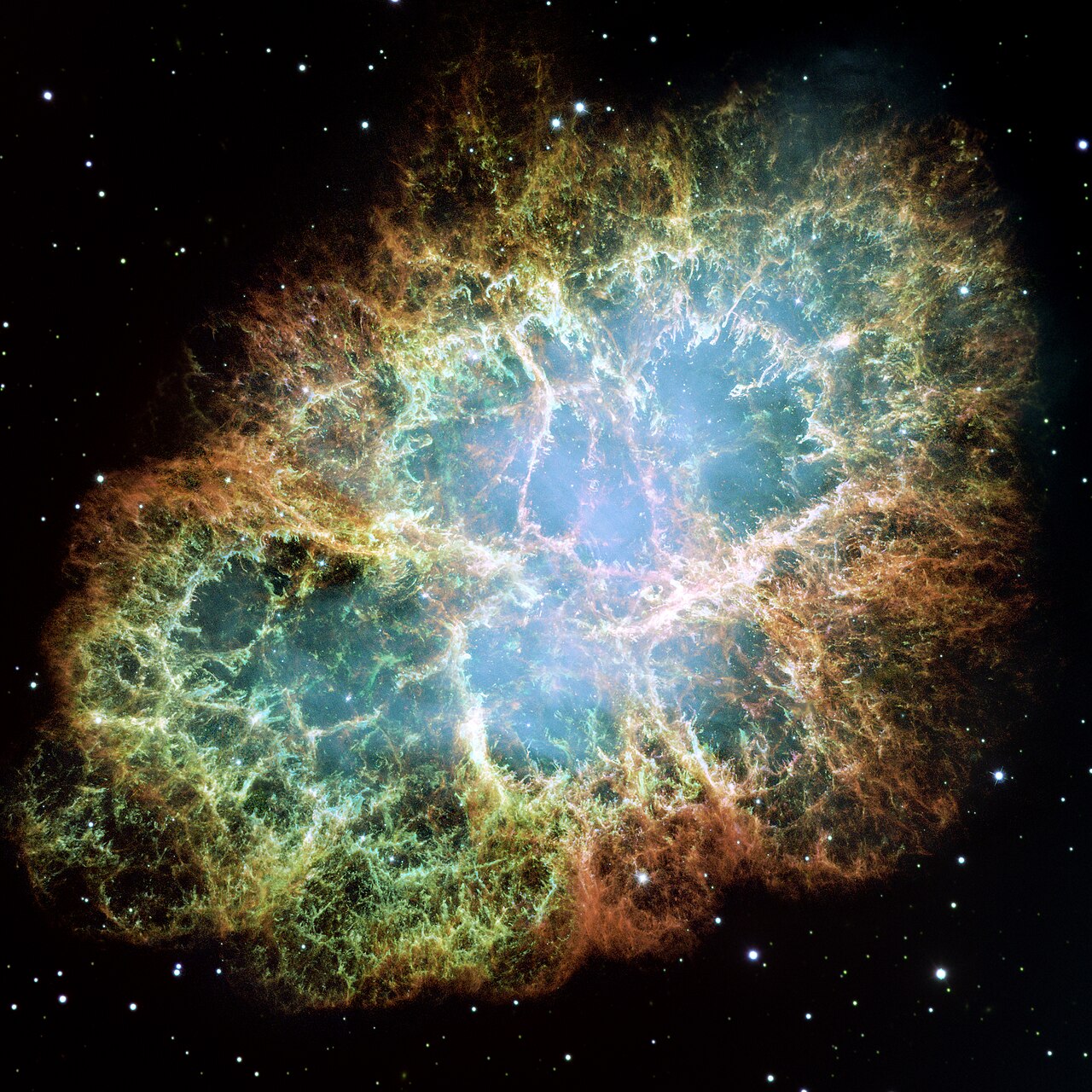
“This is a mosaic image, one of the largest ever taken by NASA’s Hubble Space Telescope, of the Crab Nebula, a six-light-year-wide expanding remnant of a star’s supernova explosion.” Credit: NASA/ESA, via Wikipedia.
While the previous study examined how DESI’s 2024 data constrain dynamical dark energy models when combined with other cosmological observations, those results were based on an earlier stage of the survey. Since then, DESI has released a more advanced dataset with improved precision and broader coverage across cosmic time. This raises a natural follow-up question: do these stronger measurements merely refine existing constraints, or do they begin to shift the balance between a constant and an evolving form of dark energy?
A peer-reviewed paper entitled “Dynamical dark energy in light of the DESI DR2 baryon acoustic oscillation measurements”, by Gan Gu from the National Astronomical Observatories at the University of Chinese Academy of Sciences and co-authors, was published in Nature Astronomy in September 2025. The study analyzes new measurements from the second data release (DR2) of DESI to assess whether the expansion of the universe is better explained by a constant form of dark energy or by dark energy that changes over time, focusing specifically on baryon acoustic oscillations.
To address this, the authors analyze DESI DR2 baryon acoustic oscillation measurements combined with other established cosmological data, such as observations of the cosmic microwave background and supernovae, to constrain different dark energy scenarios. The study compares constant and time-varying dark energy models using the same observational framework, emphasizing internal consistency across datasets.
The results show that DESI DR2 significantly sharpens constraints on the universe’s expansion history. While the data remains broadly consistent with the standard model, the authors find that some evolving dark energy models provide fits that are slightly preferred by the combined datasets. However, these preferences are modest and depend on the specific model assumptions. The paper emphasizes that no single dataset alone provides decisive evidence for dark energy evolution.
The authors conclude that DESI DR2 baryon acoustic oscillation measurements substantially improve the precision of dark energy tests, but do not yet deliver unambiguous proof that dark energy changes over time.
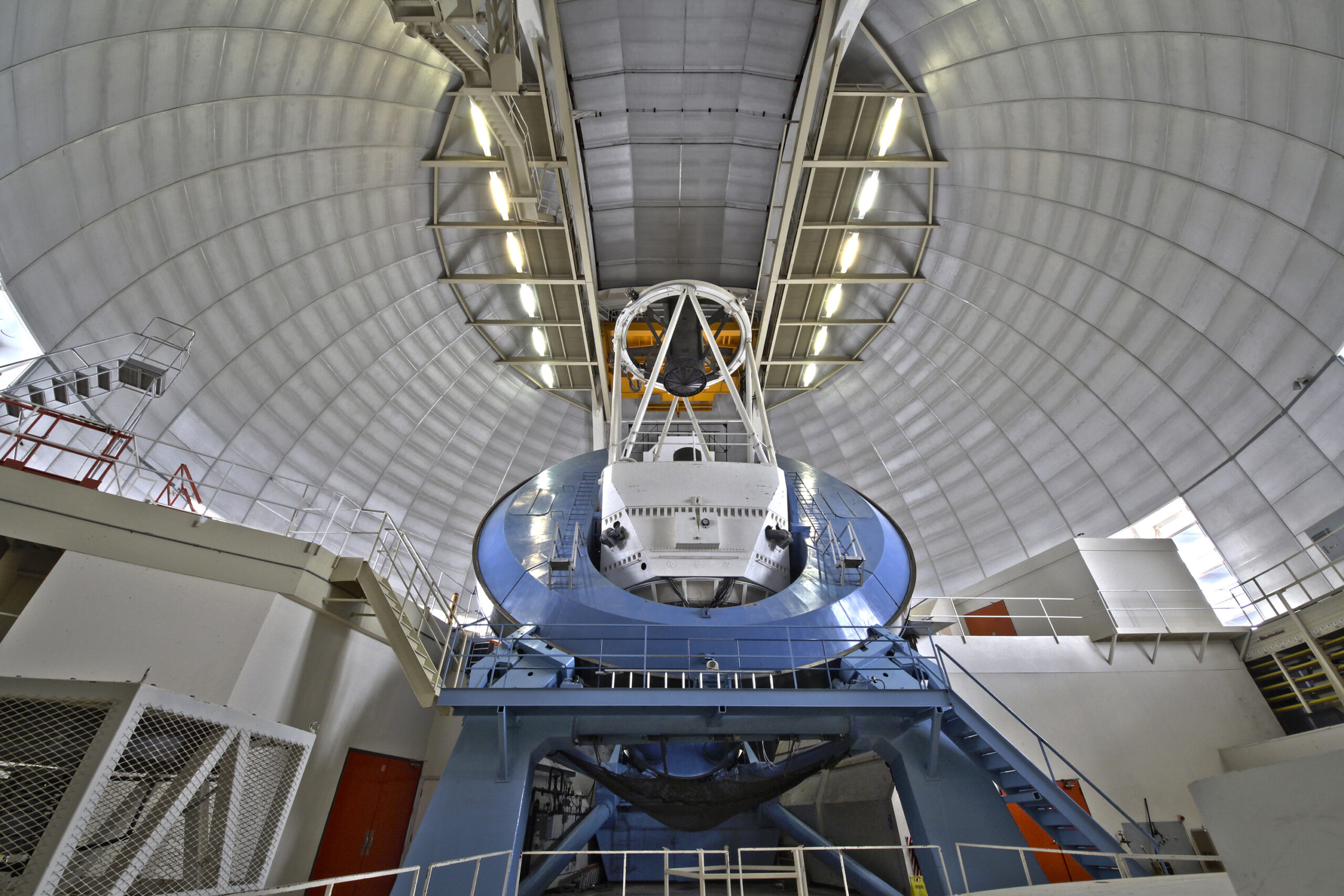
Mayall 4-meter telescope at Kitt Peak National Observatory. Image: DESI image gallery
Up to this point, the studies have asked a similar question: whether increasingly precise observations favor dark energy that changes over time, while still assuming that dark energy and dark matter – which is the invisible form of matter inferred from its gravitational effects on galaxies and cosmic structure – behave as separate components of the universe. (For more on dark matter, see the article Novel Theory Explains Both Dark Matter and Dark Energy. Will a New Space Telescope in 2027 Shed Light on the Enduring Mystery? in this edition).
A final step is to question the assumption that dark matter and dark energy are disconnected. What if dark energy does not evolve in isolation, but instead interacts directly with dark matter? The last study shifts the discussion in this direction, surveying theories in which the nature of dark energy is defined not only by how it evolves but by how it exchanges energy or momentum with other cosmic components.
A peer-reviewed paper entitled “Interacting Dark Energy: Summary of models, Pathologies, and Constraints”, by Marcel van der Westhuizen from the Centre for Space Research at North-West University in South Africa, and co-authors, was published in Physics of the Dark Universe in December 2025. The paper provides a broad review of theories in which dark energy does not evolve independently but instead exchanges energy or momentum with dark matter.
The authors systematically classify interacting dark-energy models according to how the interaction is introduced and how it affects cosmic evolution. They review models of the overall expansion of the universe and at the level of change in physical structures such as galaxies as they grow. The paper discusses mathematical consistency, stability, and causality, as well as how these models are implemented in cosmological calculations. The review also summarizes how different datasets, such as those from the cosmic microwave background, large-scale structure surveys, and supernova observations, are used to constrain interactions.
The researchers show that many interacting dark energy models suffer from serious theoretical problems, including instabilities, unphysical behavior at early times, or violations of basic consistency conditions. Even when these issues are avoided, observational data place strong limits on the strength of any interaction. The study concludes that interacting dark energy remains an interesting but highly restricted possibility. While such models can, in principle, modify cosmic expansion and structure growth, most versions face either theoretical problems or strong observational constraints. As a result, the authors emphasize that interacting dark energy theories should be approached with caution.
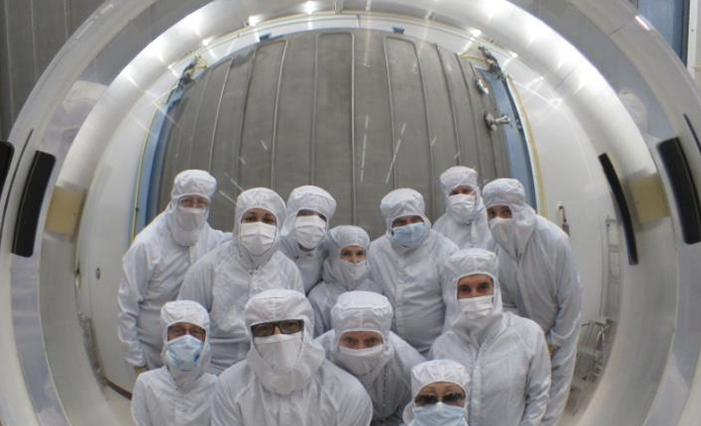
DESI researchers. Image: DESI image gallery
Taken together, these six studies paint a consistent picture: current observations do not yet require abandoning the standard cosmological model, but they have sharpened the conditions under which such a conclusion could change.
Across different datasets, modeling choices, and analytical strategies, hints of evolving dark energy repeatedly appear, but they also weaken or disappear when systematic effects are controlled, alternative parameterizations are used, or broader consistency checks are applied. Rather than converging on a clear signal of new physics, the evidence so far highlights how sensitive these claims are to data selection, modeling assumptions, and measurement precision.
At the same time, DESI has reshaped observational cosmology by delivering much more precise measurements of how the universe expands. Analyses of DESI’s early data already limit how much dark energy could change over time, and newer measurements tighten those limits even further. While some models with evolving dark energy are still possible, the range of allowed changes seems now narrow, and scenarios that differ strongly from constant dark energy are increasingly ruled out.
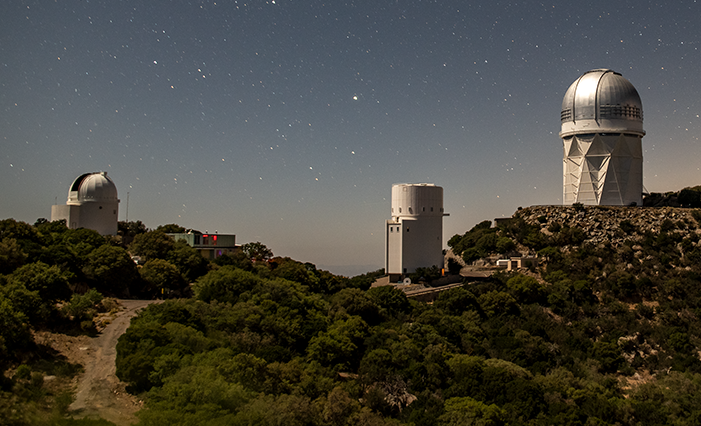
The Kitt Peak National Observatory, which hosts DESI. Image: DESI image gallery
The broader message from this research is that any claim of change requires extreme caution and careful testing. Possible signals must hold up against uncertainties in data, modeling choices, and alternative explanations, and progress often comes from ruling out weak interpretations rather than finding dramatic new ones.
For now, the consistency of dark energy remains a major open problem, and while DESI and similar surveys are not providing sudden breakthroughs, they are steadily narrowing the range of plausible explanations. As data and methods improve, the focus may shift from asking whether dark energy evolves to determining how confidently such evolution can be demonstrated. Until then, the standard cosmological model endures because it continues to pass increasingly precise tests.
Craving more information? Check out these recommended TQR articles:
- Mind Reading Technology Connects Brains to Machines
- Where Do I End and Where Does the Machine Begin?
- AI and the Human Brain: From Mind-Reading AI to a Simulated Conversation with Einstein
- Restoring Hope: AI Breakthroughs Transform Lives of Paralyzed Individuals
- The Most Intimate Data: Accessing Another Human’s Thoughts
We would appreciate your feedback on The Quantum Record and similar content.
Have we made any errors?
Please contact us at info@thequantumrecord.com so we can learn more and correct any unintended publication errors. Additionally, if you are an expert on this subject and would like to contribute to future content, please contact us. Our goal is to engage an ever-growing community of researchers to communicate and reflect on scientific and technological developments worldwide in plain language.