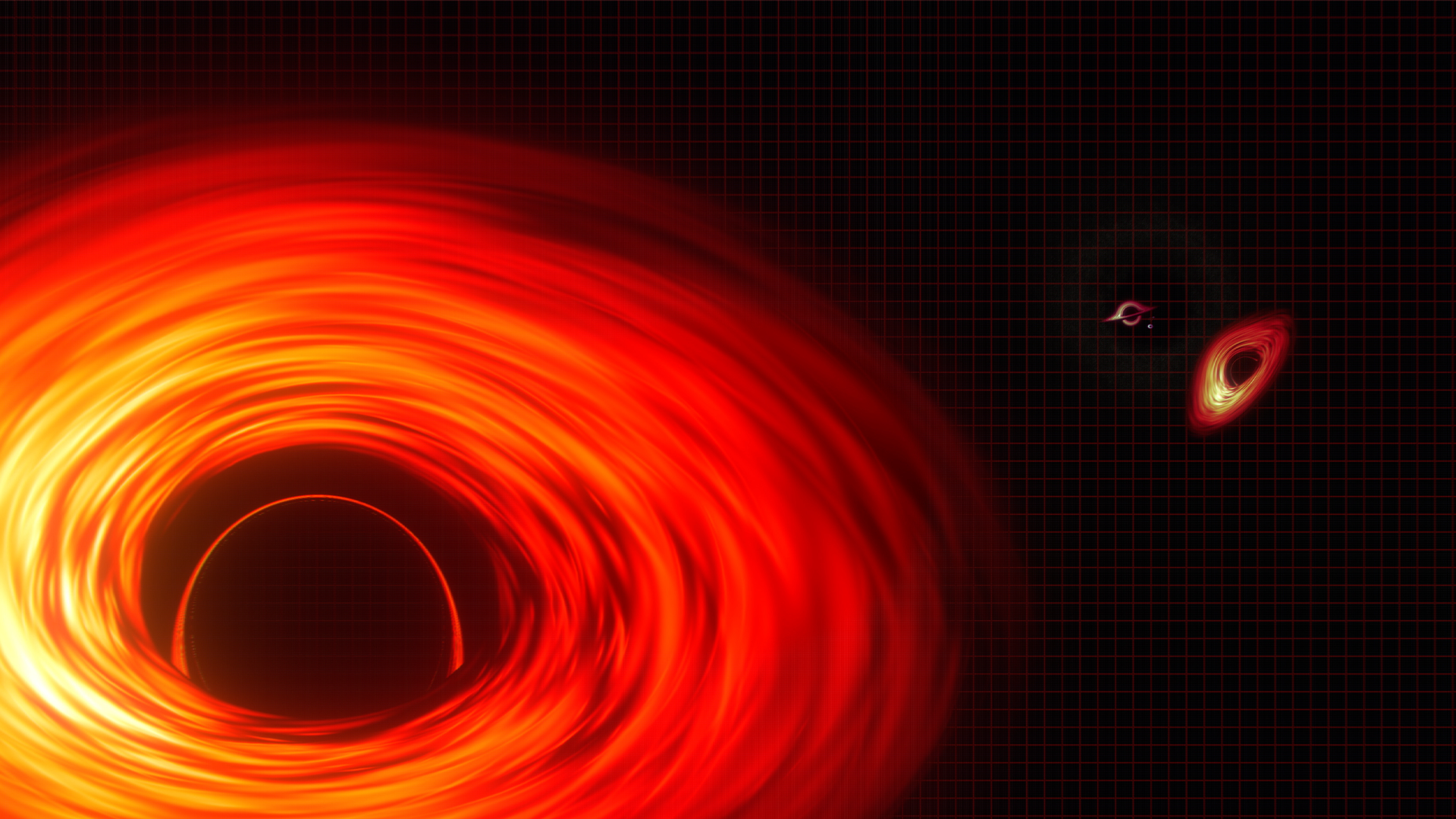
“This image compares the sizes of a few monster black holes that are found at the centers of galaxies.” Credit: NASA’s Goddard Space Flight Center Conceptual Image Lab
By Mariana Meneses
Recent research is expanding how black holes are studied by relying less on electromagnetic radiation alone and more on alternative observational channels, particularly gravitational waves and precise measurements. These methods are opening ways to probe how the objects form, move, and even whether some of them are black holes at all.
According to The Laser Interferometer Gravitational-Wave Observatory (LIGO), gravitational waves are ripples in spacetime caused by massive objects accelerating through the universe. Such objects include orbiting or colliding black holes and neutron stars, a phenomenon predicted by Albert Einstein’s general theory of relativity published in 1916. These waves carry information about their violent origins and the nature of gravity itself and were first directly detected in 2015 by LIGO.
Supported by the U.S. National Science Foundation and operated by Caltech and MIT, LIGO is a ground-based observatory consisting of two 4-kilometer-long arms. Laser beams bounce back and forth in the arms with advanced stabilizers, vacuum systems, and thousands of sensors enabling the detection of minuscule changes in the length of the arms caused by gravitational waves. In a 2015 breakthrough, LIGO measured tiny distortions in spacetime produced by the merger of two black holes more than a billion light-years away.
What Are Gravitational Waves? | Horizon: What on Earth Is Wrong with Gravity? | BBC Earth Science
A study entitled “The NANOGrav 15 yr Dataset: Targeted Searches for Supermassive Black Hole Binaries” was published in February 2026 in The Astrophysical Journal Letters and is open access. The paper presents the first concrete, end-to-end framework for identifying individual pairs of merging supermassive black holes using low-frequency gravitational waves.
Led by Nikita Agarwal, from the Department of Physics and Astronomy at West Virginia University, the researchers are participants in the North American Nanohertz Observatory for Gravitational Waves (NANOGrav) collaboration. NANOGrav is “an international collaboration dedicated to exploring the low-frequency gravitational wave universe through radio pulsar timing.”
Reporting on the study, Phys.org explains that the work builds on NANOGrav’s landmark 2023 detection of a universal gravitational-wave background that produces a persistent, low-frequency reverberating hum. The hum is caused by many distant supermassive black hole binaries, which are systems containing two black holes that orbit each other and emit gravitational waves as they draw closer, spiral around each other, and eventually merge. Rather than treating this background as noise, the researchers show how it can be used as a reference field to pinpoint individual sources, effectively laying the groundwork for a future “map” of black hole mergers across the universe.
The team combined pulsar timing data, consisting of extremely precise measurements of radio pulses from rapidly rotating neutron stars, with targeted observations of quasars. According to NASA, “quasars are classified as a type of object known as an Active Galactic Nucleus (AGN), a galaxy with an extremely bright core caused by the light emitted as matter falls into a central supermassive black hole. Quasars are the most powerful type of AGN.”
Guided by earlier theoretical work suggesting that binaries are far more likely in quasar-hosting galaxies, the researchers conducted focused searches on 114 active galactic nuclei. Not all AGNs produce quasars, which are a specific and extremely luminous subclass of AGNs. This search approach allowed testing of different detection methods under realistic conditions to establish benchmarks for confirming continuous gravitational-wave sources.
The analysis highlighted two particularly promising candidates, which now motivate deeper follow-up observations. Beyond the specific detections, the authors emphasize that their framework represents a shift in gravitational-wave astronomy from detecting a diffuse background to resolving individual, long-lived sources. If successful at larger scales, this strategy could open a new observational window on galaxy mergers, black hole growth, and the structure of spacetime itself, much as X-ray or radio astronomy once did for earlier generations of astrophysics.

“The first galaxies were small and very irregularly shaped. We believe that larger and more structured galaxies like the Milky Way formed through the mergers of these smaller and less structured galaxies. Our experiment will reveal unique insights into the physical processes governing this process.” (NANOGrav) Image: Olena Shmahalo, on NANOGrav.
While the NANOGrav study focuses on identifying where supermassive black hole binaries are and how they evolve as long-lived systems, other recent work shows that gravitational waves can also be used to measure what happens at the moment of merger.
A peer-reviewed study entitled “A complete measurement of a black-hole recoil through higher-order gravitational-wave modes” was published in the journal Nature Astronomy in September 2025 by Juan Calderón Bustillo, from the University of Santiago de Compostela, in Spain, and co-authors. Using only data from gravitational waves, the study reports the first complete measurement of both the speed and direction of the recoil of a black hole formed from the merger of two others. The measurement was made for the event called GW190412, which was a merger of two black holes of unequal masses detected in 2019 by the LIGO and Virgo observatories.
Reporting on the study, Phys.org explains that black-hole recoils occur because gravitational waves are emitted unevenly during a merger, causing the newly formed black hole to receive a “kick” that can reach thousands of kilometers per second. By analyzing higher-order gravitational-wave modes, which are subtle features in the signal that depend on the observer’s position relative to the source, the researchers were able to reconstruct the recoil’s magnitude and orientation in three dimensions.
The result demonstrates a new level of precision in gravitational-wave astronomy, showing that today’s detectors can do more than simply detect distant mergers: they can reconstruct the motion of objects billions of light-years away. The authors note that measuring recoil directions could help identify cases where black hole mergers also produce electromagnetic signals, such as flares generated when a recoiling black hole passes through dense environments like active galactic nuclei. More broadly, the study highlights how gravitational waves provide a powerful, standalone tool for probing extreme astrophysical events.
Together, these gravitational-wave studies show how black holes – from long-lived binaries to the violent aftermath of merger events – can be located, tracked, and dynamically characterized without relying on light at all. Other recent work extends this shift beyond gravitational waves, using precise dynamical measurements from electromagnetic data to address a different but equally fundamental question: how massive black holes form in the first place, and how early they can appear in cosmic history.
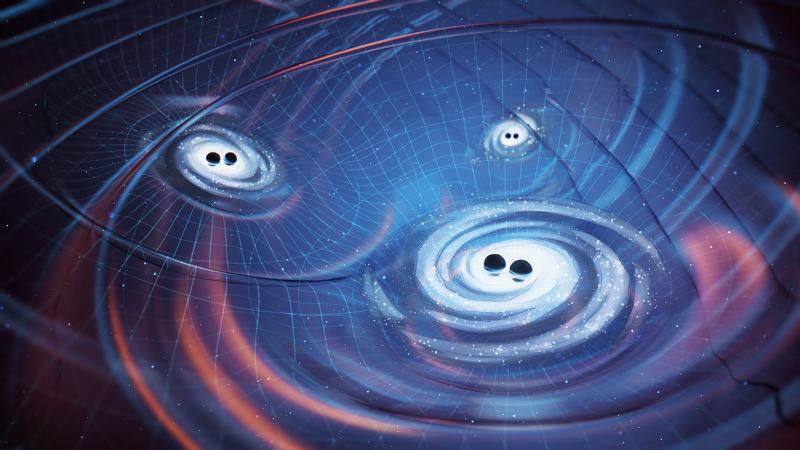
Supermassive binary black hole binary systems at the cores of galaxies produce ripples in spacetime called gravitational waves. Gravitational waves from all supermassive black hole binaries in the universe combine to form a background detectable from pulsar timing. Image: Olena Shmahalo, on NANOGrav
A recently published preprint (yet not peer-reviewed) on arxiv.org is entitled “A direct black hole mass measurement in a Little Red Dot at the Epoch of Reionization”. The paper was co-authored by a large team led by Ignas Juodžbalis, from the Kavli Institute for Cosmology, University of Cambridge, and was last revised by the team in September 2025.
Reporting on the research, Quanta Magazine notes that the study shows the discovery, detected by the James Webb Space Telescope (JWST), of an unusually massive and isolated black hole in the early universe with a mass about 50 million times greater than the Sun.
Known as QSO1, the object appears to exist largely on its own without a surrounding galaxy, challenging the long-standing assumption that supermassive black holes form only after galaxies assemble and evolve. Seen as it existed roughly 750 million years after the Big Bang, QSO1 belongs to a growing class of mysterious “little red dots” observed by JWST that defy conventional models of early cosmic structure.
To confirm that QSO1 is indeed a black hole rather than an unusual galaxy, detailed follow-up observations used gravitational lensing, which allows astronomers to detect faraway objects by the way their light bends around large masses and long JWST exposures. The measurements showed gas orbiting a compact central mass at high speeds, allowing researchers to directly estimate the black hole’s mass and to rule out the presence of a substantial stellar population nearby. The gas is composed almost entirely of hydrogen, indicating that QSO1 reached its enormous size before many stars had formed and dispersed heavier elements, and that the black hole likely dominates the object’s total mass.
The discovery intensifies a central debate in cosmology: how such massive black holes could arise so early in the universe’s history. It challenges the standard explanation, which is that black holes don’t form until after stars burn through their fuel and implode. Several alternative scenarios remain plausible, including the direct collapse of dense gas clouds or the formation of primordial black holes from fluctuations in the density of matter shortly after the Big Bang.
QSO1 does not yet confirm any single theory, but it strongly suggests that black holes and galaxies did not always grow together.
Image: vector_corp, on Freepik.
While the QSO1 result pushes black hole formation to unexpectedly early times using direct dynamical measurements from JWST, it still operates within a broad astrophysical framework of star collapse and gas accretion. A different line of work extends the question of black hole origins even further back, into the conditions of the early universe itself, by linking black holes to high-energy particle signals detected on Earth.
In this context, a new study asks whether black holes formed shortly after the Big Bang could still be observable today, not through light or motion, but through extreme events that defy conventional explanations.
The study entitled “Explaining the PeV neutrino fluxes at KM3NeT and IceCube with quasiextremal primordial black holes” was published in the journal Physical Review Letters in December 2025, by Michael J. Baker and colleagues, and is not open access. The paper addresses an anomalous observation made in 2023, when an ultra-high-energy neutrino struck Earth with an energy far beyond what known astrophysical sources can plausibly produce, challenging existing models of particle physics and cosmology.
Neutrinos in 60 seconds | Fermilab
Reporting on the study, Phys.org explains that the authors propose an exotic explanation involving primordial black holes (PBHs) formed shortly after the Big Bang. Unlike black holes produced by collapsing stars, PBHs could be relatively small and hot, gradually evaporating through Hawking radiation as black holes are theorized to do over a very long time. The team focuses on a special class called quasi-extremal primordial black holes, which carry a hypothesized “dark charge” associated with a heavy, unseen counterpart to the electron. As these PBHs evaporate, the process could end in an explosive release of particles, producing neutrinos with energies comparable to the one detected by the KM3NeT experiment.
Beyond explaining a single “impossible” neutrino, the framework has broader implications: it could provide indirect evidence for Hawking radiation, support the existence of primordial black holes, and potentially account for dark matter itself. If confirmed, the authors suggest that such explosions would offer a rare experimental window into the conditions of the early universe and physics beyond the Standard Model. (For more on dark matter, see Novel Theory Explains Both Dark Matter and Dark Energy. Will a New Telescope Shed Light on the Enduring Mystery? in this month’s edition.)
Revealing Sagittarius A Star – Milky Way Black Hole | National Science Foundation News
Do black holes even exist?
After exploring increasingly indirect and exotic ways of detecting black holes, from gravitational waves to high-energy particles, the final study flips the direction of inference. Instead of asking “what can black holes do to matter and spacetime?”, it asks “what else could mimic a black hole’s gravity?”. It uses the Milky Way’s center, where there is one of the most familiar and well-studied black hole candidates called Sagittarius A*.
The study, entitled “The dynamics of S-stars and G-sources orbiting a supermassive compact object made of fermionic dark matter,” was published in the journal Monthly Notices of the Royal Astronomical Society in February 2026, by V Crespi, from the Instituto de Astrofísica de La Plata, in Argentina, and colleagues. The paper challenges the standard assumption that the Milky Way hosts a supermassive black hole at its center, proposing instead that the observed gravitational effects could be produced by a dense core of fermionic dark matter. In this scenario, dark matter would consist of fermions, which are particles that cannot occupy the same quantum state, whose quantum pressure could prevent collapse and mimic the gravitational signature of a black hole.
Fermionic dark matter: theory & phenomenology
Reporting on the study, Phys.org explains that the authors revisit the motions of the so-called S-stars and G-sources, which are objects observed orbiting extremely close to the galactic center at speeds of thousands of kilometers per second. While these orbits are usually taken as strong evidence for the presence of Sagittarius A* in the middle of the Milky Way, the team shows that a compact, massive core of fermionic dark matter could generate an almost identical gravitational pull, reproducing the observed stellar dynamics without invoking a black hole.
A key strength of the model is its ability to connect vastly different spatial scales. Using data from the European Space Agency’s now-retired Gaia space observatory, which mapped the Milky Way’s rotation far from its center, the researchers show that the same dark matter distribution can also explain the galaxy’s outer rotation curve. In this framework, the dense central core and the extended dark matter halo are not separate components but two regimes of a single, continuous dark matter structure.
Crucially, the study also addresses one of the strongest pieces of evidence for a black hole: the “shadow” imaged by the Event Horizon Telescope, an observatory created by linking ground-based radio telescopes to capture the first-ever direct images of black holes. The authors point to earlier work showing that an illuminated fermionic dark matter core can bend light strongly enough to produce a shadow-like feature similar to that observed for Sagittarius A*. While current data cannot yet distinguish between a black hole and this dark matter alternative, the researchers argue that future high-precision observations, such as searches for photon rings that would be unique to black holes, could provide a definitive test.
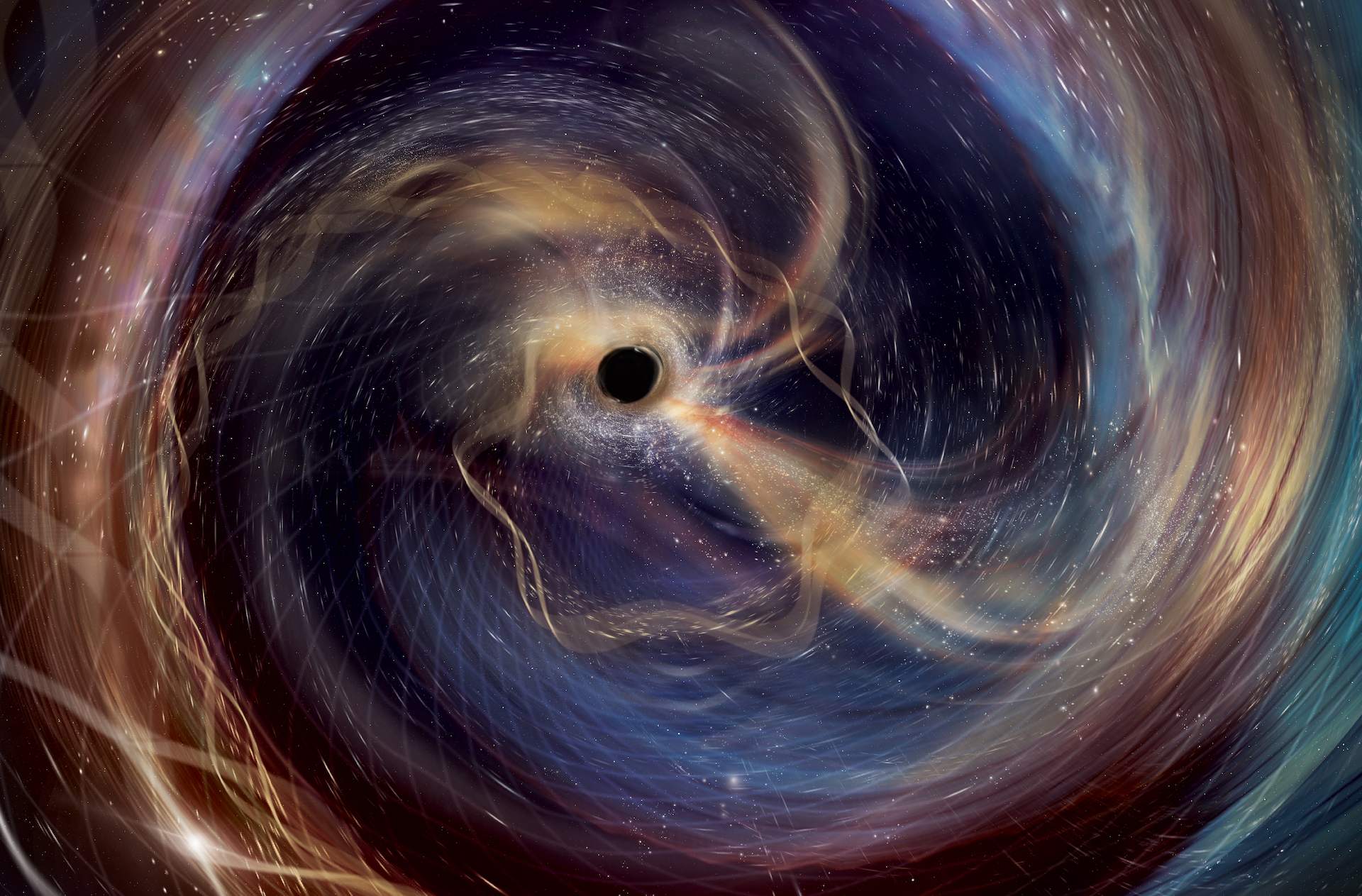
“Artistic impression of the ‘loudest’ black hole”. Credit: Aurore Simonnet, the University of British Columbia.
Taken together, these studies illustrate how black hole research is becoming increasingly multi-modal, drawing on gravitational waves, particle physics, and precise dynamical measurements alongside traditional electromagnetic observations. Each approach probes a different physical regime.
Some findings push black hole formation to earlier cosmic epochs than previously expected, others suggest new observational signatures of black holes long after their formation, and the final study explicitly questions whether one of the most iconic black hole candidates, Sagittarius A*, might be a black hole at all.
The studies discussed here suggest that black holes are, first and foremost, testable ideas that must earn their status across multiple, independent lines of evidence. As new instruments sharpen our view of gravity, matter, and the early universe, these powerful hypotheses may ultimately deepen, or even revise, our understanding of how the cosmos is built.
Craving more information? Check out these recommended TQR articles:
- Mind Reading Technology Connects Brains to Machines
- Where Do I End and Where Does the Machine Begin?
- AI and the Human Brain: From Mind-Reading AI to a Simulated Conversation with Einstein
- Restoring Hope: AI Breakthroughs Transform Lives of Paralyzed Individuals
- The Most Intimate Data: Accessing Another Human’s Thoughts
We would appreciate your feedback on The Quantum Record and similar content.
Have we made any errors?
Please contact us at info@thequantumrecord.com so we can learn more and correct any unintended publication errors. Additionally, if you are an expert on this subject and would like to contribute to future content, please contact us. Our goal is to engage an ever-growing community of researchers to communicate and reflect on scientific and technological developments worldwide in plain language.