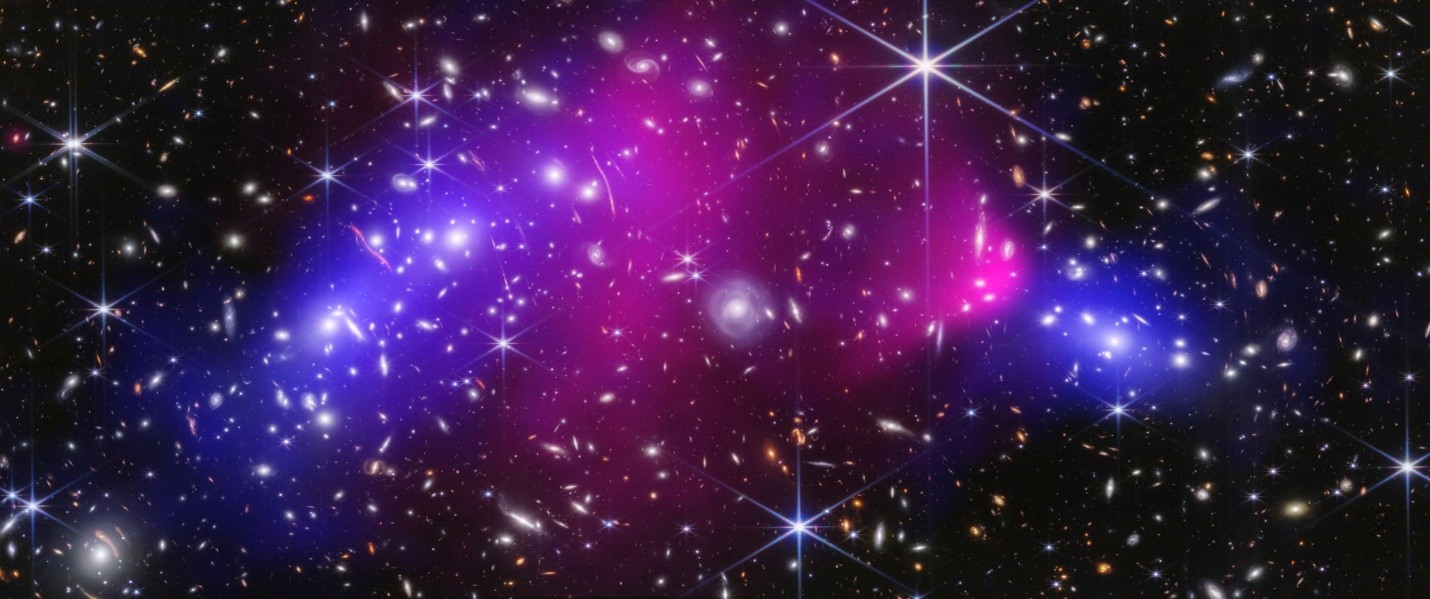
June 2025 composite image of “the central region of the Bullet Cluster, which is made up of two massive galaxy clusters. The vast number of galaxies and foreground stars in the image were captured by NASA’s James Webb Space Telescope in near-infrared light. Glowing, hot X-rays captured by NASA’s Chandra X-ray Observatory appear in pink. The blue represents the dark matter, which was precisely mapped by researchers with Webb’s detailed imaging.” Image and caption: NASA, ESA, CSA, STScI, CXC
By James Myers
Dark matter comprises about one-quarter of the mass and energy of the universe but continues to be shrouded in mystery. We can’t see it because it doesn’t interact with light (which is why we call it dark), but we know that it’s out there because we can measure its gravitational effects on visible objects like planets and stars. What exactly is dark matter: is it a particle, a fluid, some form of modified gravity, or is it even matter to begin with, notwithstanding the word we use in its name?
Dark matter continues to be a heavily researched subject decades after detection of its effects on the physical matter that we can detect, which accounts for only 5% of the mass and energy of the universe. Some theories hold that it’s a particle called a WIMP – a weakly-interacting massive particle – or another type of particle called an axion that’s trillions of times lighter than a WIMP. Neither WIMPs nor axions have been detected, and much evidence is now pointing in other directions with a number of novel ideas emerging for dark matter candidates.
In May 2025, Guanming Liang and Robert Caldwell, of Dartmouth College, published a paper in Physical Review Letters entitled Cold Dark Matter Based on an Analogy with Superconductivity. Their theory holds that, in the first moments after the physical universe was born 13.8 billion years ago in the Big Bang, electrons froze or “stiffened” into a state similar to what are known as Cooper pairs. Normally in constant motion as they orbit the nucleus of atoms, electrons carry electricity and repel each other, but in Cooper pairs they lose their electrical resistance and instead join together to act as superconductors.

Could paired electrons in the infant universe have formed bubbles that coalesced to form dark matter? Image: Pixabay
The theorists provide mathematical support for Cooper-like pairing of electrons in the newborn universe, when protons and neutrons had not yet combined to form atoms. The paired electrons, they write, formed fluid-like droplets that didn’t interact with physical matter but instead clumped together to form regions in space that are impenetrable by visible matter. These regions are now commonly referred to as dark matter and appear to be five times denser than regular matter, but they wouldn’t be matter at all if they are in fact composed of Cooper-like pairs of electrons.
Dark “matter” appears to act like gravity by pulling on physical matter, but the new theory also contributes a solution to another universal mystery, which is the nature of what’s called dark energy that pushes matter away. Like dark matter, dark energy can’t be observed directly but is detected by its actions that appear to propel physical matter. Dark energy comprises about 70% of the mass and energy in the universe, so solving both mysteries at once – explaining how dark matter pulls and dark energy pushes – would open a vast window onto the 95% of the universe where much remains unknown.
Liang and Caldwell propose that only some of the early universe electron pairs stiffened at a sufficiently low temperature into dark matter. Other pairs became locked in place at a higher temperature to form a dark energy force, exerting its mass in the background and pushing the continuing expansion of the universe. The expansion of the universe was first observed by astronomer Edwin Hubble in 1929, and in 1998 it was discovered that the rate of expansion is accelerating. More recently, the acceleration rate was found to be variable and now in a slowing phase. As cosmologist Paul Sutter writes in Scientific American, the mathematics of the new theory allow for a variable expansion rate for dark energy.
(For more on the search for the cause of the slowing of universal expansion, see The Quantum Record’s March 2025 article What’s Slowing the Expansion of the Universe? New Technologies Probing Dark Energy May Hold the Answer).
Dark matter’s gravitational effect acts as a ‘scaffolding’ that shapes the physical matter in galaxies.
The existence of dark matter was inferred in 1933 by astronomer Fritz Zwicky, who observed that the mass of all the stars in a particular galaxy cluster could account for only about 1 percent of the gravity that would be needed to keep the cluster from splitting apart into separate galaxies.
In the nine decades since, technology has provided increasingly powerful tools to measure the effects of dark matter on individual galaxies and clusters of many galaxies. Astronomical observations of the formation and development of galaxies, the distribution of mass during galactic collisions, and the movement of galaxies within galaxy clusters have provided further evidence for the effects of dark matter.

Vera Rubin, surrounded by antique globes. Image: American Institute of Physics, in Wikipedia.
In the 1970s, astronomer Vera Rubin studied the rotation of spiral galaxies, beginning with the Milky Way’s neighbour Andromeda. Rubin observed that the rotational force of Andromeda’s spiral arms exceeds by far the gravity of the galaxy’s stars, so that without five to ten times more mass than her telescope could see the galaxy would fly apart. The conclusion that a halo of dark matter surrounds the galaxy and accounts for the unseen mass has been reconfirmed in the decades since.
With continuing improvements in the technology of astronomy, telescopes both on Earth and in space have given rise to other viable theories about dark matter. In January 2024, in Illuminating Dark Matter: Have We Found the First Dark Stars?, The Quantum Record reported on a proposal that dark matter is self-interacting, which would help to explain why it appears to exist in densities that vary in different parts of galaxy clusters. Self-interacting dark matter might also be the cause of theorized “dark stars” in the early universe, which would have generated heat by bits of dark matter colliding and annihilating each other. Visible stars like our Sun, by contrast, generate heat by nuclear fusion.
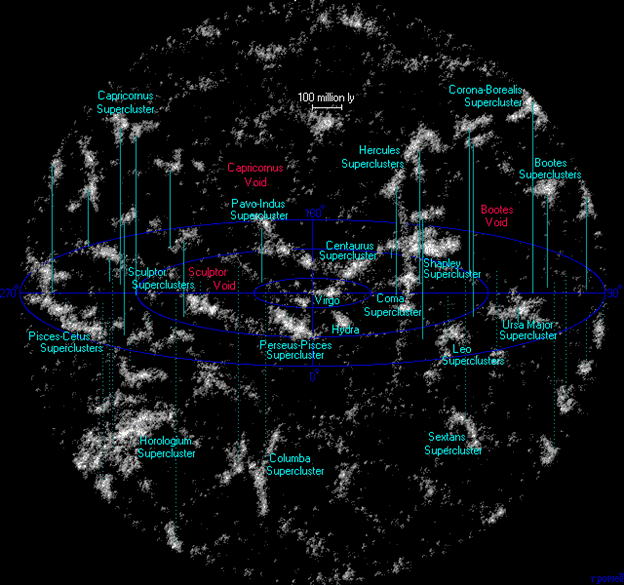
Map of a section of galaxy clusters and superclusters, interspersed by voids. Image from atlasoftheuniverse.com.
The extreme sensitivity of the James Webb Space Telescope (JWST), which was launched at the end of 2021 and orbits the Sun at a distance of 1.5 million kilometres from Earth, has provided the clearest images yet of the early universe. The JWST’s mirror is six times larger than its counterpart on the Hubble Space Telescope, which remains in operation 35 years after launching.
Occupying the same orbit as JWST is the European Space Agency’s space telescope Euclid, which launched in 2023. Euclid is creating a three-dimensional map of the universe’s large-scale structure by looking back through 10 billion light-years across more than one-third of the sky. Mapping the evolution and expansion of the physical universe through time will reveal more about the role of gravity, dark matter, and dark energy in shaping the physical matter in the 5% of the universe that we can measure directly.
NASA has scheduled May 2027 for completion and activation of the Nancy Grace Roman Space Telescope, named after the U.S. space agency’s first chief astronomer. The Roman Telescope’s field of view will be 100 times larger than Hubble’s, and with its 300-mexapixel camera the new telescope could image the light from a billion galaxies during its expected service life. The unprecedented breadth of Roman’s surveys will provide a comprehensive map of the distribution of galaxies, galaxy clusters, and voids in “the most detailed dark matter studies ever undertaken,” according to NASA.
The telescope will detect dark matter by its gravitational lensing effect on light. Light naturally travels in straight lines, but massive objects in space like planets and stars bend the surrounding weblike fabric of spacetime. When light encounters an impenetrable mass, it travels around the curves in space and time, producing intensified and sometimes multiple images of the distant source. The gravitational lensing of light effectively transforms galaxy clusters into massive natural telescopes by allowing measurement of cosmic objects behind them that are otherwise too far away to detect.
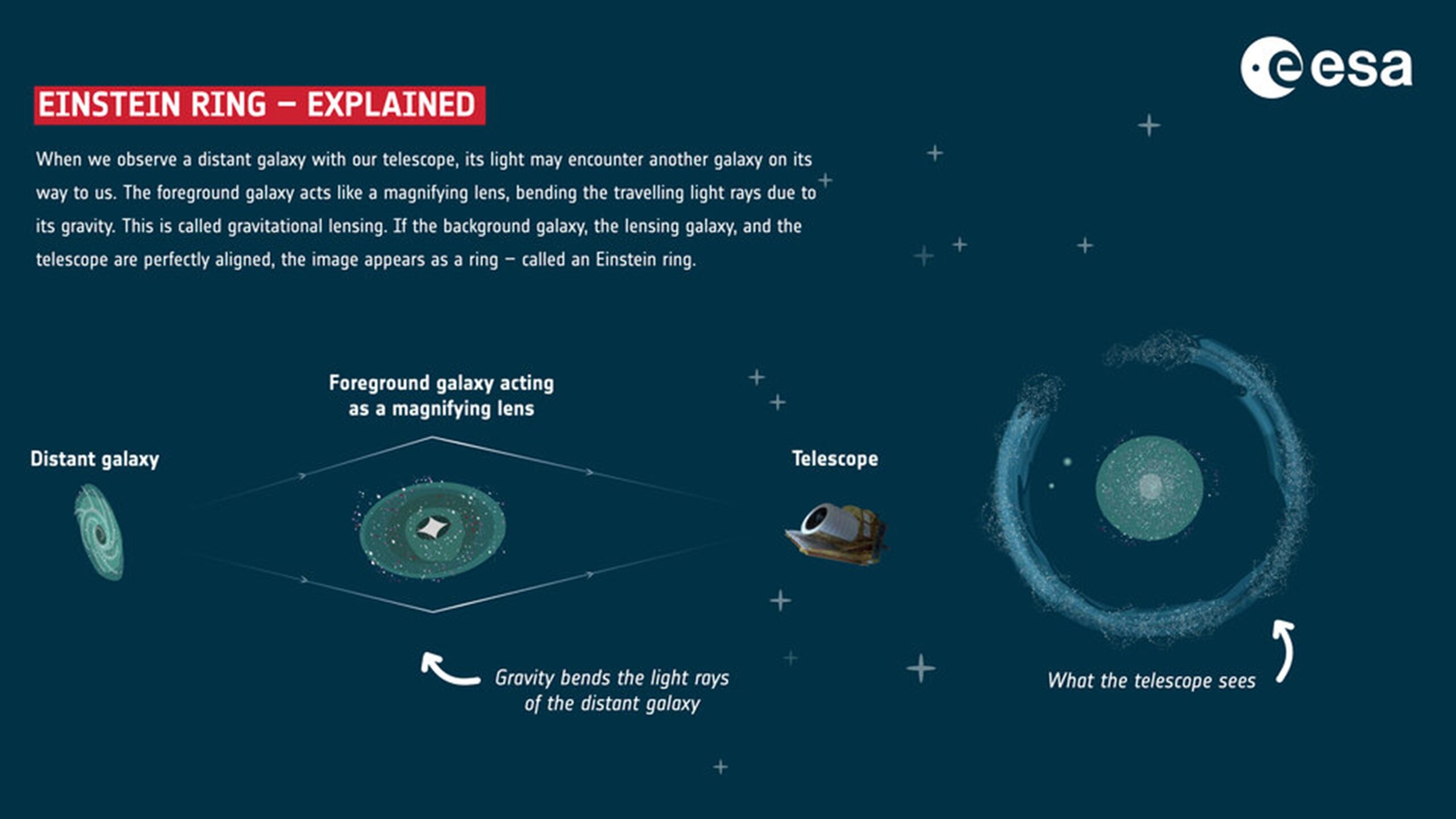
This graphic illustrates the effect of gravitational lensing, with light from a galaxy too far away to detect directly bends around another massive object that acts as a magnifying lens for a space telescope to measure. Soon after its deployment in 2023, the ESA’s Euclid telescope observed an Einstein ring in galaxy NGC 6505 which, at 590 million light-years away, is relatively close to Earth and has been studied since 1884. Einstein’s theory of general relativity predicted gravity’s bending of light, and an Einstein ring is a rare complete circle of gravitationally distorted light. The galactic source of the Einstein ring imaged by Euclid is 4.42 billion light-years away. Image: European Space Agency
Since the gravity of all visible matter in galaxy clusters is far too little to bend light to the degree observed, the density of dark matter in particular regions can be inferred as the cause of the difference. As NASA explains, the Roman telescope “will measure the locations and quantities of both normal matter and dark matter in hundreds of millions of galaxies. Throughout cosmic history, dark matter has driven how stars and galaxies formed and evolved. If dark matter consists of heavy, sluggish particles, it would clump together readily and Roman should see galaxy formation early in cosmic history. If dark matter is made up of lighter, faster-moving particles, it should take longer to settle into clumps and for large-scale structures to develop.”
Although the future date when enough evidence will have been gathered for a conclusion on the question is unknowable, combining Roman’s highly-detailed observations with data from other latest-generation telescopes like JWST and Euclid, the moment may very soon arrive. It could unlock the key to understanding the function of dark matter that comprises one-quarter of the universe’s mass and energy, and it would add a massive amount of new information to our knowledge of the universe at the quantum level.
As advanced instruments like the JWST, Euclid, and Nancy Grace Roman Telescope provide vast amounts of precision data on gravitational differences in galaxies, galaxy clusters, and voids, more surprises may be in store for our understanding of dark matter and dark energy. Applying machine learning to analyze the data will help to identify patterns in wide expanses of the cosmos that could yield far greater information on the nature and operation of these forces that pull and push on visible physical matter.
In the meantime, the idea that dark matter is a product of a Cooper-like pairing of electrons in the early universe remains one of a number of compelling theories for the nature of dark matter and possibly also dark energy. Will the JWST and Roman Telescope finally shed light on the 95% of the universe that’s hidden from view, or will the unknown always remain greater than what we know? In the end, maybe only time will tell.
Craving more information? Check out these recommended TQR articles:
- Mind Reading Technology Connects Brains to Machines
- Where Do I End and Where Does the Machine Begin?
- AI and the Human Brain: From Mind-Reading AI to a Simulated Conversation with Einstein
- Restoring Hope: AI Breakthroughs Transform Lives of Paralyzed Individuals
- The Most Intimate Data: Accessing Another Human’s Thoughts
We would appreciate your feedback on The Quantum Record and similar content.
Have we made any errors?
Please contact us at info@thequantumrecord.com so we can learn more and correct any unintended publication errors. Additionally, if you are an expert on this subject and would like to contribute to future content, please contact us. Our goal is to engage an ever-growing community of researchers to communicate and reflect on scientific and technological developments worldwide in plain language.