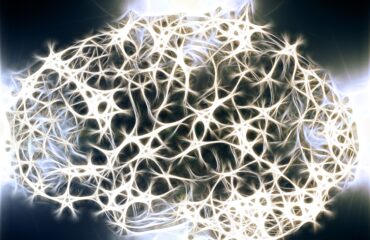
Are quantum information bits the unifying basis of reality? Image by Gerd Altmann, on Pixabay.
By James Myers
What is reality? Is the physical matter of our bodies and everything we see around us the basis of what’s real, or is all that like the visible tip of an iceberg with far more of what’s truly real lurking far below the visible waves of light?
A new theory says that reality is fundamentally rooted in quantum information, and the physical mass that we see is one of the ways that information expresses itself.
Although nobody has found a limit to the total amount of energy (E) in the universe, Einstein’s famous equation E=mc2 tells us that, in its equivalent form of physical mass (m), energy operates in measurable limits. A measurement, such as the weight or resistance of a particular mass, is information, and a paper released in February describes not only how the universe could retain informational memory in a quantum memory matrix, but also how that memory might explain the mysteries of dark energy and dark matter.
Last month, The Quantum Record featured recent theories on dark energy and dark matter that account for 95% of the energy and mass of the universe. While it’s known from their effects on physical mass that dark energy is a force that expands the universe and dark matter is a force that compresses matter gravitationally, neither is directly measurable – and that’s why they’re both called “dark.” According to the new proposal, both mysterious forces could be a product of the way that the universe stores quantum information in the curved fabric of space and time.
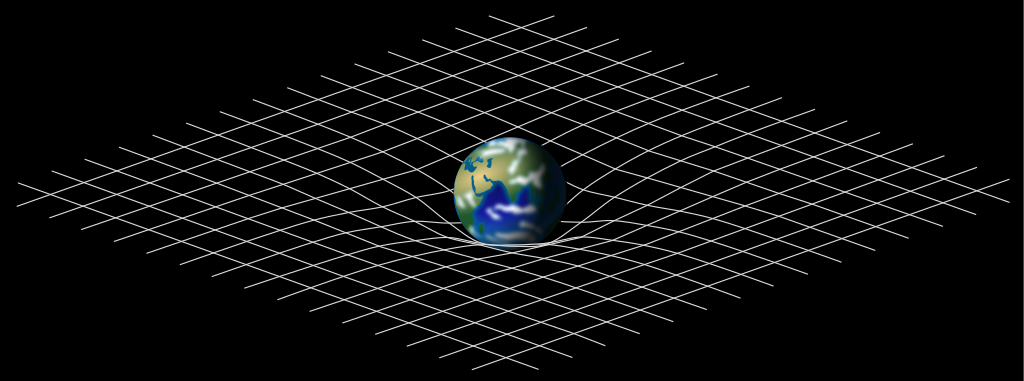
Artistic representation of the fabric of spacetime showing its curvature around a massive object such as the Earth. Roger Penrose proposed that conscious observations are recorded in spacetime curvature. Image: Mysid
Physical mass and the limits of mass provide information. Physicists propose that the universe stores information in a quantum memory matrix.
The law of conservation of information is a fundamental property of the universe. It was hotly contested by physics luminaries Stephen Hawking and Leonard Susskind in a debate that began at a 1983 lecture. Hawking took the position that since black holes evaporate (although at an incredibly slow rate) the information they contain also evaporates, while Susskind argued that the universal conservation law prevent loss of information in the evaporation process. They accepted a compromise proposal by Nobel Prize-winner Gerard ‘t Hooft that information falling into a black hole is never lost but permanently imprinted in two dimensions on the event horizon – which is the limit in space and time – of a black hole. There’s a black hole with an event horizon in the middle of our Milky Way galaxy, and practically every other galaxy in the universe.
Although there are many ways of defining information depending on its context, in all cases information tells us something about limits.
At its most fundamental level, information about a particular thing can be understood as a description of the change or difference that makes the thing’s limits unique from the limits of any other thing.
We might never know if there’s limit to the energy of the universe, but we do know that the lowest limit for a single unit of energy – which is called a quantum and is the unit of information in quantum computers – is the in the foundation of energy’s actions and reactions. As defined by physicist Max Planck, the quantum is the minimum amount of energy that can act as either the input for or output of a change in mass, which Einstein’s famous equation tells us is equivalent to energy when mass is multiplied by the square of lightspeed (c2). The new proposal says that every quantum is part of an information storage matrix.
The February paper entitled Entropy, Information, and the Curvature of Spacetime in the Informational Second Law, by University of Leiden Assistant Professor of Physics Dr. Florian Neukart and co-authors, proposes that the fabric of space and time (spacetime) is actually a quantum memory matrix (QMM). As Dr. Neukart wrote on Space.com in October 2025, the matrix is “made of tiny ‘cells’, which is what quantum mechanics suggests. Each cell can store a quantum imprint of every interaction, like the passage of a particle or even the influence of a force such as electromagnetism or nuclear interactions, that passes through. Each event leaves behind a tiny change in the local quantum state of the spacetime cell.”
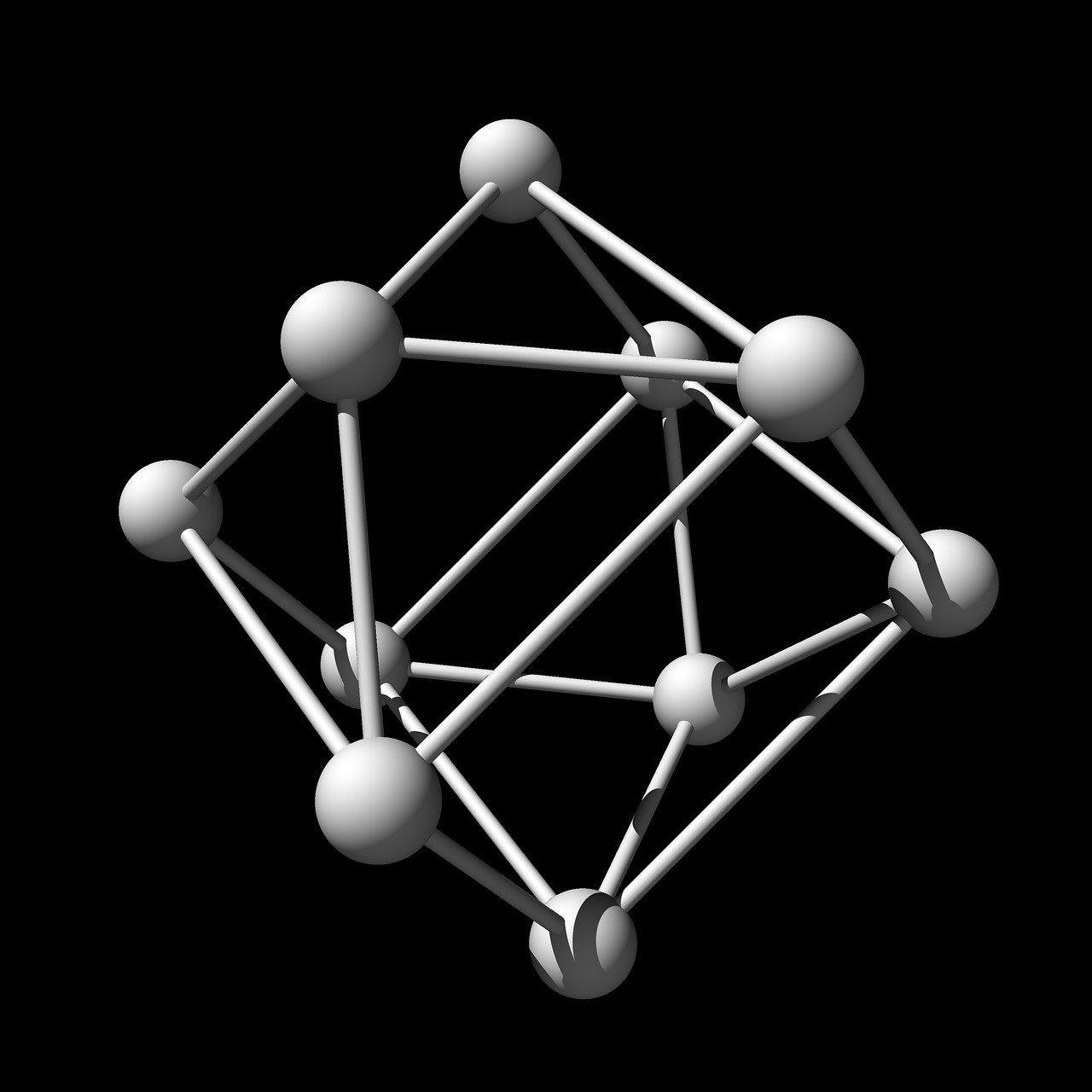
Imagine a matrix, or lattice, consisting of many cells. Image by Pete Linforth, on Pixabay.
In other words, the universe itself remembers at a quantum level. And, logically, why shouldn’t it? If there’s one universe, where else would information about quantum actions and reactions go, if it’s not retained in a permanent record of some form?
The quantum memory matrix stores information in curves.
The proposal by Dr. Neukart and co-authors relates the information-storing curvature of the spacetime fabric to entropy. Broadly defined, entropy is the change in energy over time from a state of maximum order to maximum disorder – analogous, for example, to water spilling out of the ordered limits of a glass onto the floor where it winds up in a disordered state.
The curvature of spacetime is described in the field equations underlying Einstein’s E=mc2, which set out the universal relationship between the curved geometry of space (in the left-hand side of the field equation) and the motion of mass in time (on the equation’s right-hand side).

Underlying Einstein’s famous E=mc², one of his field equations uses the symbol K. Shown on the right, Einstein defined the symbol K as a fraction whose numerator consists of pi multiplied by 8 and further multiplied by G, which is the gravitational constant. The sum of these three values is divided, in the denominator, by c (the speed of light) raised to the exponent 4.
Curvature comes in two varieties: positive, which can be thought of as closed curves, and negative, which can be thought of as open curves. The paper by Dr. Neukart and co-authors demonstrates that spacetime curvature “acts as a geometric source term for coarse-grained entropy production. Regions of positive curvature correspond to entropy generation, while regions of negative curvature correspond to entropy release or information recovery.”
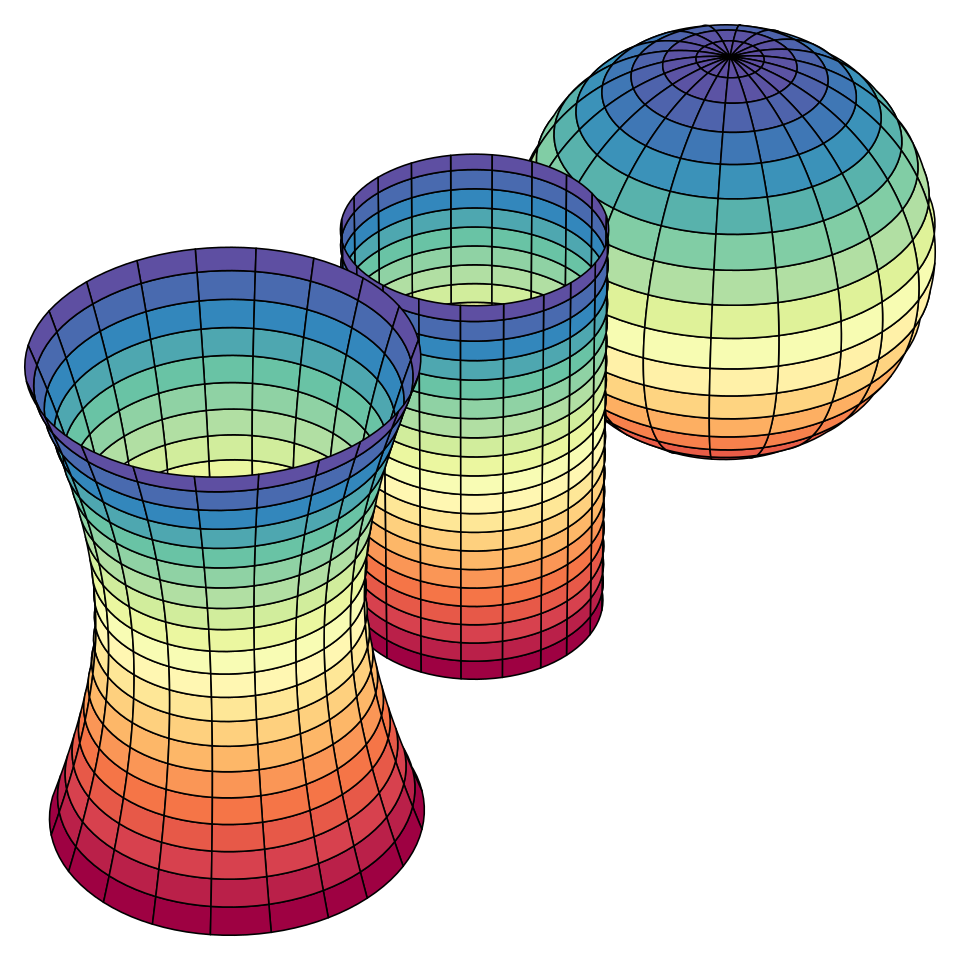
Illustration of saddle-shaped negative Gaussian curvature, on the left, and spherical-shaped positive Gaussian curvature, on the right. The cylinder, in the middle, has zero Gaussian curvature. Image by Nicoguaro, on Wikipedia.
In this scenario, the disorder of entropy accumulates within the limits of a closed curve, for example a sphere, and is released as information in an open curve, for example one that is saddle-shaped.
The authors indicate that, in their formulation, variances in particular curvature measurements (known as scalar and metric) correspond to fluctuations in quantum information. They state that, “Einstein’s equations remain intact but admit a complementary thermodynamic interpretation in which curvature tracks the redistribution of coarse-grained information,” as illustrated below in figure 1 from their paper.
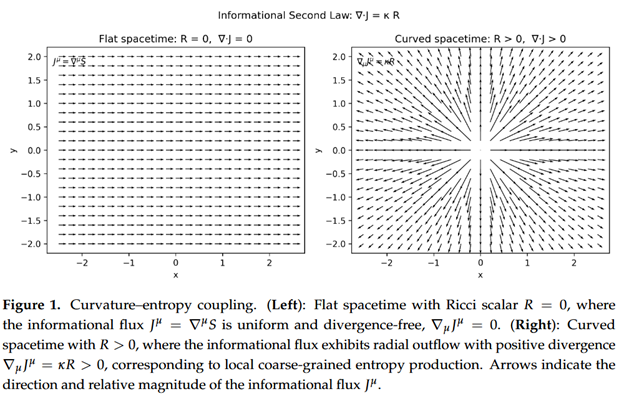
Comparison of information distribution in flat and curved spacetime geometry from Entropy, Information, and the Curvature of Spacetime in the Informational Second Law, by Florian Neukart and co-authors.
The quantum memory matrix is consistent with the principles of thermodynamics.
Thermodynamics is an area of study in physics that relates energy and entropy to temperature and physical work, or change, and the paper indicates that the dynamics of information is consistent with existing knowledge of thermodynamics. For example, it’s already understood that at all temperature ranges, more thermodynamic energy and quantum information can be extracted from particles called bosons, which include photons of light energy, than particles like electrons which are classified as fermions. For both particle types, the second law of thermodynamics is a bedrock principle that says energy, and therefore quantum-level information on energy, moves in only one direction that’s commonly referred to as the “arrow of time.”

Dr. Florian Neukart. Image: Universiteit Leiden
In his Space.com article, Dr. Neukart explained the goal of the work that he and his colleagues have been doing on the nature of quantum information. “The idea is to treat information – not matter, not energy, not even spacetime itself – as the most fundamental ingredient of reality. We call this framework the quantum memory matrix (QMM).”
In the lattice of cells that comprises the matrix, each has a finite-dimensional limit and retains a specific electrical charge that provides a unique signature for the history of local quantum interactions.
While many theories hold that the fabric of spacetime is a continuous, or smooth, unity, the QMM approach is different. As Dr. Neukart wrote, “At its core is a simple but powerful claim: spacetime is not smooth, but discrete – made of tiny “cells”, which is what quantum mechanics suggests. Each cell can store a quantum imprint of every interaction, like the passage of a particle or even the influence of a force such as electromagnetism or nuclear interactions, that passes through. Each event leaves behind a tiny change in the local quantum state of the spacetime cell.”
The quantum memory matrix concept appears to be consistent with the compromise that Gerard ‘t Hooft brokered in the debate between Stephen Hawking and Leonard Susskind on the universal conservation of information. Dr. Neukart writes that from the QMM perspective, as matter falls into a black hole, “the surrounding spacetime cells record its imprint. When the black hole eventually evaporates, the information is not lost. It has already been written into spacetime’s memory.”
The mathematics behind QMM extend spacetime imprinting to other specific types of information. For example, the matrix can also retain a record of the strong and weak nuclear forces that hold atoms together, as well as changes in the electromagnetic force where “even a simple electric field changes the memory state of spacetime cells.”
Perhaps the most revolutionary outcome of QMM could be its ability to explain dark energy and dark matter. Dr. Neukart wrote that, “In one study, currently under peer review, we found that clumps of imprints behave just like dark matter, an unknown substance that makes up most of the matter in the universe. They cluster under gravity and explain the motion of galaxies – which appear to orbit at unexpectedly high speeds – without needing any exotic new particles.”
Astronomer Vera Rubin was the first to observe that matter in the spiral arms of the galaxy Andromeda exceeds by far the gravity of the galaxy’s stars, so that without five to ten times more mass than Rubin’s telescope could see the galaxy would fly apart. The conclusion that a halo of dark matter surrounds and shapes the galaxy, accounting for the unseen mass, has been reconfirmed in the decades since.
In another study on QMM, Dr. Neukart and collaborators “showed how dark energy might emerge too. When spacetime cells are saturated, they cannot record new, independent information. Instead, they contribute to a residual energy of spacetime. Interestingly, this leftover contribution has the same mathematical form as the “cosmological constant”, or dark energy, which is making the universe expand at an accelerated rate.”
Are we part of a cyclic quantum universe?
A typical interpretation of the Big Bang theory, according to which the physical universe was born 13.8 billion years ago from unknown sources, frames time as a linear process. The Big Bang theory holds that time began 13.8 billion years ago and extends in a straight line, possibly forever, into the future. The quantum memory matrix theory, however, points to time as a circular, rather than linear, process.
As Dr. Neukart wrote, “But if spacetime has finite memory, what happens when it fills up? Our latest cosmological paper, accepted for publication in The Journal of Cosmology and Astroparticle Physics, points to a cyclic universe – being born and dying over and over. Each cycle of expansion and contraction deposits more entropy – a measure of disorder – into the ledger. When the bound is reached, the universe ‘bounces’ into a new cycle.”
More specifics on the nature of a cyclic quantum universe are available in a June 2025 paper by Dr. Neukart and co-authors entitled Information Wells and the Emergence of Primordial Black Holes in a Cyclic Quantum Universe.
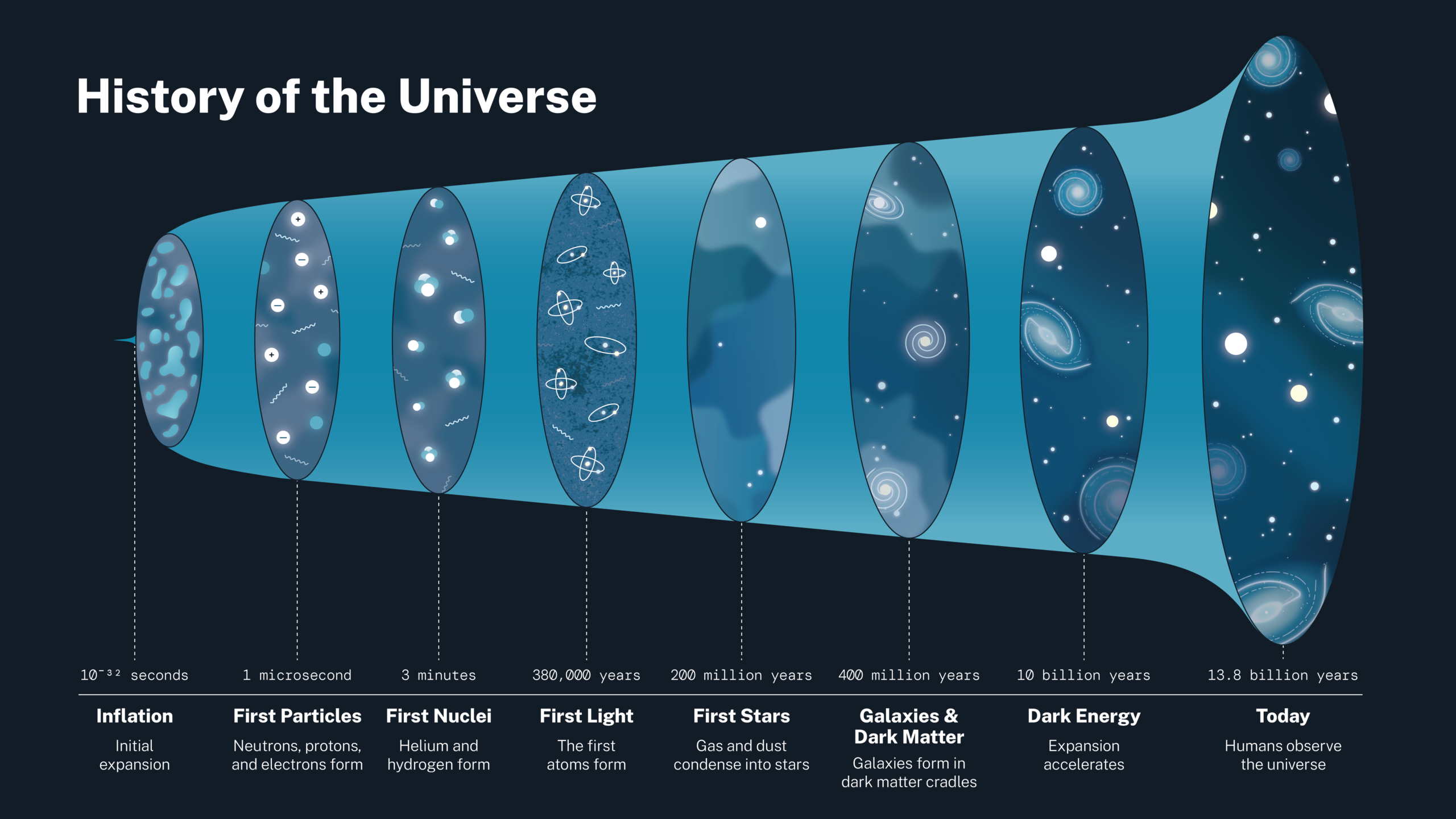
The history of the universe is depicted here according to the Big Bang theory. “Dark energy has been described by some as having the effect of a negative pressure that is pushing space outward. However, we don’t know if dark energy has the effect of any type of force at all.” ( NASA)
A fundamental unresolved problem in physics is the cause of the Big Bang. The “big bounce” is an alternative to the Big Bang theory of the universe, theorizing that instead of beginning from nothing the universe that we know is another cycle of a universe that has always existed and will always exist. In a cyclic universe, time did not begin 13.8 billion years ago because time has no beginning and no end. In this conception, time and the physical universe are not linear but circular and, like circles, time and physics have an unlimited capacity at the extremes.
Did the Big Bang really have no cause? Our everyday experience is that something can’t magically come from nothing. The cycle of physical cause and effect is encoded in Isaac Newton’s third law of motion: for every effect (reaction) there’s an equal and opposite cause (action) and for every cause there’s an effect. Unless the universe is cyclic, however, the third law of motion would fail at the moment of the Big Bang because the explosion of mass would be an effect without a cause.
A cyclic quantum universe opens new lines of thinking about the past and future of the universe and its motion at the foundational level of the quantum of energy. Within a cyclic quantum universe, the quantum memory matrix model of spacetime provides a framework for how the one thing that has no known limits – the universe and its energy in quantum units – could operate variably within specific limits and retain an infinite memory of its self-limiting functions.
What about conservation of observational information?
Would a quantum memory matrix be limited to recording the physical actions and reactions of energy? Stephen Hawking and Leonard Susskind debated the conservation of physical information but did not address the question of conservation of observational information.
Measurements of things like quantum interactions, made by physicists and other scientists like those who are developing quantum computers, are observations. Does the universe also keep a record of the observational bits of information that are obtained by observers like Hawking and Susskind? Is a record of the individual observer also fundamentally part of a universal memory matrix?
That question may lie at the heart of the still-unexplained quantum observer effect that has puzzled scientists since it was discovered in 1801. For over two centuries it has been demonstrated time and again that observing a quantum action changes its physical outcomes. So, what’s the connection between physical memory and observational memory?
Solving the physical memory question could well be the first step to unravelling the mysteries of our observing minds.
Craving more information? Check out these recommended TQR articles:
- Thinking in the Age of Machines: Global IQ Decline and the Rise of AI-Assisted Thinking
- Cleaning the Mirror: Increasing Concerns Over Data Quality, Distortion, and Decision-Making
- Not a Straight Line: What Ancient DNA Is Teaching Us About Migration, Contact, and Being Human
- Digital Sovereignty: Cutting Dependence on Dominant Tech Companies
We would appreciate your feedback on The Quantum Record and similar content.
Have we made any errors?
Please contact us at info@thequantumrecord.com so we can learn more and correct any unintended publication errors. Additionally, if you are an expert on this subject and would like to contribute to future content, please contact us. Our goal is to engage an ever-growing community of researchers to communicate and reflect on scientific and technological developments worldwide in plain language.