
Image by Gerd Altmann, on Pixabay
By Mariana Meneses
AI has become a major global industry, with the broader market valued at about US$617.62 billion, according to Statista, and generative AI reaching an estimated US$63 billion in 2025. The United States remains the largest machine-learning market, and, along withChina, accounts for most large-scale AI systems developed since 2019.
This concentration raises concerns that leading countries may retain much of AI’s economic value while shifting environmental, infrastructure, and labor costs elsewhere, reinforcing existing global inequalities in wealth, power, and technological capacity. Issues like these are prompting a re-evaluation of future options for the direction of AI, including ways that AI could be used to reduce global inequities.
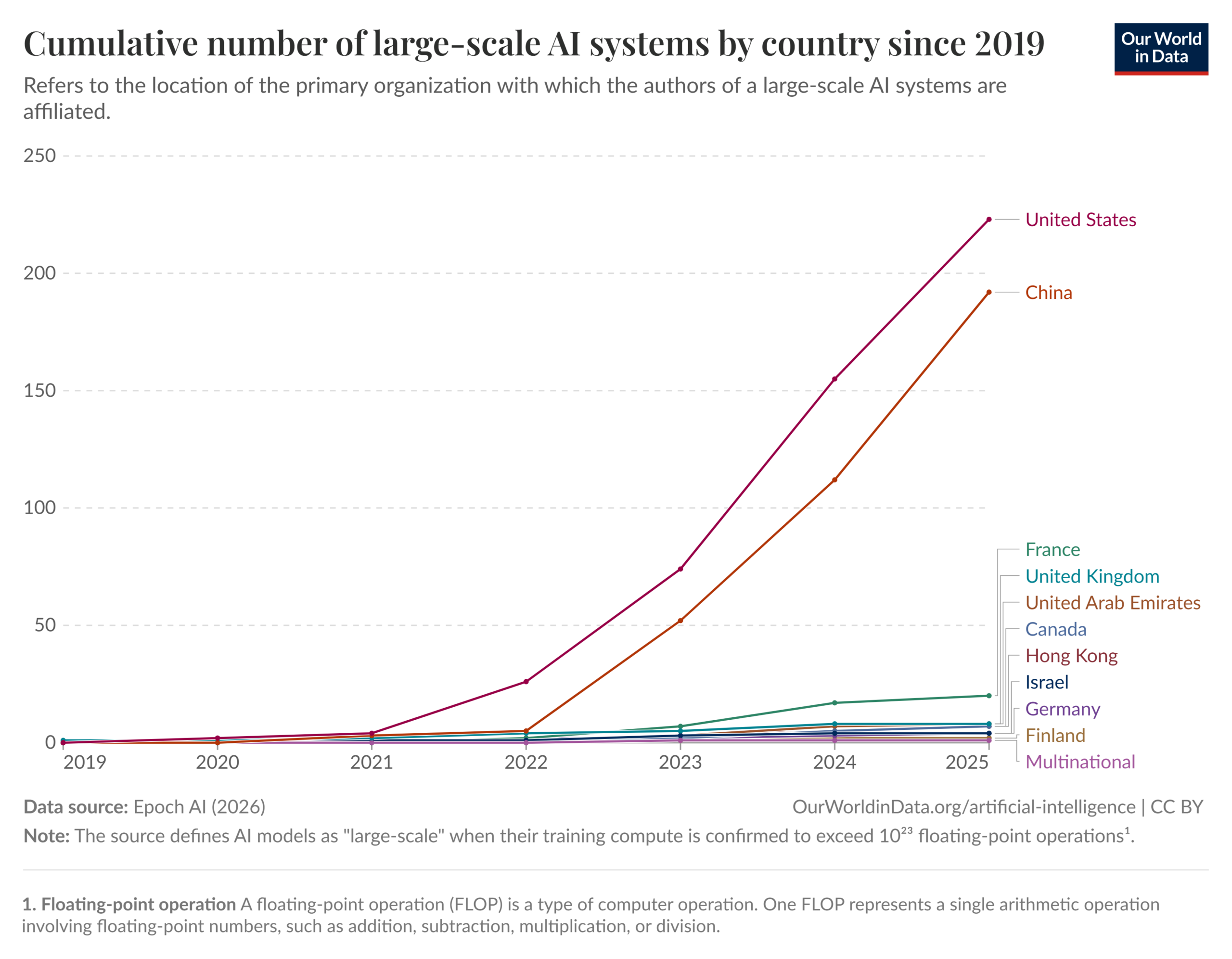
Image: Our World in Data
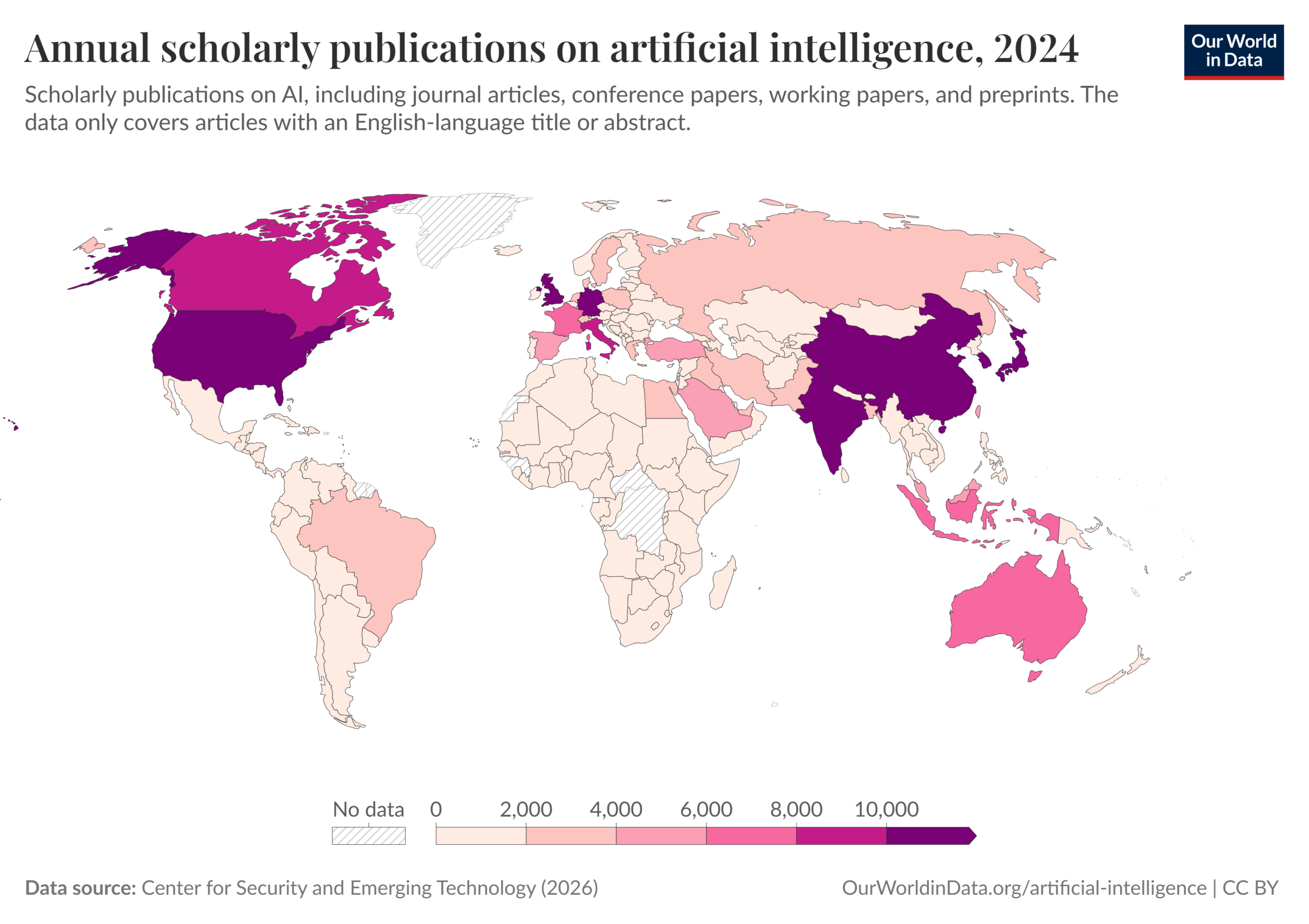
The geography of AI research reflects a similar concentration. A 2024 map of annual scholarly publications, by Our World in Data, shows the highest research activity across the US and Canada, China, Western Europe, and Australia, while many regions contribute far fewer studies. This imbalance may shape which problems are prioritized, whose data and experiences inform AI development, and where scientific and economic benefits accumulate.
“Authors are linked to the country of the institution they worked at when the article was published, not their country of origin”. Image: Our World in Data
A similar pattern appears in AI adoption. Our World in Data estimates from March 2026 show the highest shares of working-age adults using generative AI in the United States, Canada, Europe, and Australia. This suggests that access to and practical use of these tools arealso concentrated in wealthier regions, potentially widening existing gaps in who benefits from AI as it becomes more integrated into work and everyday life.
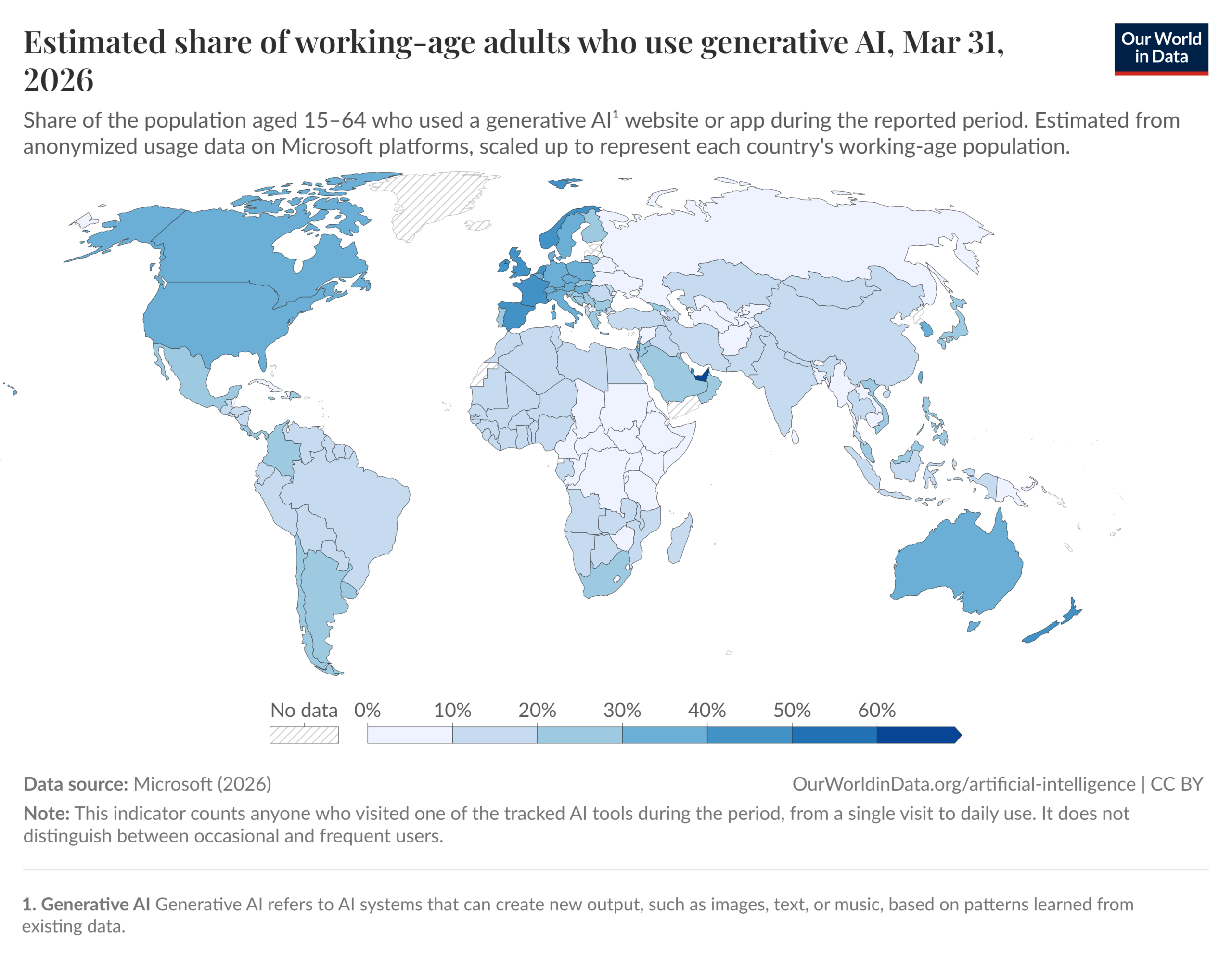
Image: Our World in Data
Gaps in AI’s benefits are beginning to gain the attention of policymakers, even within wealthy countries.
For example, In June 2026, Canada announced its new AI for All strategy, which seeks to ensure that the benefits of AI are broadly shared within the country. Over the next five years, it plans to expand AI adoption, along with stronger safety rules, committing over $2 billion in new spending and targeting $200 billion in additional GDP growth and 250,000 new jobs by 2031. As part of this effort, the federal government announced more than $10.2 million for six organizations in Manitoba developing or adopting AI and digital technologies, with the funding expected to assist small and medium-sized businesses across several industries. The strategy is built on the premise that inclusive AI adoption requires technological investment to be accompanied by access to skills, economic opportunities, trusted tools, and public safeguards.
“AI is here. The question is whether it will improve the lives of all Canadians or benefit only a few. AI can shorten our emergency room wait times and make a small business more competitive, if it is governed by Canadian values with a clear goal of improving the lives of all Canadians. That’s why we need an ambitious new strategy: AI for All. We will build trust so that all Canadians are empowered to use this technology safely and with confidence. AI that builds Canada strong for all: that is our mission.” – Mark Carney, Prime Minister of Canada.
Writing about the Canadian labor market, Rosalie Wyonch argues that AI is more likely to reshape employment gradually than cause mass unemployment, since adoption remains concentrated in a limited number of sectors and most firms already using AI report no change in employment. The effects may still be uneven: early-career workers in AI-exposed occupations are showing weaker employment outcomes, while Black and Indigenous Canadians, younger people, and workers with less education are overrepresented in jobs considered more vulnerable to automation. Wyonch argues that AI may inherit and reinforce these pre-existing inequalities, making equity a broader labor-market challenge.
Simon Blanchette, writing for The Conversation, argues that Canada’s strategy sets ambitious targets but provides fewer concrete measures to address worker displacement, digital inequality, algorithmic bias, and environmental impacts. Although the plan includes AI literacy, upskilling, youth work placements, and support for Indigenous-led initiatives, it offers limited modelling of job losses, few enforceable protections for workers affected by AI-based hiring or workplace surveillance, and insufficient attention to barriers involving connectivity, gender disparities, data rights, consent, and access to redress. The strategy also promotes a major expansion of domestic computing infrastructure while providing little detail on how water use, land use, energy demand, and local environmental burdens will be measured or governed.
Canada’s experience shows how difficult it may be to distribute AI’s benefits fairly — even in a country with substantial technological, financial, and institutional capacity.
Across countries, those differences are far greater, raising the possibility that unequal access to infrastructure, skills, data, and investment could widen existing development gaps.
Globally, the United Nations Development Programme (UNDP) report ‘The Next Great Divergence’ argues that AI could become the next major general-purpose technology, comparable to electricity, computing, and the internet. Its central concern is whether AI will reduce development gaps or create a new wave of inequality. The Asia-Pacific region is presented as the key testing ground because it includes both global AI leaders and countries still facing major gaps in electricity, connectivity, skills, data, and institutional capacity.
“In some high-income economies 2 in 3 people already use AI tools, while in many low-income countries usage remains close to 5%. A new flagship report from UNDP warns that unequal readiness and uneven adoption of AI could set in motion a “Next Great Divergence” in the form of rising inequality between countries.” — UNDP Asia and the Pacific.
The UNDP report examines how AI may affect inequality across society, the economy, and governance.
It could expand access to education, healthcare, social protection, disaster response, agriculture, climate adaptation, and biodiversity monitoring, including in underserved communities. However, these benefits depend on who has access and who is represented in the data. Children, women, rural and Indigenous communities, displaced people, and lower-income groups may be excluded or harmed by limited connectivity, underrepresentation, biased systems, or decisions that are difficult to understand or challenge. Economically, AI could increase productivity and support new industries, while also disrupting routine cognitive work, gig work, outsourcing, and low-skill services, with women and young workers facing particular risks.
The UNDP report’s policy message is to “leave no mind behind.” AI should be guided by whether it expands human capabilities, not only by whether it increases efficiency or GDP. This requires investment in hard infrastructure, such as connectivity, electricity, devices, computing, and secure data systems, alongside soft capacity, such as skills, regulation, transparency, accountability, and public participation. Because countries start from very different positions, the report calls for differentiated roadmaps: lower-capacity settings should prioritize access and essential services, transitional economies should scale infrastructure and workforce transitions, and higher-capacity countries should lead on standards, green AI, open ecosystems, and regional public goods.
Regional deficiencies in digital infrastructure contribute to global inequalities.
Discussing specifically the African context, Tiego Capital founder Kgothatso Meka, writing for MIT Sloan Management School, warns that Africa’s progress in AI remains limited by major gaps in electricity, connectivity, data-center capacity, digitized public systems, computing power, and actionable national strategies. Although AI could add an estimated US$2.9 trillion to the continent’s economy by 2030, Meka argues that much of this value may flow abroad through licensing fees, cloud services, and data extraction if African countries remain primarily consumers of foreign platforms. He also raises concerns about “data colonialism,” in which African data, languages, histories, and cultural knowledge are processed and monetized elsewhere, leaving the continent economically dependent and underrepresented in AI systems.
Ojo Emmanuel Ademola, writing for The Guardian Nigeria, has a related point, that rising costs for computing, energy, data centers, advanced chips, and AI services could deepen Africa’s dependence on foreign platforms if countries do not invest in their own data governance, infrastructure, technical expertise, and capacity to develop AI systems suited to local needs.
AI can support efforts to reduce poverty and economic inequality
The chapter “AI in Combating Poverty and Economic Inequality”, by Yingying Zeng, from the University of Georgia, and co-author, published in June 2026 in the book Artificial Intelligence in Social Work, argues that AI can support efforts to reduce poverty and economic inequality by helping governments, nonprofits, and social service providers identify at-risk populations, allocate resources more effectively, expand financial inclusion, and improve access to services such as education, healthcare, employment support, and social welfare. It begins by situating AI within a global and US context of persistent poverty, racial and economic disparities, and inequalities intensified by the COVID-19 pandemic. In this setting, AI is presented as a potentially useful tool for predictive analytics, poverty mapping, targeted aid distribution, job matching, alternative credit scoring, and more responsive public policy.
The chapter repeatedly warns that AI is not inherently equitable: because systems are often trained on historical data, they can reproduce inequalities linked to race, gender, immigration status, disability, wealth, and unequal access to opportunity. Risks include biased algorithms, discriminatory welfare fraud detection, unfair housing decisions, intrusive surveillance, privacy violations, opaque decision-making, and AI-driven denials of health insurance claims. The authors argue that AI’s contribution to poverty reduction depends on how it is designed, governed, and implemented, calling for representative data, diverse development teams, bias audits, explainable systems, legal safeguards, ethical review, community participation, and collaboration among policymakers, developers, social workers, ethicists, and affected communities.
Jessica Williams, writing for J-Pal, argues that AI could support social good and help reduce educational inequality by expanding access to personalized feedback, tutoring, accessible learning materials, teacher support, and more effective targeting of resources, particularly for lower-performing students and underserved communities. However, these benefits are not automatic: poorly integrated tools, unequal access, biased systems, and overreliance on technology could instead deepen existing disparities, so AI must complement evidence-based teaching and be implemented with strong attention to equity, local needs, and human oversight.
“A 10% increase in broadband access raises GDP growth in developing nations by 1.4%” — Apoorve Dubey, writing for the World Economic Forum
In other words, AI could help with inclusion. Apoorve Dubey, writing for the World Economic Forum, argues that AI can help reduce inequality by expanding digital inclusion, improving access to education, communication, employment, innovation, and essential services, particularly when combined with affordable connectivity and digital skills. However, Dubey warns that unequal access to infrastructure, computing power, data, and advanced AI systems could concentrate benefits among wealthy countries and large technology companies, so inclusive policies, open and transparent models, stronger regulation, representative data, and international cooperation are needed to ensure AI broadens opportunity rather than deepening existing inequalities.
AI may support economic justice, but only when transparency, accountability, and reducing inequality are built into its use.
Paschal Donohoe, writing for Time, argues that AI can serve the public good and help reduce inequality when it is directed toward practical, locally adapted solutions that improve everyday lives, strengthen public services, raise productivity, and expand economic opportunity. Rather than focusing only on large, resource-intensive models, Donohoe emphasizes “small AI” tools built around local data, languages, infrastructure, and needs, such as applications that support farmers, health workers, teachers, and small businesses. However, these benefits depend on reliable electricity, affordable connectivity, digital skills, strong regulation, trustworthy data, and inclusive policies; without these foundations, AI could widen existing divides instead of helping close them.
As generative AI raises concerns about job displacement and widening inequality, different impact-driven startups are exploring how the technology could support digital inclusion, improve services, and expand opportunities for underserved workers.
For instance, Valor International reports on Brazilian startups taking on this challenge. One example is Simbi’s “Social Demand Map”, which combines local indicators such as the Municipal Human Development Index, the Social Vulnerability Index, and data related to the Sustainable Development Goals to help organizations identify where social needs are concentrated and guide private investment.
“We have to acknowledge that artificial intelligence is, in many contexts, generating inequality. Starting from that premise, we are working to flip that logic and use AI to promote more equitable distribution of private social investment” — Tadeu Silva, product and technology director and co-founder of Simbi.

Image by Gerd Altmann, on Pixabay
AI may become a powerful tool for expanding access to education, healthcare, financial services, public support, and economic opportunity.
But the same technology could also deepen existing inequalities if its benefits remain concentrated in countries, companies, and communities that already possess the infrastructure, data, skills, and investment needed to develop and use it. AI is therefore not an equalizing force by default. Its social effects will depend on the political, economic, and institutional choices that shape who controls it, whose needs it serves, and who bears its costs.
The examples discussed throughout this article suggest that some of AI’s most socially valuable applications may not come from ever-larger models, but from practical tools adapted to local languages, data, infrastructure, and everyday needs. Yet even these applications require affordable connectivity, reliable electricity, digital skills, representative data, human oversight, transparency, accountability, and meaningful ways for affected communities to participate in and challenge automated decisions.
Ultimately, reducing inequality through AI will require more than expanding access to technology. It will require ensuring that people and countries can participate in creating its value, rather than remaining only consumers, sources of data, or hosts for its environmental and infrastructural costs.
Whether AI contributes to a new global divergence or helps close existing gaps will depend less on what the technology can do than on how its benefits, risks, power, and opportunities are distributed.
Craving more information? Check out these recommended TQR articles:
- Fraudulent Data Influencing Decision-Making: AI, Fake Respondents, and the Future of Public Opinion Research
- Research Highlights Benefits of AI Literacy and Questioning Outputs to Combat Cognitive Offloading
- The Algorithmic Governance Challenge: Inside the Battle Over Social Media Algorithms
Enjoyed this? Help us improve.
Have we made any errors?
Spotted an error or want to contribute your expertise? We’d love to hear from you — reach us at info@thequantumrecord.com. The Quantum Record exists to bring researchers and curious minds together around science and technology that matters.