

Image: Gerd Altmann, via Pixabay.
By Mariana Meneses
According to internet culture reporter Katya Ungerman, writing for The New York Times, contemporary society is experiencing a kind of “re-enchantment,” marked by growing interest in religion, mysticism, conspiracy theories, and supernatural explanations for reality, particularly among young people.
Drawing on philosopher Max Weber’s concept of the modern world’s “disenchantment” through science and rationality, Ungerman argues that society may be moving in the opposite direction, away from shared standards of reality and toward a more pre-modern worldview. Information overload and increasingly convincing AI-generated media, she suggests, are making evidence easier to fabricate and harder to trust.
“During a global survey of students conducted in mid-2024, it was found that a whopping 86 percent said they were using artificial intelligence tools in their schoolwork. Almost a fourth of them used it on a daily basis.” — Statista.
That crisis of trust is not limited to AI-generated media. According to Thomas Germain, writing for the BBC, AI-powered systems including Google Search, ChatGPT and Claude can be manipulated into repeating false information when they rely on webpages or social media posts as sources. Germain demonstrated this by publishing a blog post falsely claiming he was a world-champion hot-dog eater, a claim later repeated by some AI systems. Because AI increasingly presents users with a single authoritative-sounding answer rather than multiple sources, misinformation may be accepted with less scrutiny. Experts warn that similar tactics are already being used in areas such as health, finance, and consumer advice, with potential effects on public opinion, purchasing decisions, and voting behavior.
A growing pressure for adoption
On his blog Blood in the Machine, tech journalist Brian Merchant published an article entitled “AI Killed My Job: Education Workers,” which is a compilation edited by Joanne McNeil of testimonials from teachers, tutors, librarians, IT workers, coaches, graders, and other education professionals describing how generative AI is reshaping their work and institutions. Across their testimonies, contributors describe growing pressure to adopt AI tools, fears of replacement, declining student engagement, and a broader sense that educational priorities are shifting from learning and human development toward automation, efficiency, and cost savings.
Melissa Hogenboom, writing for the BBC, voices researchers’ warning that heavy reliance on AI chatbots may weaken memory, creativity, critical thinking, and problem-solving by encouraging “cognitive offloading,” which means the outsourcing of mental effort to machines. Hogenboom highlights early studies suggesting that students using ChatGPT show less brain activity, weaker recall of their own writing, and less sense of ownership over their work, while other research points to “cognitive surrender,” in which users accept AI outputs with minimal scrutiny. The article concludes that while AI can support thinking, excessive reliance on chatbots may weaken independent reasoning over time.

Image: Gerd Altmann, on Pixabay.
In April 2025, TQR published an article entitled Thinking in the Age of Machines: Global IQ Decline and the Rise of AI-Assisted Thinking after “brain rot” was chosen as Oxford’s Word of the Year. The article drew on a 2025 survey by Microsoft and Carnegie Mellon University showing that reliance on AI assistants may erode the “cognitive musculature” needed for critical judgment, raising concerns about long-term effects on problem-solving and attention spans. It also discussed a 2025 study by Michael Gerlich, from the SBS Swiss Business School, which found a significant negative relationship between frequent AI use and critical thinking skills, especially among younger individuals. The study identified cognitive offloading as a key factor in this decline, while also finding that higher levels of education appeared to help preserve critical thinking abilities despite AI use.
Since then, a growing body of research has reinforced the idea that generative AI may reduce cognitive effort and weaken critical engagement when used passively, but it can also support higher-order reasoning when used reflectively and under structured guidance.
One of the most striking examples comes from the MIT Media Lab, in Cambridge, Massachusetts. In the preprint (last updated on Dec. 25) entitled “Your Brain on ChatGPT: Accumulation of Cognitive Debt when Using an AI Assistant for Essay Writing Task,” BCI (Brain-Computer Interface) researcher Nataliya Kosmyna and co-authors investigate the cognitive consequences of using large language models during essay writing through a combination of electroencephalography (EEG) recordings using scalp sensors that measure the brain’s electrical activity, natural language processing (NLP) text analysis that uses computational techniques for analyzing and extracting meaningful data from unstructured human language, interviews, and essay scoring by both human teachers and AI systems.
They had 54 participants between the ages of 18 to 39 years old, all recruited from universities in greater Boston area, including MIT and Harvard. These included undergraduate students, postgraduate students, post-docs, research scientists and software engineers.
Participants who relied heavily on ChatGPT showed weaker neural connectivity, poorer memory recall, and more homogeneous writing than both search-engine users and those who wrote without technological assistance. The researchers described this as “cognitive debt”: repeated delegation of thinking to AI systems may reduce short-term mental effort while gradually weakening semantic (i.e. language) processing, creativity, independent judgment, and memory formation.
In a reversal phase, former ChatGPT users struggled when later required to write unaided, whereas participants who first worked without AI showed stronger recall, more strategic prompting, and better neural engagement after gaining access to the tool. The study suggests that participants performed better when AI was used to refine and extend their thinking, rather than to generate it from the outset.

Image: Gerd Altmann, on Pixabay.
Additional research suggests that AI’s effects depend heavily on how it is used.
]Reporting on their experiment in Finland involving 75 participants aged 19 to 46 years who were training for teaching positions, Auli Lehtinen and coauthors found that higher-performing teaching students engaged in more prompt refinement and fact-checking, while lower-performing participants relied more on copy-pasting and uncritical acceptance of AI outputs. Working in groups, the participants had been tasked with developing a primary school lesson plan on education for sustainable development, and were instructed to use GenAI tools, namely ChatGPT and Bing Chat (now Copilot), and other online resources as they found relevant. The findings are described in Generative AI for Collaborative Learning: Fostering Critical Thinking in Teacher Education, published in the Journal of Computer Assisted Learning in April 2026.
Similarly, in Exploring the Impact of AI on Critical Thinking Development in ESL: A Systematic Literature Review, by Nur Yasmin Khairani Zakaria and colleagues and published in the Arab World English Journal in 2025, a review of English as a Second Language (ESL) teaching and learning found that AI can improve grammar, organization, feedback, engagement, and idea generation. However, the authors observe that excessive reliance may weaken independent reasoning, originality, analytical depth, and problem-solving skills. They conclude that “Educators should design structured writing tasks that encourage students to critically assess AI-generated content, refine their ideas, and apply their own judgment. For example, assignments that require students to edit AI-generated text, compare multiple AI responses, or reflect on AI suggestions can promote more profound engagement with language learning.”
Together, the studies distinguish between passive AI dependence and active, reflective collaboration with AI.
In another study, entitled “Exploring the Impact of Generative AI ChatGPT on Critical Thinking in Higher Education: Passive AI-Directed Use or Human–AI Supported Collaboration?”, published in the journal Educational Sciences, Nesma Ragab Nasr and coauthors found that those who treated ChatGPT as an “answer machine” showed limited critical engagement. By contrast, those who refined prompts, questioned responses, and compared outputs against prior knowledge demonstrated stronger analytical thinking. Their findings reinforce a recurring theme across the literature: AI appears most beneficial when used as a collaborator in reasoning rather than as a substitute for it.
The same distinction appears across different countries, disciplines, and professional settings. In an article entitled “Exploring the Impact of AI Feedback on College Students’ Critical Thinking: an Intervention Experiment Based on Design Discipline,” published in the journal Frontiers in Psychology in March 2026, Jinhua Yang and Tianyue Niu found that AI-assisted feedback improved analytical thinking among 70 undergraduate students at Fuzhou University in China, when used under structured and reflective conditions. The researchers argue that personalized AI feedback encouraged students to reconsider assumptions, refine arguments, and engage more deeply in problem-solving.
Similar conclusions emerged outside the classroom. Surveying hundreds of knowledge workers, the study entitled “The Impact of Generative AI on Critical Thinking: Self-Reported Reductions in Cognitive Effort and Confidence Effects From a Survey of Knowledge Workers”, Hao-Ping (Hank) Lee, from Carnegie Mellon University, and co-authors found that AI tools such as ChatGPT and Copilot often reduce the cognitive effort devoted to comprehension, analysis, synthesis, and evaluation, particularly when users place high confidence in AI outputs. While AI improved efficiency, higher trust in the technology was associated with less scrutiny and weaker critical engagement, leading the authors to call for systems that preserve human judgment, verification, and accountability.
“Metacognition comprises both the ability to be aware of one’s cognitive processes (metacognitive knowledge) and to regulate them (metacognitive control). Research in educational sciences has amassed a large body of evidence on the importance of metacognition in learning and academic achievement.” – Fleur, Bredeweg, van den Bos (2021).
Rather than viewing AI as inherently harmful or beneficial, researchers argue that its effects depend on how it is used. Kosmyna and colleagues warn that repeated delegation of thinking to AI may accumulate cognitive debt, weakening memory, semantic processing, creativity, and independent judgment. Yet studies by Lehtinen, Nasr, Zakaria, and Yang suggest that when users actively refine prompts, compare sources, question outputs, and engage in reflective inquiry, AI can support metacognition and higher-order reasoning.
Another possibility is that critical thinking is evolving rather than disappearing.
As generative AI increasingly handles drafting, summarization, coding, and information retrieval, Hao-Ping Lee and colleagues argue that human cognition is shifting from producing information to evaluating it. Yet this shift comes with risks. Across the studies, greater trust in AI was associated with less scrutiny and weaker critical engagement, while confidence in one’s own expertise correlated with more active evaluation and skepticism. Many participants acknowledged routinely accepting AI-generated information with little verification in low-stakes situations, despite recognizing the risks of hallucinations and bias.
Research findings increasingly treat AI literacy as a core challenge of the AI era rather than a secondary technical skill. Researchers argue that reflective AI use must be deliberately cultivated through education, interface design, institutional incentives, and habits of skepticism. Common recommendations include refining prompts, fact-checking, comparing sources, calibrating trust, and focusing assessment on reasoning rather than answers alone. The goal is not to reject AI, but to ensure that human judgment, accountability, and intellectual autonomy remain central to its use.
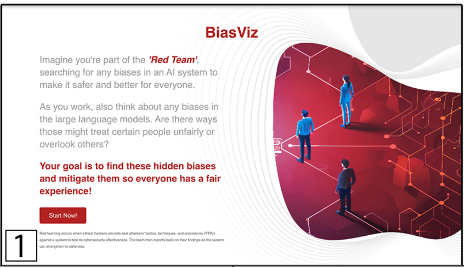
BiasViz is an interactive educational platform designed to help middle school students critically examine bias in large language models (LLMs). Image: Darabipourshiraz et al (2026).
Some researchers are now examining how these skills can be developed from an early age. One example comes from a recent project focused on middle school students and AI bias.
In the article entitled “BiasViz: A Project-Based, Narrative-Centered Learning Tool for Engaging Middle School Students in Critical Thinking about AI Biases,” Hasti Darabipourshiraz, from Northwestern University, and co-authors present an interactive educational platform designed to help middle school students critically examine bias in large language models (LLMs). Conducted with students aged 11–14 from a rural public school, the study combined project-based learning and narrative-centered learning to engage students in identifying, testing, visualizing, and reflecting on AI bias.
Using a tool called BiasViz, students brainstormed stereotypes, designed prompts, tested GPT-3 outputs, identified biased responses, and visualized patterns, focusing on geographic stereotypes linking rural communities to low-paying or agricultural work. Despite having little prior knowledge of AI, many were able to recognize and explain bias in AI-generated content, particularly when it reflected assumptions about their own communities. Participants also developed a stronger understanding of how bias can emerge from human-generated training data, how it can be tested, and why fairness matters in AI systems. The authors conclude that hands-on investigations of AI bias, especially when connected to students’ lived experiences, can help cultivate the critical skills needed to question, evaluate, and challenge AI-generated information.
Taken together, these studies suggest that the central challenge of the AI era may not be whether humans continue to think, but how they think, and which cognitive skills they continue to cultivate.
The emergence of increasingly capable AI systems has also renewed the discussion about a related question: what exactly should count as intelligence in the first place? Could AI be changing how intelligence itself is understood? What forms of intelligence remain uniquely human?
In an article draft entitled “The Dissolution of IQ in the Age of Artificial Intelligence: Toward a Spherical Model of Innate Human Intelligence” hosted on the preprint server and early-stage research platform SSRN in March 2026, independent researcher Theodore K. McClendon argues that although AI systems increasingly outperform humans in many of the cognitive tasks measured by IQ tests, including memory recall and sequential reasoning, human intelligence extends beyond these abilities to encompass emotion, intuition, imagination, moral judgment, embodiment, and meaning-making.
McClendon believes that while IQ testing was historically used as a gatekeeping tool associated with exclusionary practices, AI may force a broader reassessment of how intelligence is defined and measured, shifting attention toward forms of intelligence that are more difficult to automate, including creativity, ethics, collaboration, and culturally diverse ways of knowing.
AI Literacy: one of the central educational challenges of modern societies
The emerging picture is more nuanced than the claim that AI is simply “making people stupid.” Across the studies, the decisive factor is not the presence of AI itself, but how people choose to use it. When AI becomes a shortcut that replaces reflection, verification, memory, and independent reasoning, researchers increasingly associate it with cognitive offloading, weaker critical engagement, greater vulnerability to misinformation, and the accumulation of what some describe as “cognitive debt.” Yet the same technologies can also support learning, creativity, and higher-order reasoning when used to question assumptions, refine ideas, compare sources, and deepen understanding rather than replace it.
This is why many researchers now view AI literacy as one of the central educational challenges of the AI era. As increasingly capable systems become embedded in schools, workplaces, and everyday life, the challenge is not only teaching people how to use AI, but how to evaluate it, challenge it, and know when not to trust it.
At the same time, if machines continue to outperform humans in tasks such as memory retrieval, pattern recognition, and procedural reasoning, qualities such as judgment, creativity, ethical reasoning, contextual understanding, and meaning-making may become even more important. So, if AI can change how we think, which forms of thinking will societies cultivate, reward, and protect?
Craving more information? Check out these recommended TQR articles:
- Thinking in the Age of Machines: Global IQ Decline and the Rise of AI-Assisted Thinking
- Digital Sovereignty Movement Grows as Global Infrastructure Concentrates Under Few Companies
- Nations Adopt Digital IDs for Citizens, While Critics Highlight Privacy Issues
- Cleaning the Mirror: Increasing Concerns Over Data Quality, Distortion, and Decision-Making
Enjoyed this? Help us improve.
Have we made any errors?
Spotted an error or want to contribute your expertise? We’d love to hear from you — reach us at info@thequantumrecord.com. The Quantum Record exists to bring researchers and curious minds together around science and technology that matters.