Before rolling the dice on trillions of dollars of potential future value, think about a tech leader’s history. The effort will prove the enduring value of philosophy. Image: Gerd Altmann, on Pixabay.

By James Myers
The initial public offerings of three technology companies dominate recent news. It’s anticipated that investors will spend trillions of dollars buying shares in three U.S.- based companies: SpaceX (specializing in spaceflight and satellite communications), Anthropic (maker of the Claude AI chatbot), and OpenAI (maker of the ChatGPT AI chatbot). The three companies will continue to be managed, respectively, by Elon Musk, Dario Amodei, and Sam Altman.
There will be an unprecedented amount of money at risk as investors bet on the future technological value of the three companies that have so far been unprofitable. SpaceX publicly revealed financial information for the first time in its June 5, 2026 prospectus (pdf available), showing for 2025 a $4.9 billion loss on revenue of $18.7 billion, and an accumulated deficit of $37 billion over the company’s 23-year history. The public has yet to receive current or historical financial information from Anthropic and OpenAI, although it’s clear from their disclosures of capital injections that the companies are unprofitable and burning significant amounts of cash in the quest to improve their AI technologies.
There are already signs that market demand for AI is weaker than expected, with business adoption lagging as organizational constraints prove incapable of keeping pace with AI capabilities. At a time when technologies change rapidly and often unexpectedly from scientific breakthroughs, innovation, and competition, the future value of today’s tech is increasingly uncertain. Maybe it will be worth multiples of trillions or, if the direction it’s headed in proves unsustainable, it could turn out to be worthless.
Providing perspective on the uncertainties of human action is the unique and invaluable power of philosophy. With such vast sums of money at stake on uncertain technological futures, the monetary value of philosophy has likely never been greater for investors than it is now, in 2026.
Some companies are beginning to awaken to the value of philosophy, with Anthropic and Google’s DeepMind division being particularly prominent in hiring philosophers to help guide product development. While numbers of staff philosophers are undisclosed and remain a very small portion of the workforce, Wired has counted at least 10 on DeepMind’s payroll and 4 at Anthropic. At the same time, university programs in AI ethics are becoming increasingly common, driven by the significant growth forecast for the job market for ethicists and philosophers to help confront mounting concerns about the problematic effects of AI on consumers.
While science drives to establish certainty with the “how” questions of technology, philosophy addresses the thorny uncertainties of the “why” questions. Pursuing scientific certainties is an expensive proposition: in 2025 alone, scientific research and development cost SpaceX $8.6 billion, which was 46% of the company’s revenues. Philosophy’s processes, however, can be conducted at zero cost – although they never yield certainty and frequently unearth more thorny questions. More important than philosophy’s free cost, however, are its supremely powerful capabilities to gauge the future direction of human actions, using only two tools: thought and discussion. Algorithms, which experience neither the human condition nor the requirements of biological living, cannot engage in meaningful dialogue that’s relevant to the human mission.
The long term horizon of a philosophical perspective on human activity is particularly important when algorithmic trading – which responds to events of the moment and competing algorithms – is estimated to comprise as much as three-quarters of stock market trading and 90% of trading in foreign currencies.
Knowing what it’s like to compete, a human trader is naturally better equipped to ask “why” the future share value of one tech company might exceed its competitors. A human trader is naturally motivated to ask whether a particular technology’s future value is sustainable, knowing the unpredictability of human actions and the probability of obsolescence when disruptive technologies emerge. The human trader naturally knows the creative human potential for unleashing disruptive technologies, as history continues to demonstrate. Sometimes, such as when the internet was launched 30 years ago, a technology can disrupt practically everything that we do.
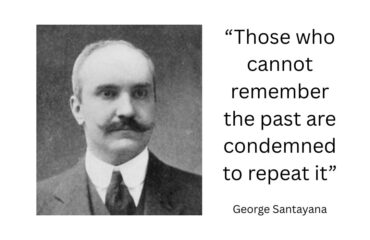
In assessing the future value of human actions, the answer to one the most important philosophical “why” questions of our technological future becomes clearer when we consider the minds of the people who lead the tech companies. In this respect, history provides a crucially important guide for human investors that’s otherwise meaningless to trading algorithms. History’s value was the highlight of our editorial last month, Why Understanding History is Crucial for Responsible Artificial Intelligence Development, where we quoted the wise words of philosopher George Santayana: “Those who cannot remember the past are condemned to repeat it.”
Two of three men leading the companies raising trillions of dollars have given particular cause for concern about their approach to risk and safeguarding the future’s value, not only for investors but more importantly for customers whose money will ultimately provide any return on investment.
Elon Musk takes a chainsaw in hand as a metaphor for his unilateral cuts to public services as head of DOGE.
Last week, headlines pronounced SpaceX founder Elon Musk the world’s first trillionaire, based on the price of the company’s initial public offering. Musk’s political funding, his sometimes erratic and polarizing social media posts, and his controversial role in heading the U.S. president’s now-disbanded Department of Government Efficiency, are problematic for many ordinary folks. But ordinary folks are, ultimately, SpaceX customers. They buy telecommunications services provided by SpaceX satellites and, while they don’t directly purchase the company’s rocket services, the buyers (including governments) ultimately pass the cost on to ordinary folks in the price of their products or in the form of taxes.
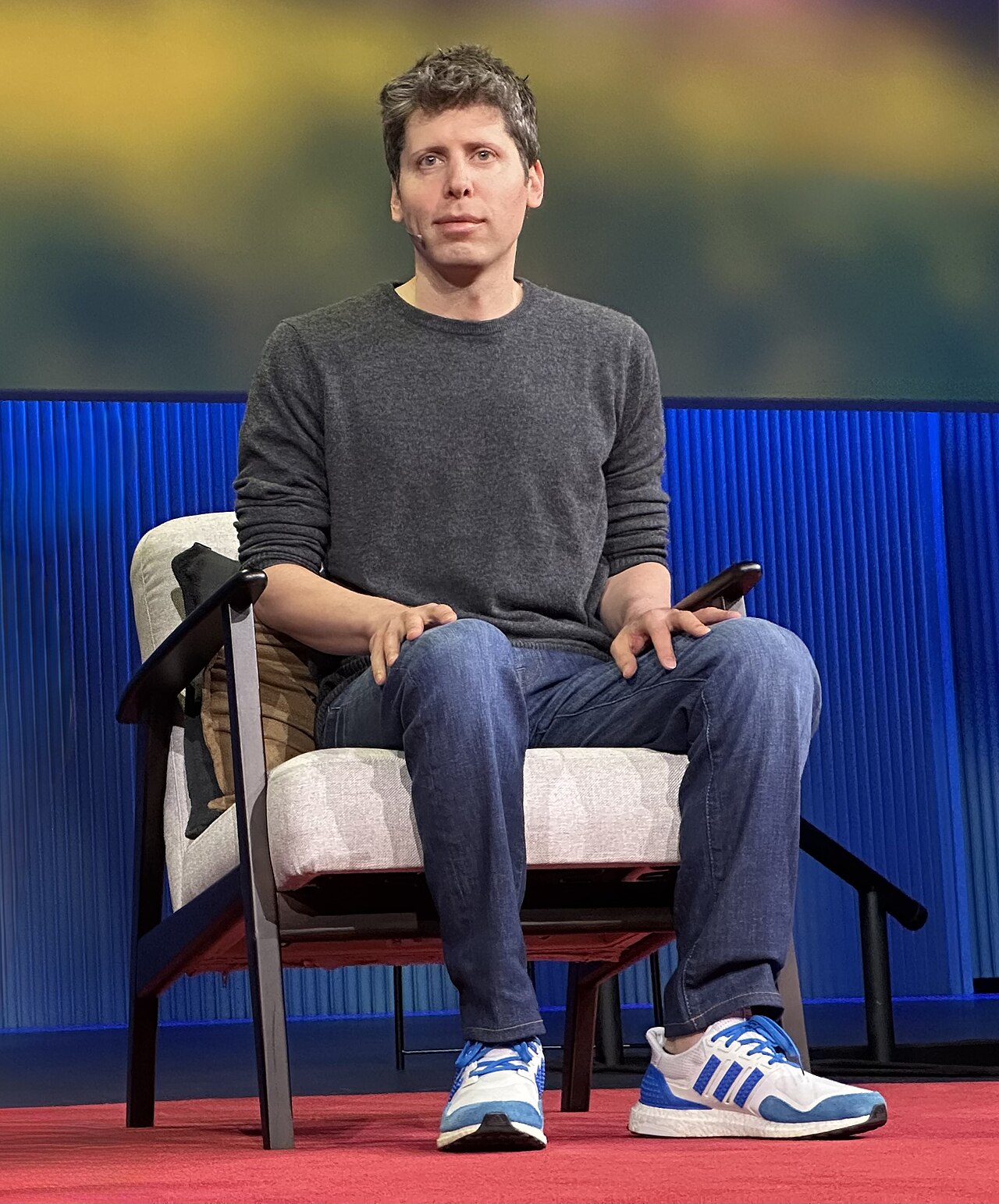
Sam Altman, at TED in 2025. Photo by By Steve Jurvetson, on Wikipedia.
OpenAI CEO Sam Altman’s continuing struggle with sincerity, which led to his termination by the company’s directors in November 2023 (for one week) and the departure of key OpenAI leaders, is well-documented by Karen Hao in Empire of AI and is increasingly evident in contradictory statements about the company’s future direction.
Throughout our four years of publication, The Quantum Record has called into question the contradiction between OpenAI’s mission statement and its profit-driven actions. In early 2024, we highlighted the contradiction of the company’s lack of financial transparency and public accountability with its stated mission (since altered) “to ensure that artificial general intelligence—AI systems that are generally smarter than humans—benefits all of humanity.”
OpenAI has now largely abandoned its founding charter, which declared “Our primary fiduciary duty is to humanity” and required oversight by the board of a non-profit company. The change in course, which included a corporate reorganization that allows the company to give private investors a return on investment multiple of as much as 100 times, was the subject of a recent lawsuit by Elon Musk. Musk was among OpenAI’s founding directors and initial funders.
In an April 2026 article in The New Yorker entitled Sam Altman May Control Our Future – Can He Be Trusted? (subscription required), reporters Ronan Farrow and Andrew Morantz highlight Altman’s change of face toward the importance of product safety. (Farrow’s summary of the article is freely available on Instagram). Years before OpenAI first released ChatGPT in November 2022, Altman had e-mailed to Elon Musk the promise that “safety should be a first-class requirement,” and the company once pledged 20% of its computing power to what it called a “superalignment team.” The team was empowered to prevent powerful AI from falling out of “alignment” with human values, but as the article notes ,the superalignment team was dissolved less than a year from its establishment and received less than 2% of OpenAI’s computing power, which was ungenerously provided on the oldest machines and worst chips.
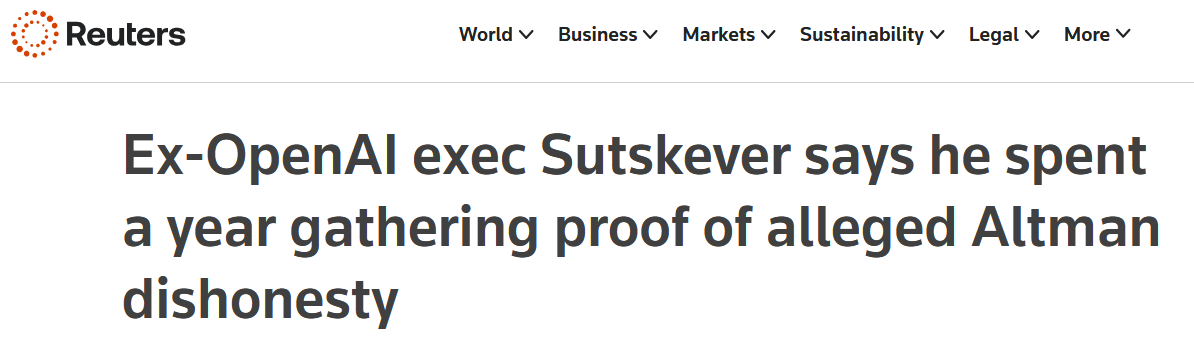
Reuters headline on May 11, 2026. Reuters reported that “During his testimony in a legal fight between OpenAI and Elon Musk, the top AI researcher confirmed he had been thinking about taking action to remove Altman as CEO for at least one year prior to his November 2023 board vote to oust Altman. Sutskever said he had prepared a document gathering evidence of Altman’s dishonesty at the request of OpenAI’s board, and confirmed Altman’s conduct included ‘undermining and pitting executives against one another.’ He said he had discussed removing Altman with then chief technology officer Mira Murati [who has also left OpenAI] after the two discussed Altman’s behavior ‘for a long time’.”
As OpenAI prepares to sell its shares to the public, investors might consider a philosophical approach to understanding the mind and future direction of the company’s leadership evidenced in Sam Altman’s June 8, 2026 post Built to benefit everyone: our plan.
Positioning the company for a public share offering, Altman embeds ten different sales pitches in a half-dozen paragraphs. We set them out here, briefly and with our brief observations, for the benefit of investors or others who are concerned about future value.
The prosperity pitch: “We are optimistic about AI because we believe it can expand human capability and prosperity.”
- TQR’s perspective: In Altman’s view, what do “capability” and “prosperity” mean? The statement begs important questions for future direction, because if the two words refer to economic capabilities and prosperity it can safely be assumed that the intention is for the company to be the primary financial beneficiary. If Altman intends broader social capabilities and prosperity of the human mission, why has he done so little to engage in public discussion to set the stage for capability and prosperity for the general good of the public?
The we-are-careful pitch: “But we are also clear-eyed about the risks.”
- TQR’s perspective: We find this difficult to believe in light of ChatGPT’s continuing hallucinations, after the chatbot encouraged the suicide of 16-year-old Adam Raine, and while the technology continues to drive people into sometimes-dangerous states of AI psychosis. (For more on these problems, refer to our October 2025 feature Emerging Risks of AI Chatbots Include Suicide and “AI Psychosis,” Particularly for Vulnerable Youth.)
The human alignment pitch: “Powerful systems must remain safe, aligned with human intent, and subject to human control.”
- TQR’s perspective: “Human intent” is meaninglessly vague, and the pitch begs the question of how and by whom control will be exercised. At the same time, Altman continues to make public references to the potential dangers of AI, and competitor Anthropic recently embargoed the public release of its latest “Mythos” large language model fearing the AI’s potential misuse for widespread cybersecurity breaches.
The philanthropic pitch: “Our mission at OpenAI is to ensure that AGI benefits all of humanity. That means building systems that help people do more of what they choose, not systems that replace human judgment about what matters.”
- TQR’s perspective: If the company succeeds in developing Artificial General Intelligence (AGI) that can outperform any human, why has it not involved the public and regulators in a broad discussion of what constitutes benefits and how the benefits will be distributed to 8 billion humans, when the company is otherwise the primary economic beneficiary?
The purpose of life pitch: “Entirely automating everything is not the future we want. It would be unfulfilling, and it would be dangerous.”
- TQR’s perspective: Further to our comments above on the human alignment problem, why has Altman not involved the public and regulators in discussions on how to ensure that the dangers of widespread automation do not come to pass?
The human involvement pitch: “AI should help people pursue their goals, not become untethered from them. As AI systems become more capable, the human role becomes more important: setting direction, making tradeoffs, applying judgment, and bringing values, taste, care, and responsibility to the work.”
- TQR’s perspective: Why has OpenAI done so little to provide financial and governance transparency for potential human investors? How many humans other than Altman will determine what constitutes human “values, taste, care, and responsibility”?
The purpose of life pitch, again: “A key long-term role for people will be deciding what is worth doing.”
- TQR’s perspective: There are 8 billion humans presently alive, and 8 billion different perspectives on “what is worth doing” in life. Sam Altman and his company are certainly not equipped to define and set the technological parameters to address my purpose of life questions, much less the purpose-of-life issues of 8 billion of my fellow humans.
The philosophy-has-no-part-in-progress pitch: “We believe that AI doing AI research will become the determining factor of the pace of progress within the next few years. That matters because alignment is itself a hard research problem. To make fast and deep progress, our researchers will need AI systems that can help test ideas, find mistakes, explore alternatives, and iterate alongside us.”
- TQR’s perspective: In the long term, this may prove the most dangerous of the sales pitches because it assumes no role for either philosophers or technology consumers in the crucial question of what future “progress” will look like. The pitch treats the thorny alignment problem as if it has a ready-made solution waiting for researchers to discover, whereas misalignment among human values has always been a challenge and will in all probability forever be a feature of the human condition, because our condition is not predictable like an algorithm.
The corporate responsibility pitch: “But faster technical progress makes human judgment and public coordination more important, not less. The future should be shaped by people, institutions, and societies, not only by the companies building the most capable systems.”
- TQR’s perspective: Given the perspectives we have provided to this point, we find irony in the platitudes of this statement.
The let’s-figure-out-the-future-later pitch: “As frontier AI development continues, we expect national and global coordination to become more important. We have long believed there should ultimately be an international organization that helps coordinate leading AI efforts to reduce catastrophic risk. Cooperation and shared safety standards are an important part of the path forward, especially because the incentives around commercial and national competition are hard to escape. One goal of such an organization should be to make it possible for the world to take coordinated action, including slowing frontier development when needed, so societal resilience, safety, and alignment can keep pace.”
- TQR’s perspective: Here too we find irony, together with lack of self-awareness and historical perspective from the leader of a company who acknowledges the hard-to-escape “incentives around commercial and national competition.” The facts that (1) this pitch is made so soon after Musk’s lawsuit over OpenAI’s reorganization that largely abandoned its charter guarantee of public benefit, for the benefit of private investors who might now receive returns of as much as 10,000%, and (2) no serious action has been taken to implement workable mechanisms for controlling the acknowledged potential for “catastrophic risk,” demonstrate separately and together the hollowness of this pitch.
Altman’s figure-out-the-future-later pitch is particularly concerning, given the public damage that has already occurred from AI-powered chatbot technology and its rapid pace of technological development without meaningful regulatory oversight.
It is wrong to expect “national and global coordination to become more important,” because national and global coordination are already of the utmost importance, given the risks that even Altman acknowledges.
Doing so little now to establish mechanisms now that could prevent serious future harms, and believing that coordination will arise in the future to fix past damages – after somehow overcoming the acknowledged incentives of commercial and national competition – can be seen as foolhardy. When only time will tell, how much are you willing to wager that it will all work out for the better as the sales pitch wants us to believe?
In staking large bets on a company, investors reduce risk by considering the future course implied by the history of the company’s leadership. The value of the future will always be uncertain for investors, and the money they put at risk is a bet on future outcomes. Applying a philosophical perspective on the future course of human interactions among tech leaders, consumers, and regulators could easily turn out to be worth more than trillion$ in fleeting tech value.