
Image: Pixabay
By James Myers
In January, a former software engineer at Elon Musk’s xAI revealed that the company has introduced AI agents called “human emulators” as part of its workforce.
According to the former employee, Sulaiman Ghori, the emulators appear on company organization charts together with human employees and interact with the live workers. Emulators are programmed to follow the same steps that humans perform in a work task, either to replace the human worker or to increase production without having to employ more humans.
Ghori related the example of a human worker at xAi who managed a project with the help of 20 emulators that operated in parallel. In the company’s internal tests of the technology, Ghori indicated that workers were unaware they were interacting with an algorithm and, when invited by the emulator to “come to my desk” for help, the humans were surprised to discover that “there’s nothing there.” The outcome of the tests demonstrates how readily the emulators can replace human workers.
xAi aims to create and market a workforce of a million emulators operating simultaneously, with the promise of slashing human jobs and costs by as much as 99% for the company’s clients.
Emulators can operate 24 hours a day, three times more than an average human worker, making them especially attractive for companies to amplify productivity at a significantly lower cost than human labour. “If a human can do it on a screen, we can do it better,” the company promises. Fees for use of the emulators will contribute to the profit of xAi and its owner, the world’s wealthiest human.
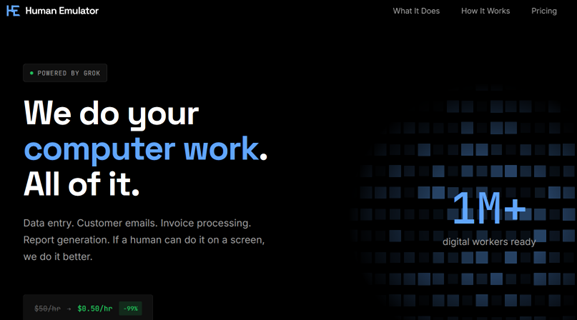
Homepage of xAI-sponsored website humanemulator.co, which promises better than human results at an hourly cost of only 50 cents, a 99% reduction from the $50 hourly wage that a human would otherwise be paid to do the work. “If a human can do it on a screen, we can do it better,” the company promises.
xAi promotes human emulators not only for their capacity to conceive, code, test, and deploy software but also their ability for “back-office automation” and to take over corporate finance work with “Tax prep, accounting, audits with perfect accuracy and complete audit trails.”
The emulators will require significant computing power, and Ghori stated that one option under consideration by xAi is to pay millions of Tesla owners for use of computers in their vehicles when they’re idle. In addition to controlling xAi, Elon Musk is the CEO of Tesla, which recently promised to award him with company shares worth up to $1,000,000,000,000 (one trillion dollars) if Tesla meets specific future targets.
Before he left xAi, software engineer Sulaiman Ghori told the Relentless podcast about the use of human emulators at xAi. He also provides a rare inside view of the internal processes at xAi.
When asked about the biggest errors in tests of the emulators, Ghori stated that process steps are sometimes missed because they weren’t included in the algorithm’s instructions. The omitted steps, he said, were ones that human operators take for granted and perform so routinely that they failed to make the procedures explicit in the programming. On the flip side, Ghori indicated that in some tests for tasks they weren’t trained on the emulators performed “flawlessly,” a pleasing result that wasn’t expected.
How will displaced humans earn a living when they’re replaced by emulators?
Replacement by AI and automation is a significant concern of many workers, especially younger people whose entry-level or early-career jobs are likely easiest to automate first.
In November 2025, the Stanford University Institute for Human-Centered AI released a study entitled Canaries in the Coal Mine? Six Facts about the Recent Employment Effects of Artificial Intelligence using data from the largest payroll software provider in the U.S. The data indicated that “since the widespread adoption of generative AI, early-career workers (ages 22-25) in the most AI-exposed occupations have experienced a 13 percent relative decline in employment even after controlling for firm-level shocks.” By contrast, employment was stable for more experienced workers in the same fields or in jobs like nursing that are less easily automated.
Adjusting for alternative explanations by excluding technology-related firms and occupations more susceptible to remote work, the researchers found that “employment declines are concentrated in occupations where AI is more likely to automate, rather than augment, human labor.” They focused on six indicators that “provide early, large-scale evidence consistent with the hypothesis that the AI revolution is beginning to have a significant and disproportionate impact on entry-level workers in the American labor market.”
 Last August, Reuters and Ipsos conducted a six-day poll of 4,446 U.S. adults in which 71% expressed concern that AI will be “putting too many people out of work permanently.” Two-thirds of the respondents agreed with the statement that “AI will have uncontrollable consequences.”
Last month, a survey by U.K. recruiting firm Randstad of 27,000 employees in 1,225 organizations and 35 countries revealed that 27% of workers in the U.K. are concerned their jobs might be replaced by AI in the next five years. Most concerned were workers in the gen-z generation born between 1997 and 2012.
Last August, the World Economic Forum’s report Why AI is replacing some jobs faster than others highlighted the areas in which AI is having the greatest effect on job losses. “Software development is getting hammered,” the report noted, as three-quarters of developers now use AI assistants. “Customer support is another sitting duck,” the authors predicted, and finance is an industry in which algorithmic trading – which now accounts for about 70% of volume in US equity markets – is likely to continue propelling AI-related job losses.
How do we prepare for a world in which AI takes over a wide range of jobs and millions become unemployed?
Around the world, governments are unprepared for the scale of the social and economic upheaval that would follow mass unemployment as AI replaces human workers. Also unprepared are the businesses that would lay off so many workers, because ultimately their customers are humans who need to earn money to buy their products. An initial increase in profits and efficiency could easily turn out to be the peak of a very steep decline in future economic fortunes for both the businesses and their unemployed workers.
As legislators lag with proactive measures, the issues are drawing the attention of economists. In a press conference last September, the chair of the U.S. Federal Reserve noted (pdf available) that “You see people who are sort of more at the margins – so kids coming out of college and younger people, minorities – are having a hard time finding jobs. The overall job-finding rate is very, very low. However, the layoff rate is also very low. So you’ve got a low – a low-firing, low-hiring environment.”
In the meantime, the major proponents of AI and automation are failing to consider what a world with huge numbers of unemployed people will look like. An AI promoter consistently in the global spotlight is Elon Musk, who told Blackrock CEO Larry Fink in a discussion last month at the World Economic Forum annual meeting at Davos that, “The goal of my companies is to maximize the future of civilization.”
Musk was, however, unable to explain maximization in any sense other than endless amounts of material goods and satisfaction of material desires. “My prediction, in the benign scenario of the future,” he told Fink, “is that we’ll actually make so many robots and AI that they’ll actually saturate all human needs. You won’t be able to even think of something to ask the robot for, at a certain point. There will be such an abundance of goods and services. My prediction is there will be more robots than people.”
Fink responded with the question, “How do you then have human purpose in that scenario?”
After a momentary pause, Musk replied, “Nothing’s perfect, you know,” and then he struggled to assemble a rationale for how a world full of robots and abundance but workers with no jobs and no capital would give purpose to human existence.
There remains no answer to Fink’s question, as important as it is to the philosophy of the human emulator technology that Musk and others are building for rapid deployment. Is the goal of human existence simply material satisfaction, or do qualities like community, love, creativity, and discovery – on which no price can be placed – play a crucial role in human purpose and drive?
Emulating industrial production is quite different from replicating a fulfilling human experience. Will the effects of xAI’s technology, and others like it, be limited to emulating humans and driving economic activity, as the company claims or, as Fink asked, will the technology rob us of purpose as it makes many humans obsolete and unemployed?
Craving more information? Check out these recommended TQR articles:
- Mind Reading Technology Connects Brains to Machines
- Where Do I End and Where Does the Machine Begin?
- AI and the Human Brain: From Mind-Reading AI to a Simulated Conversation with Einstein
- Restoring Hope: AI Breakthroughs Transform Lives of Paralyzed Individuals
- The Most Intimate Data: Accessing Another Human’s Thoughts
We would appreciate your feedback on The Quantum Record and similar content.
Have we made any errors?
Please contact us at info@thequantumrecord.com so we can learn more and correct any unintended publication errors. Additionally, if you are an expert on this subject and would like to contribute to future content, please contact us. Our goal is to engage an ever-growing community of researchers to communicate and reflect on scientific and technological developments worldwide in plain language.