

Image by Gerd Altmann, on Pixabay.
By James Myers
Transferring, or teleporting, a quantum state from one point in space to another is an exceedingly difficult task, especially when the quantum source at each location is different. This is why the recent success in wirelessly teleporting a quantum state over 270 metres between two different quantum sources is a breakthrough for the potential development of a global quantum internet.
A quantum is the smallest bit of energy in the universe that can be either the cause or effect of a change in physical mass, and a quantum state is a unit of information about a particular quantum configuration.
Using quantum properties, either for experimentation or for the rapidly emerging technology of quantum computing, requires a source for the quantum that is being used, and in the case of the breakthrough teleportation the source was light. Specifically, the scientists used two particles of light – a light particle is called a photon – and each of their two photons came from a different light source. Up to that point, teleportation of a quantum state had succeeded only when the quantum source at both locations was the same.
Teleportation is the instantaneous transfer of quantum information from one location to another without physically moving the quantum object such as a photon. The process exploits the quantum mechanical process of entanglement, which is not yet fully understood. Entanglement is the connection of one quantum and another quantum, such that the two quanta are in exactly the same informational state in spite of the sometimes-galactic distance in space that physically separates them. Unlike the existing internet, where information exists in a single state at any one time, a quantum internet would require the ability to maintain entangled information for processing multiple states simultaneously.
Originally derived from science fiction (recall the transporter beam in the Star Trek series), the word teleportation is used to describe the connection of photons and other quantum informational units through space because the connection happens instantaneously. Teleportation was a science fiction method for transporting living beings and other objects through space without the passage of even the tiniest fraction of a second of time that would change the state of the atoms in transit. Quantum teleportation can be thought of as the zero-time transmission of quantum information, achieved through entanglement.
Although zero-time transmission in a quantum internet will enable far greater amounts of data to process in parallel between many machines at a capacity far exceeding today’s best supercomputers, quantum states are very fragile. Quantum entanglement is extremely susceptible to disconnection, a problem called “decoherence,” from heat, electromagnetism, and other environmental factors known as “noise.” Moreover, for still-unknown reasons, a quantum state is destroyed by the act of observation with even a single look or measurement, a problem called the quantum “observer effect.”
Overcoming these challenges is the key to establishing a global network capable of transmitting quantum information between computers and sensing devices, allowing them to combine their massive processing potential and multiply their capabilities exponentially.
The record-breaking 270-metre quantum teleportation was achieved with a new protocol for synchronizing quantum states from separate sources.
For teleportation of quantum information to occur, three quantum information bits – called qubits – are required. Initially, two people in separate locations (physicists often refer to them as “Alice” and “Bob”) share a pair of entangled qubits, each party holding one of the pair. When a third qubit with an unknown state is prepared for teleportation from one end of the pair to the other, it interacts first with the entangled qubit at the sender’s location through a special kind of joint measurement, and then it collapses into a new state that is the same as the state of the entangled qubit pair. The third qubit is effectively synchronized, or harmonized, with the entangled pair without affecting either of them.
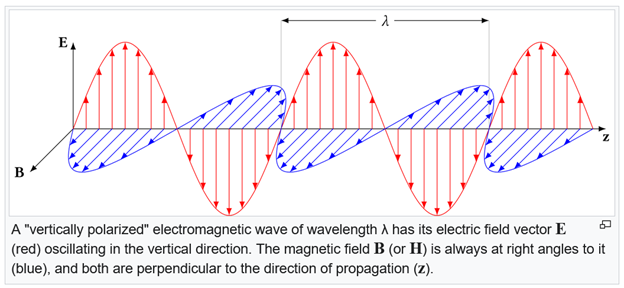
Polarization of the electromagnetic wave is illustrated in this image, showing that the electric part of the wave, in red, is always at right-angles (90 degrees) to the wave’s magnetic part, in blue. Any oscillation in either half of the wave will have a right-angled reflection in the other half. Image: Francois~frwiki, on Wikipedia.
The quantum observer effect prevents direct measurement of any of the three qubits, therefore measurement is made of their state of polarization. A change or oscillation of energy between the entangled pair causes the harmonized third qubit to polarize, meaning that it flips its orientation at right-angles to the two qubits. The effects of the polarization can be measured with no need for direct measurement of the qubits, thereby preserving their state that would otherwise be destroyed by the observer effect.
Overcoming the challenge of harmonizing and polarizing photons from different sources requires absolute precision to prevent any harmonic defects. For this reason, Professors Klaus Jöns, of Paderborn University in the German city of Ostwestfalen-Lippe, and Rinaldo Trotta, of Sapienza University in Rome, have for nearly a decade researched the use a special type of photon source to achieve teleportation between photons that come from different sources. Employing a source called quantum dots, the scientists created a new teleportation protocol to synchronize photons from different sources over a record distance of 270 metres. “Alice” and “Bob” no longer need to have qubits from the same source.
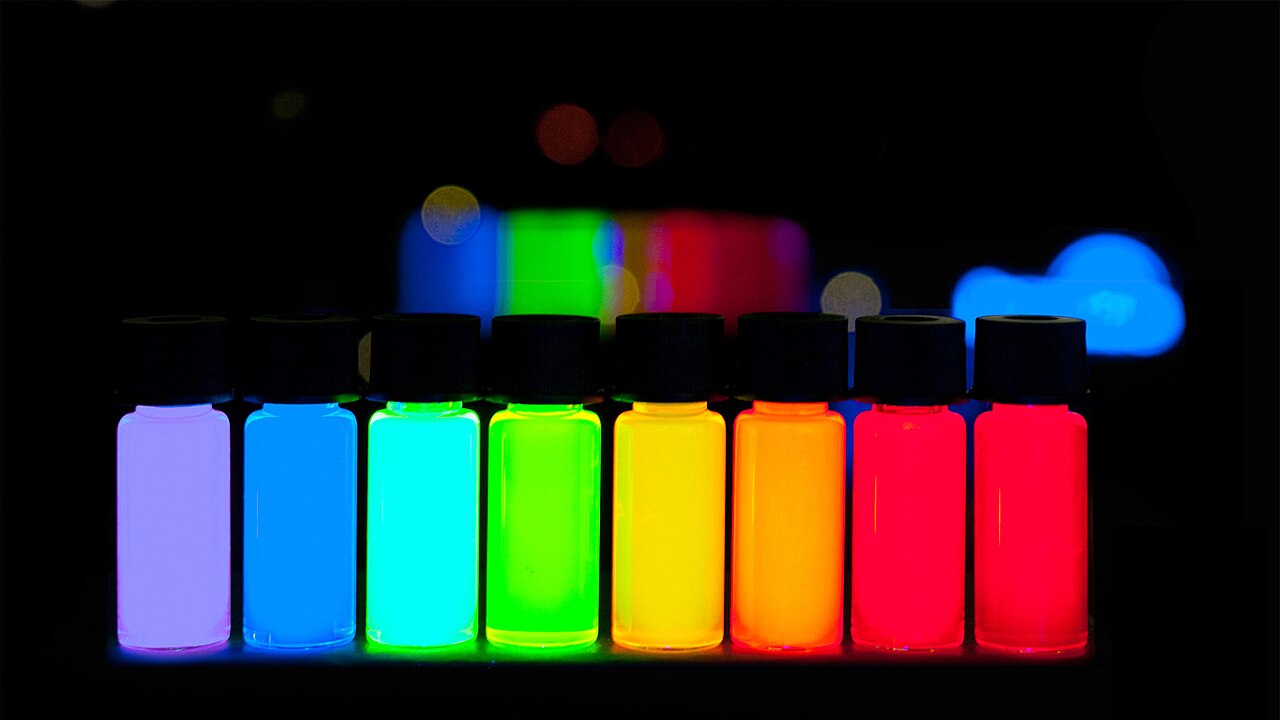
Tiny quantum dot particles emit light at different wavelengths, and therefore colours, based on their size, not on the number of electrons. Image by Antipoff, on Wikipedia
Quantum dots, whose discoverers earned the Nobel Prize in Chemistry in 2023, are not individual quanta. As photon sources, quantum dots are particles so tiny that their chemical properties are determined not by the number of their electrons, as is the case with chemical elements, but instead by their size, which determines the colours of the quantum dots. Quantum colour can be thought of as the equivalent of electrical frequencies, which exist at a larger scale where differences in frequencies are perceived as colour. (For more on quantum dots, and their potential to harvest solar energy, see The Quantum Record’s article From Silicon to Perovskite: A Power Boost for the Next Generation of Solar Energy).
The experiment that demonstrated the teleportation breakthrough over 270 metres between two buildings at Sapienza University was published in the journal Nature Communications in November 2025 in an open-access article entitled Quantum teleportation with dissimilar quantum dots over a hybrid quantum network.
The scientists used GPS technology to assist with synchronization, ultra-fast single-photon detectors for spatial positioning, and stabilization systems to compensate for turbulence in the surrounding atmosphere. The fidelity, or accuracy, of the teleported quantum state reached between 81%-83%, which the researchers describe as “above the classical limit by more than 10 standard deviations.” The high fidelity rate, they explain, “opens a new route to implement solid-state based quantum relays and builds the foundation for practical quantum networks.”
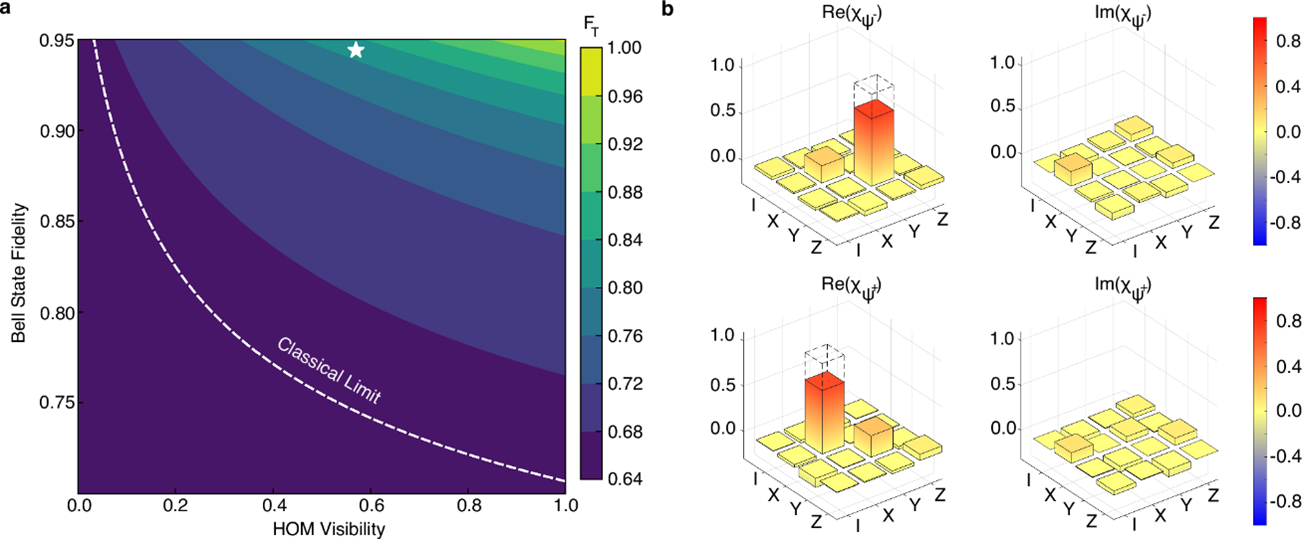
The graph on the left side of this image shows, with the white line, the decrease in teleportation fidelity using earlier “classical” protocols. At the top, the white star indicates the expected fidelity rate with the researchers’ theoretical model. The authors placed the four matrix depictions on the right side to demonstrate the experimental process, the complexities of which they describe in detail. Images from Quantum teleportation with dissimilar quantum dots over a hybrid quantum network in Nature Communications.
The authors state that in a global quantum network, relays and repeaters will be required for transferring and boosting signals that lose fidelity over long distances, similar to the way that present-day electrical and fibre-optic networks need devices to switch and amplify transmissions. The processes for quantum relays and repeaters are, however, more complex since it is not possible to measure and copy quantum information. Furthermore, overcoming the particular fragility of quantum states requires the addition of other “stringent requirements” for the photon sources, including a high production rate, precise tunability of their wavelengths, and a “near-unity” degree of entanglement.
For two decades, quantum dots have been investigated as photon sources that could meet the strict limitations and produce a consistent output when other light sources are prone to fidelity loss as brightness increases. The advantage of quantum dots is their production of photons that are dissimilar and can therefore act as relays because of their differences, while they remain synchronized. With their production consistency and high brightness, quantum dots are also especially compatible with quantum memory.
Using state of the art procedures and equipment to control their quantum dots, Professors Jöns and Trotta were able to produce a high-fidelity connection from one end of the Sapienza University campus to the other. They report that while a single teleportation event achieved between 81%-83% fidelity, about 11% of the total teleportation events that they created produced a high average fidelity rate of 78%-80%. This achievement indicates good prospects for further research to increase the overall average fidelity to the level required by a global quantum internet, and the authors suggest several techniques under development that could prove to be especially helpful.
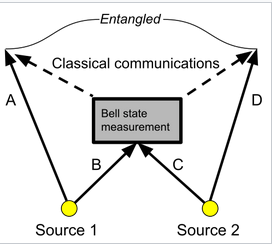
Illustration of entanglement swapping where initially particles (A,B) and (C,D) are in separately entangled pairs but subsequently A becomes entangled with D after a special process known as a Bell state measurement is applied to particles B and C. Image by johnjbarton on Wikipedia.
Professor Jöns stated that, “The experiment impressively demonstrates that quantum light sources based on semiconductor quantum dots could serve as a key technology for future quantum communication networks. Successful quantum teleportation between two independent quantum emitters represents a vital step towards scalable quantum relays and thus the practical implementation of a quantum internet.”
The researchers’ next step toward a quantum internet is to build a quantum relay that allows for “entanglement swapping” between quantum dots. The process of entanglement swapping, which is a form of quantum teleportation, begins with two pairs of entangled particles. If the particles in one entangled pair are labelled A and B and the particles in the other entangled pair are labelled C and D, entanglement swapping occurs after a specific type of measurement is performed on particles B and C. The observer effect of that measurement causes particles A and D to become entangled. The entanglement of A and B has, therefore, been swapped to an entanglement of A and D.
Advancing research for higher fidelity rates, entanglement swapping, and other necessities for relays in a quantum internet will require the continued cooperation of many experts. The recent achievement in record-distance quantum teleportation included collaboration with other universities and research centres. The quantum dots were precision-engineered at Johannes Kepler University in Linz, Austria, and tiny resonators were manufactured at the University of Würtzburg, in Germany.
The teleportation breakthrough was achieved as other important milestones for a versatile and affordable quantum internet were reached.
At nearly the same time that Professors Jöns and Trotta announced their results, another research team at the University of Stuttgart and Saarland University in Saarbrücken, German reported success in quantum teleportation using a different process that compensates for frequency differences between photons. Although their method produced a much shorter 10 metre teleportation in a wired connection and lower accuracy of about 70%, further refinements could provide significant scale and accuracy.
The research study’s co-author Dr. Peter Michler claimed that with the use of quantum frequency converters, “For the first time worldwide, we have succeeded in transferring quantum information among photons originating from two different quantum dots.” It remains to be determined whether combining different methods, like those that use quantum frequency converters and others like the quantum dot protocol of Professors Jöns and Trotta, could further enhance the possibility of a quantum internet.
The quantum internet is moving quickly from theory to practicality.
Another key for creating a quantum internet is affordability. In February, Deutsche Telekom announced success in quantum teleportation with an average accuracy of 90% over 30 kilometres of the company’s fibreoptic cables in Berlin, alongside regular internet traffic and using commercially available hardware. The German telecommunications giant hailed the results, achieved in collaboration with quantum networking company Qunnect, as a “major milestone towards real-world quantum networking.” Especially important was that the teleportation occurred at a wavelength of 795 nanometres, which is “essential for many platforms such as neutral-atom quantum computers, atomic clocks, and various quantum sensors, paving the path for connecting such systems to the telecom infrastructure for the future quantum internet.”

Image by Gerd Altmann, on Pixabay.
Continued research collaboration on methods to produce consistently high fidelity rates over great distances in large numbers of quantum teleportation events could deliver the benefits of quantum networking much sooner than imagined only months earlier. Cooperation between many centres of knowledge in Europe and elsewhere, and potentially combining different approaches, could soon make it possible to connect powerful quantum computers and highly sensitive quantum sensors in many locations.
While some applications for a quantum network are being planned or are under development, the exponentially magnified speed and accuracy of many networked quantum devices operating in parallel will likely result in significant applications well beyond our imaginations today.
When human history demonstrates how unexpectedly transformative a technology can prove to be, like the current internet that was introduced with limited expectations in the mid-1990s, the question could soon be how to prevent harmful applications and support quantum internet uses that are globally beneficial.
Craving more information? Check out these recommended TQR articles:
- Thinking in the Age of Machines: Global IQ Decline and the Rise of AI-Assisted Thinking
- Cleaning the Mirror: Increasing Concerns Over Data Quality, Distortion, and Decision-Making
- Quantum Governance: Can the Gap Between Technological Acceleration and Risk Management be Closed?
- Low Earth Orbit Is Becoming Structurally Unstable with Megaconstellations, Space Debris, and Governance Issues
- Digital Sovereignty: Cutting Dependence on Dominant Tech Companies
Enjoyed this? Help us improve.
Have we made any errors?
Spotted an error or want to contribute your expertise? We’d love to hear from you — reach us at info@thequantumrecord.com. The Quantum Record exists to bring researchers and curious minds together around science and technology that matters.