

Image: VADIM Arziukov, on Vecteezy.
By Mariana Meneses
Digital platforms increasingly compete to capture and commercialize human attention. Researchers have described this process through concepts such as “human fracking” and “attention capitalism,” examining how attention has become a source of profit and a growing social, philosophical, and legal concern.
What is ‘Human Fracking’?
Princeton University History of Science Program Professor D. Graham Burnett and co-authors, in an article in The Guardian entitled “How can we defend ourselves from the new plague of ‘human fracking’?” (Jan. 2026), describe “human fracking” as the large-scale extraction and commercialization of human attention by digital platforms. Smartphones and networked screens have become deeply embedded in everyday life, while technology companies use addictive content and disruptive design to keep people looking at their devices. The authors compare this process to petroleum fracking because both treat a vital resource as something to be aggressively extracted for profit.
The authors write, “Just as petroleum frackers pump high-pressure, high-volume detergents into the ground to force a little monetisable black gold to the surface, human frackers pump high-pressure, high-volume detergent into our faces (in the form of endless streams of addictive slop and maximally disruptive user-generated content), to force a slurry of human attention to the surface, where they can collect it, and take it to market.”
The stakes, Burnett and co-authors argue, extend beyond distraction or excessive screen time. Attention is presented as the basis of our ability to think, care, relate to others, and engage with the world. Turning it into a commodity therefore affects human agency, psychological well-being, relationships, and democratic deliberation. The central problem is not technology itself, but an economic system that treats consciousness as unclaimed territory available for exploitation.
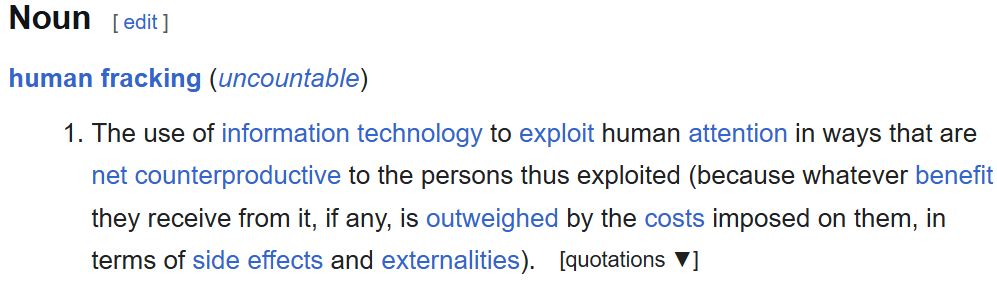
Definition of the noun ‘human fracking’. Image: Print screen from Wiktionary.
The authors argue that regulation remains fragmented and is frequently obstructed by powerful corporate interests. They also reject responses that place responsibility entirely on individuals or rely only on medication to help people tolerate harmful conditions. Instead, they call for a collective political movement that asserts human attention as something that should remain under individual control and use to shape their own lives and societies they value.
Drawing parallels with environmentalism, antismoking campaigns, and labor movements, the article argues that new forms of exploitation can generate new forms of resistance. The authors see growing concern about digital platforms across political and cultural divisions as evidence that such a turning point may already be emerging. Like earlier social movements, attention activism could transform a previously private concern into a shared political issue.
The authors sign the article as a coalition called Friends of Attention, which defines this activism through coalition-building, study, and the creation of sanctuary spaces where non-commercial forms of attention can be protected and cultivated. They argue that genuine attention includes love, curiosity, care, reflection, and daydreaming rather than merely clicking and scrolling. As digital systems turn people into what the authors call “Homo attentus”, they propose “attensity”, the freedom and capacity to direct attention collectively, as the foundation of a new politics resisting technological exploitation.
In a November 2025 article published in the journal Metaphilosophy entitled “Human Attention as a Philosophical Problem: The Question, and the Nature of Questions”, Professor Burnett had already examined the deeper philosophical assumptions behind the commodification of attention. He reviews competing definitions, including Christopher Mole’s idea of attention as “cognitive unison,” Jesse Prinz and Carolyn Dicey Jennings’s process-based accounts, and Wayne Wu’s description of attention as the selection of information for a task or action. Burnett argues that this task-oriented understanding reflects the history of twentieth-century research, much of which was shaped by military and industrial demands such as radar monitoring, target tracking, machinery operation, and rapid responses to signals.
This history matters because it helped establish attention as something measurable, operational, and therefore available for extraction within the attention economy. Burnett turns to philosophers such as Bernard Stiegler and Hans-Georg Gadamer to recover a richer conception of attention grounded in waiting, openness, interpretation, and the possibility of encountering people and the world without predetermined outcomes. This philosophical account strengthens the critique of “human fracking”: protecting attention also requires resisting definitions that reduce it to performance, reaction, or a resource that can be quantified and sold.
Earlier still, in March 2025, Burnett and Eve Mitchell published “Attention sanctuaries: Social practice guidelines and emergent strategies in attention activism”, in the journal Annals of the New York Academy of Sciences. In it, the authors argue that concerns raised by teachers, therapists, caregivers, and parents deserve serious attention even while scientific consensus about the precise harms of networked screen media remains incomplete. It presents attention activism as a collective response to “human fracking,” bringing together research, regulation, education, professional standards, public advocacy, and grassroots organizing.
Its central proposal is the creation of “attention sanctuaries”: spaces and periods of time intentionally organized to protect and cultivate attention. Classrooms, homes, workplaces, libraries, museums, and religious spaces could develop shared guidelines through discussion and consensus, identifying attentional values, examining sources of disruption, and agreeing on practices such as limiting devices or creating more opportunities for reflection, conversation, and play. The authors present these sanctuaries as a constructive complement to regulation and device restrictions, grounded in collective responsibility, education, and solidarity.

Attention, for money. Image: Aman Ansari, on Vecteezy.
What is ‘Attention Capitalism’?
The article “Attention Capitalism: The Law and Political Economy of Attention Markets”, by John M. Newman, Herff Chair of Excellence at the University of Memphis School of Law, was published in the Stanford Law Review vol. 78, in February 2026. Newton argues that the expansion of “attention capitalism”, defined as the exchange of digital products and services for human attention, is neither an inevitable consequence of technology nor the result of neutral market forces.
Attention has become a highly valuable resource: companies acquire it from users, process it through data and targeting systems, and sell access to it to advertisers. According to Newman, U.S. law has actively constructed this market by encouraging attention-extractive business models and concentrating economic and political power in corporations such as Alphabet, Meta, Amazon, and Apple.
The article examines contract, property, privacy, tax, and antitrust law, finding a consistent pattern beneath their apparent contradictions and gaps. Courts frequently enforce platforms’ one-sided terms of service while simultaneously describing services such as YouTube as “free,” even though users provide attention and content in exchange. Property law largely ignores attention despite recognizing other intangible assets, leaving individuals without a general right to exclude companies from acquiring their attention. Privacy decisions have dismissed the additional attention costs created by targeted advertising, while tax law subsidizes extraction by allowing businesses to deduct advertising expenses immediately and generally imposing no sales tax on attention transactions. Antitrust authorities have also treated zero-price digital services as if no market existed, permitting acquisitions and consolidation that strengthened dominant intermediaries.
Newman then develops a broader account of how attention markets operate. Human attention is finite and can be directed deliberately toward a goal or captured involuntarily by external stimuli. Information overload, prolonged decision-making, and repeated demands on attention can deplete cognitive capacity, making people more reliant on automated judgments, more susceptible to persuasion, and less capable of self-control or careful evaluation.

Check out our July article The AI Education Gap: Students Are Adopting, While Schools Are Adapting. Image: Towfiqu ahamed barbhuiya, on Vecteezy.
Digital firms exploit these limits through features such as infinite scrolling, autoplay, intermittent notifications, and variable rewards. Attention extraction may therefore alter not only a particular transaction but also people’s later decisions, social behavior, and capacity to act autonomously.
Because attention is produced by people but consumed by advertisers, Newman argues that digital platforms should be understood less as neutral “brokers” connecting two willing groups and more as resource-extractive intermediaries. Competition does not necessarily solve the resulting problems: firms competing more intensely for a scarce supply of attention may adopt increasingly intrusive or addictive techniques. The article also rejects individual “attention rights” as the main foundation for reform. Attention has both personal and collective dimensions, and a private-rights framework could further commodify it, overlook civic responsibilities, and produce irresolvable conflicts between attention rights and corporate claims to freedom of speech.
Newton proposes restructuring attention markets through coordinated legal reform.
This would include stronger antitrust enforcement, recognition of attentional harms under privacy law, and an end to courts’ special treatment of supposedly “free” platforms. Newman also recommends limits on advertising loads and manipulative features, taxes on corporate attention sales or consumption, reduced tax deductions for advertising, and restrictions on mandatory arbitration, liability waivers, and other abusive contractual terms.
His central conclusion is that the existing attention economy is legally constructed and therefore politically changeable: law could channel less human activity into commercial attention markets, reduce the influence of dominant firms, and redistribute power tothe users, audiences, artists, and creators who supply attention and content.
Should Digital Platforms Extract, Commercialize, and Shape Human Attention?
Human fracking describes a system in which digital platforms capture and commercialize human attention. Burnett and his collaborators frame this as a social and political problem, while Newman shows how laws and market structures have helped attention-based business models expand. Their analyses suggest that the current system is neither natural nor inevitable. Regulation, legal reform, public education, collective action, and attention sanctuaries could help reduce commercial pressure on attention and give individuals and communities greater control over how it is used.
Craving more information? Check out these recommended TQR articles:
- Thinking in the Age of Machines: Global IQ Decline and the Rise of AI-Assisted Thinking
- Digital Sovereignty: Cutting Dependence on Dominant Tech Companies
- Surge in AI Ethics Program Enrolment Sets the Stage for Students and Teachers to Succeed in the Battle for Responsible AI Development
- The Geopolitics of AI: Can AI Become a Force for Global Equity?
- The AI Education Gap: Students Are Adopting, While Schools Are Adapting
Enjoyed this? Help us improve.
Have we made any errors?
Spotted an error or want to contribute your expertise? We’d love to hear from you — reach us at info@thequantumrecord.com. The Quantum Record exists to bring researchers and curious minds together around science and technology that matters.