
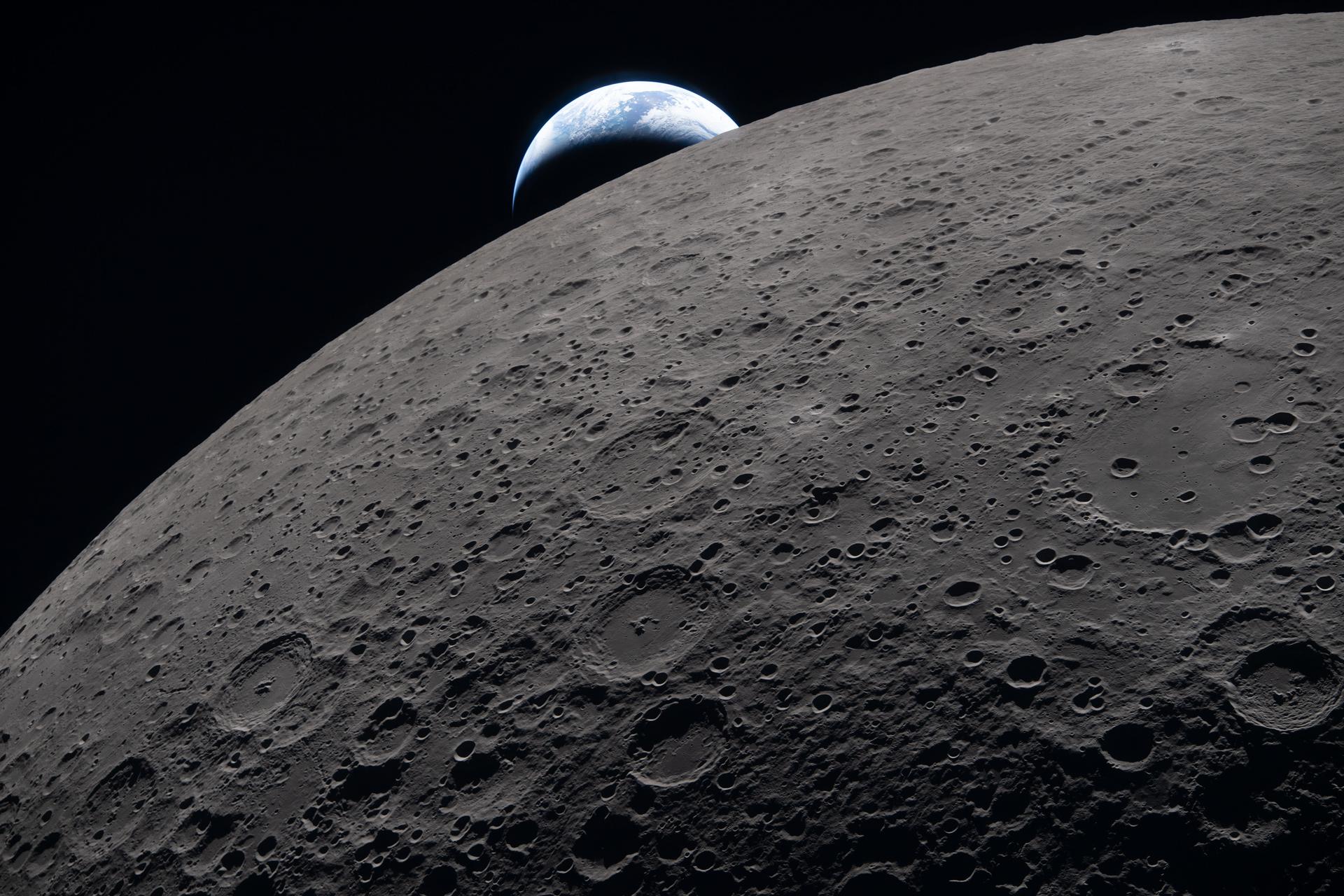
Image: NASA/Artemis II
By Mariana Meneses
The United States is reorganizing its return to the Moon. Plans for a space station in lunar orbit are being set aside in favor of building a permanent base on the lunar surface, with NASA committing tens of billions of dollars over the coming years to support sustained operations there. Missions like Artemis II, NASA’s first crewed flight to lunar orbit in more than half a century that was completed between April 1-10 (PDT), are beginning to test the systems that would make such a presence possible.
This shift reflects more than a change in engineering priorities. Establishing a Moon base requires a different kind of ambition for continuous habitation, reliable infrastructure, and the ability to operate far from Earth with limited supplies. It also brings new constraints into focus, from the Moon’s extreme environment to the challenge of developing systems that can function over long durations and at increasing scale.
Behind these technical efforts lies a broader set of motivations and tensions. The Moon is being positioned as a strategicplatform for future exploration, a potential source of resources, and a point of competition between major powers. At the same time, questions remain about how such activities fit within existing international law, and who will define the rules governing Moon access and use.
As U.S. plans for a lunar base take shape, the Moon is emerging not only as a destination, but as a site where the next phase of human activity in space will be negotiated.
As The Guardian reported, NASA intends to cancel its Lunar Gateway space station planned for lunar orbit, and redirect the Artemis program toward building a $20 billion base on the Moon’s surface over the next seven years. The shift was announced by NASA Administrator Jared Isaacman at NASA Headquarters, where he outlined early changes to the agency’s lunar strategy. Isaacman described the move as a decision to “pause Gateway in its current form” and focus on infrastructure that supports sustained operations on the lunar surface.
The Lunar Gateway, under development with contractors including Northrop Grumman and Lanteris Space Systems, was originally intended as a research platform and transfer station for astronauts traveling to the Moon. Repurposing its components for surface use is not simple, involving technical and scheduling challenges, but NASA plans to adapt existing hardware and international partner commitments to support new objectives. Still according to The Guardian, the change is already reshaping billions of dollars in Artemis contracts, with companies scrambling to respond to increased urgency as the United States faces growing competition from China’s planned crewed Moon landing by 2030.
How NASA Will Build The Artemis Moon Base | The Space Race
The policy shift is accompanied by a clearer definition of how the Moon base is expected to be developed and operated. NASA has set out a structured plan for building and sustaining a long-term presence on the lunar surface.
NASA’s current Moon Base plan (pdf), presented during the agency’s March 2026 Ignition event, treats lunar exploration as the gradual establishment of a system for continuous human habitation. The proposal focuses on establishing a sustained human presence in the Moon’s South Pole region through a phased, iterative approach, where capabilities are tested, expanded, and integrated over time, with each stage shaping the next. The plan is organized into three phases that scale both technically and operationally.
The first phase centers on access and validation by improving the reliability of surface missions, establishing accurate knowledge of landing sites, and conducting initial experiments, including the first crewed mission to the base. The second phase introduces infrastructure, with more regular crewed missions, increased payload capacity, and the first elements of a functional surface system. The third phase extends this into continuity, with large-scale payload delivery, site preparation, cargo return capabilities, and the objective of maintaining a continuous human presence on the Moon.
Across these stages, the scale increases significantly, from roughly 4,000 kilograms of payload delivered to the surface in early missions to around 150,000 kilograms in later phases, alongside a steady rise in launch and landing frequency.
NASA frames the challenges ahead in terms of “functional gaps,” “technology gaps,” and “data gaps”, covering capabilities that do not yet exist, technologies that are not yet mature, and knowledge that remains incomplete. These gaps span essential systems such as robotics, communications and navigation, logistics, mobility, habitation, power, and cargo transportation. Many of these capabilities already exist in some form on Earth, but the document emphasizes that they must be matured through flight testing, particularly in early missions, where systems can be validated and refined under real conditions.
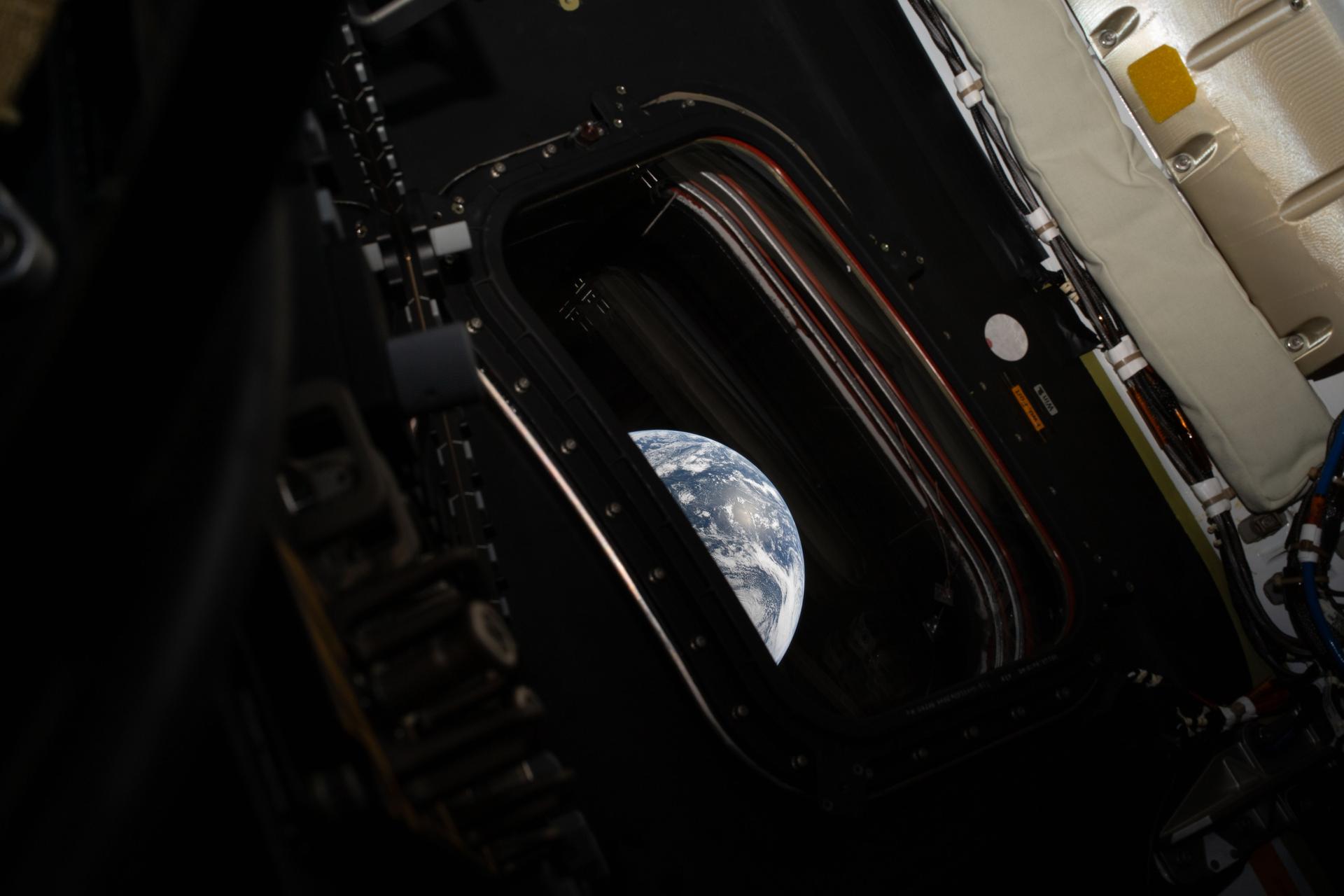
“A view of Earth taken by NASA astronaut and Artemis II commander Reid Wiseman from one of the Orion spacecraft’s four main windows after completing the translunar injection burn on April 2, 2026”. Credit: NASA
The lunar South Pole presents a lighting environment very different from that of the Apollo program landing sites from 1969-1972, with the Sun remaining low on the horizon and casting long shadows. The South Pole limits solar power generation and exposes systems to extended periods of cold and darkness. The terrain adds further constraints, with deep craters and steep slopes that complicate mobility and access to resources. Even fundamental operations depend on solving specific technical problems, including precision landing in low-visibility conditions, managing the interaction between rocket plumes and the lunar surface, and mitigating the effects of abrasive, electrostatic dust on equipment.
The plan emphasizes that the Moon Base will be built through coordinated contributions from government, industry, academia, and international partners, requiring shared standards for power, communications, docking, and other interfaces. Early systems are designed to operate independently, but the architecture evolves toward shared infrastructure in areas such as power, logistics, communications, and navigation, improving efficiency across a broader network. NASA also highlights mechanisms such as the Commercial Lunar Payload Services (CLPS) program and bulk procurement strategies to support industry participation and help establish a sustained lunar marketplace.
The Moon Base is also positioned as a platform for future missions to Mars. Long-duration lunar operations enable the testing of capabilities including autonomous systems, new logistics strategies, and advanced power systems such as nuclear technologies. The program identifies key areas for partnership, ranging from habitation and mobility to cargo delivery, resource mapping, and navigation, capabilities required for continued exploration.
In this context, the Moon serves as an environment for addressing technical and operational challenges before extending human activity further into the solar system.
This plan is being put in practice through recent missions designed to validate the systems required for sustained operations beyond Earth orbit.
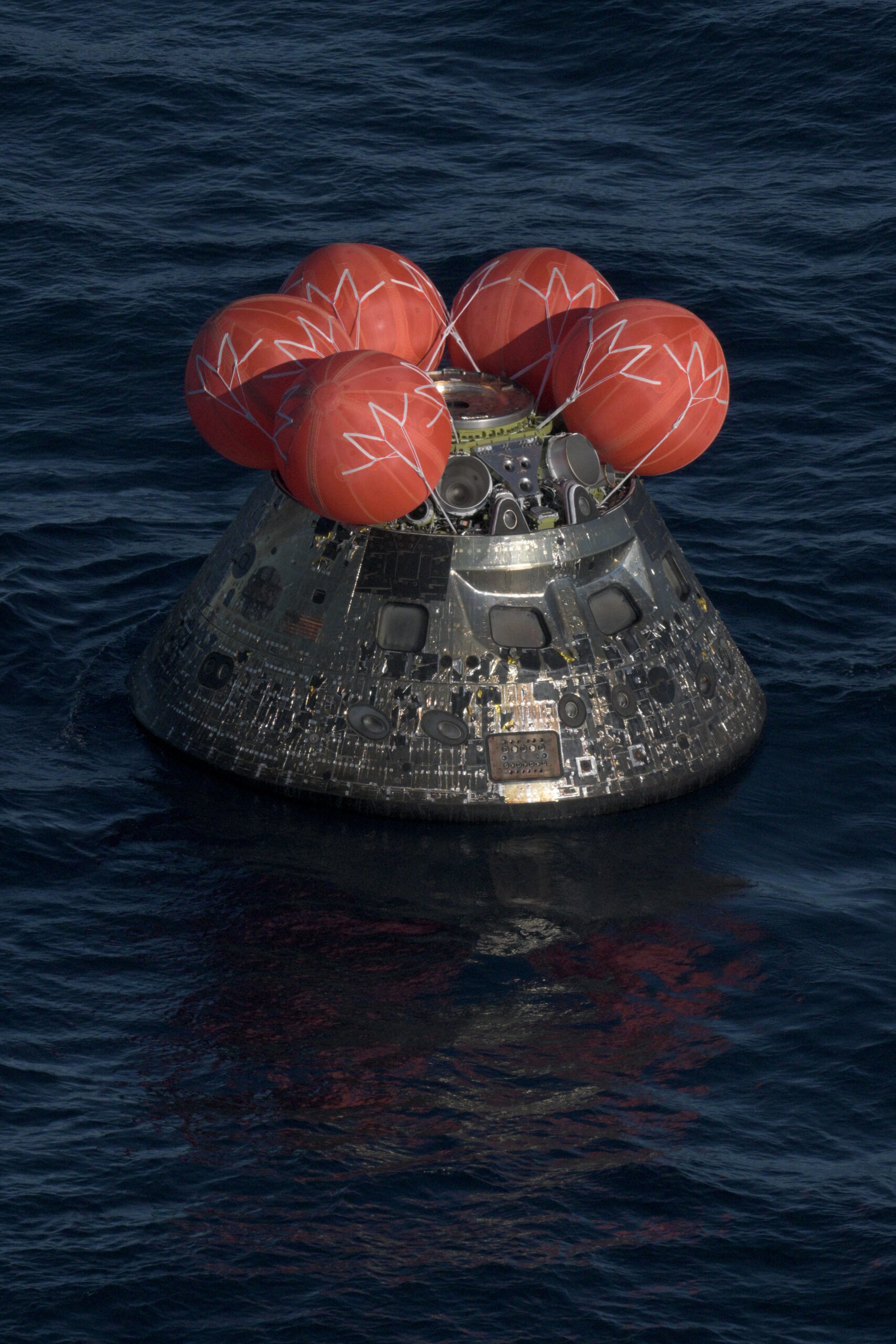
NASA’s Orion spacecraft carrying Artemis crew splashes down in the Pacific Ocean near San Diego, California, April 10, 2026. The Artemis II test flight launched on Wednesday, April 1, from NASA’s Kennedy Space Center in Florida. Credit: NASA/James Blair.
On April 10, 2026 (PDT), NASA’s Artemis II mission returned to Earth, marking the end of the first crewed journey to the Moon in more than fifty years. The Orion spacecraft, carrying NASA astronauts Reid Wiseman, Victor Glover, and Christina Koch, along with Canadian astronaut Jeremy Hansen, completed a 10-day mission that included a lunar flyby and a total distance of 1,117,659 kilometers. At their farthest point, the crew traveled 406,771 kilometers from Earth, surpassing the distance record set by Apollo 13 in 1970. The mission concluded with a successful splashdown in the Pacific Ocean, followed by recovery operations and initial medical evaluations.
Artemis II served as a full test of NASA’s deep space systems, including the Orion spacecraft and Space Launch System (SLS). During the mission, the crew verified life support systems, conducted manual piloting tests, and evaluated key operational procedures such as emergency protocols and crew performance in microgravity. Orion’s service module executed a critical burn to place the spacecraft on a trajectory that brought it within 6,545 kilometers of the lunar surface. The mission also deployed CubeSats, which are a class of standardized miniature satellites and are often called nanosatellites, from international partners and gathered data to support future docking, navigation, and long-duration mission planning.
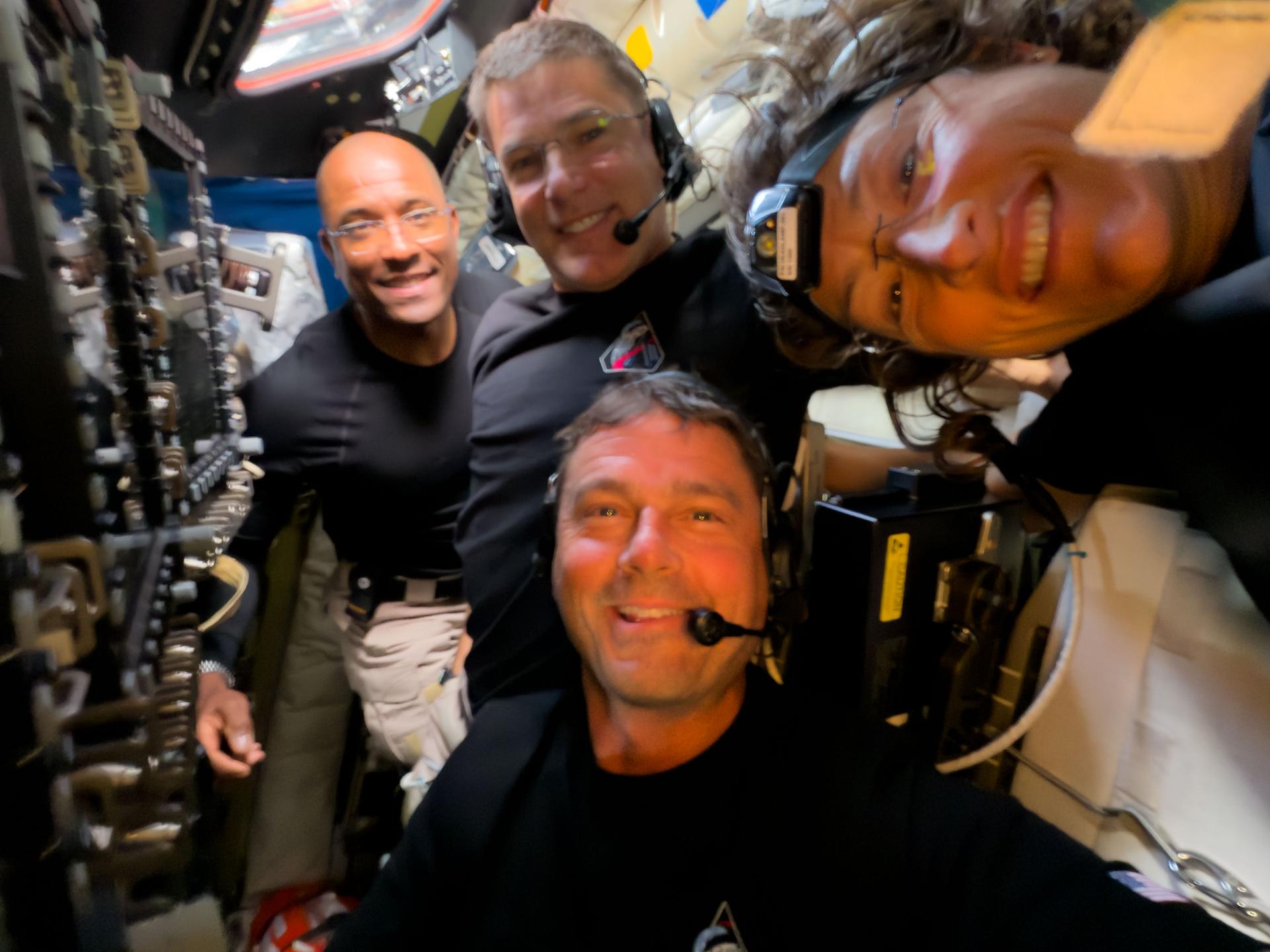
“Lunar Selfie: (April 6, 2026) – Midway through their lunar observation period, the Artemis II crew members – Reid Wiseman, Victor Glover, Christina Koch, and Jeremy Hansen – pause to turn the camera around for a selfie inside the Orion spacecraft”. Credit: NASA.
The crew also conducted scientific observations and experiments relevant to future lunar and Mars missions. These included studies on human health in deep space environments, as well as extensive imaging of the Moon, Earth, and surrounding space, capturing over 7,000 images and documenting surface features under lighting conditions similar to those expected at the lunar South Pole. With Artemis II complete, NASA is preparing for the launch of Artemis III in 2027, which will test integrated operations with lunar landers and support plans to return humans to the Moon, establish a sustained presence, and advance toward future missions to Mars.
Alongside these technical advances, the Artemis program is being framed within a broader strategic context in the United States, emphasizing its long-term implications for national and geopolitical interests.
Clayton Swope is the deputy director of the Aerospace Security Project and a senior fellow in the Defense and Security Department at the Center for Strategic and International Studies in Washington, D.C. Writing a commentary for the Center for Strategic and International Studies (CSIS), Swope argues that the United States’ return to the Moon through NASA’s Artemis program is driven by three main factors: the Moon’s strategic location, its natural resources, and the geopolitical risk of losing leadership in space to China.

Image: Vilkasss, on Pixabay.
Swope emphasizes the Moon’s functional role as infrastructure. Its proximity to Earth makes it an ideal testing ground for sustaining human life in deep space, while also serving as a potential transit hub for missions beyond it. At the same time, the Moon’s resources could reduce the cost and complexity of space operations. Water ice can be converted into fuel, while other materials such as oxygen, hydrogen, metals, rare earth elements, and helium-3 may support both in-situ activity and, potentially, economic exploitation. These resources not only enable exploration but also contribute to the scalability of human activity in space.
Geopolitics reinforces the urgency of this effort. Swope situates Artemis within a renewed competition with China, which plans to land astronauts on the Moon by 2030 and develop its own lunar infrastructure. In his view, the Moon is afoundational step in a broader trajectory of human expansion beyond Earth, with the United States positioned as a central actor in shaping that process.
China’s 66 Trillion Dollar Plan For The Moon! | The Space Race
According to Eduardo Baptista, for Reuters, China is advancing its crewed lunar program to put astronauts on the Moon by 2030, supported by rapid progress in testing key systems such as the Lanyue lunar lander, the Long March 10 heavy-lift rocket, crewed spacecraft, spacesuits, and surface vehicles. The program builds on data from a series of robotic missions, including the recovery of lunar samples from the Moon’s far side, and upcoming missions such as Chang’e-7 and Chang’e-8 aimed at further mapping and preparing landing sites.
Beyond the initial landing, China plans to establish a long-term presence through the International Lunar Research Station, a joint initiative with Russia that may include resource utilization and nuclear-powered infrastructure. The project is expected to develop into a broader system by 2045, including an orbital component to support extended operations and future missions to Mars, positioning the Moon as a central platform for sustained exploration and technological development.
An article published in the journal Space Policy, in 2023, Xiaodan Wu, from the Law Faculty at China Central University of Finance and Economics, argues that China’s leadership in the planned International Lunar Research Station (ILRS) collaboration with Russia reflects a shift in its approach to space cooperation, moving from a focus on national independence to the creation of multilateral platforms. The article is entitled “The International Lunar Research Station: China’s New Era of Space Cooperation and Its New Role in the Space Legal Order”.
According to the author, positioned alongside the U.S.-led Artemis program, the ILRS highlights a growing dynamic of simultaneous competition and cooperation among major space powers. This evolution is shaped by the interaction between techno-nationalism, prioritizing domestic capabilities, and external constraints, while also serving China’s broader goal of expanding both hard power (technological capacity) and soft power (international influence).
The article suggests that the coexistence of the ILRS and Artemis is contributing to a new structure in the global space order, where collaboration and rivalry are intertwined. For China, promoting openness and neutrality in its partnerships is seen as key to attracting international participation and addressing limitations in leadership within global cooperation frameworks.
In this respect, the ILRS is not only a technological project but also a strategic tool for influencing the development of international space law, potentially contributing to more decentralized and inclusive governance structures.
These developments are accompanied by growing debate over the legal and governance frameworks that will apply to sustained activity on the Moon, particularly as the emphasis on resources and long-term presence increases.

Image: Vilkasss, on Pixabay.
Georgina Torbet, for The Verge, argues that NASA’s Artemis program is raising legal and geopolitical questions alongside its technical goals, as missions target a return to the lunar surface by 2028 and the establishment of a base by around 2030. This marks a shift from the short-duration Apollo missions toward missions for longer-term habitation. The change introduces new logistical constraints, including reliance on in-situ resource exploitation, and the extraction of local resources such as water ice to sustain operations.
Torbet notes that this strategy introduces a structural tension: resources are needed to support a lunar base, but a base is required to locate and extract those resources. This circular logic sits alongside the practical difficulties of operating in a hostile environment marked by radiation, reduced gravity, and abrasive dust that can damage equipment. NASA has emphasized the potential value of lunar materials, such as water, helium-3, and rare earth elements, sometimes describing the effort as part of a “lunar gold rush.” Yet the actual abundance and accessibility of these resources remain uncertain, complicating the case for long-term habitation.
Thus, the author highlights that the most contentious issues may not be technical, but legal. The Outer Space Treaty establishes that no nation can claim sovereignty over the Moon, yet its application to resource extraction remains disputed. The United States maintains that extracting resources does not constitute appropriation, while many legal experts argue that this interpretation stretches, or bypasses, the treaty’s intent.
Furthermore, the Artemis Accords, drafted by NASA and the U.S. State Department and signed by more than 60 countries, reinforce the U.S. position by allowing resource use and the establishment of “safety zones” around areas of activity. In practice, critics argue, these zones could grant priority access to specific lunar regions, limiting interference from others and creating a form of de facto control without formal ownership comparable to historical land grabs on Earth that were tied to resource access.
Torbet notes how debates fit within a broader geopolitical context, where legal interpretation, international agreements, and technological development are closely intertwined.
Participation in the Artemis program is tied to acceptance of the accords, contributing to a growing alignment with the U.S. framework and shaping legal norms through practice. At the same time, countries such as China, working with partners including Russia, are pursuing parallel efforts that include plans for their own lunar base.
In this context, lunar exploration is not only a scientific or engineering project, but part of a wider competition over access, influence, and the rules that will govern activity beyond Earth, where, as some critics argue, geopolitical positioning may be the primary driver.
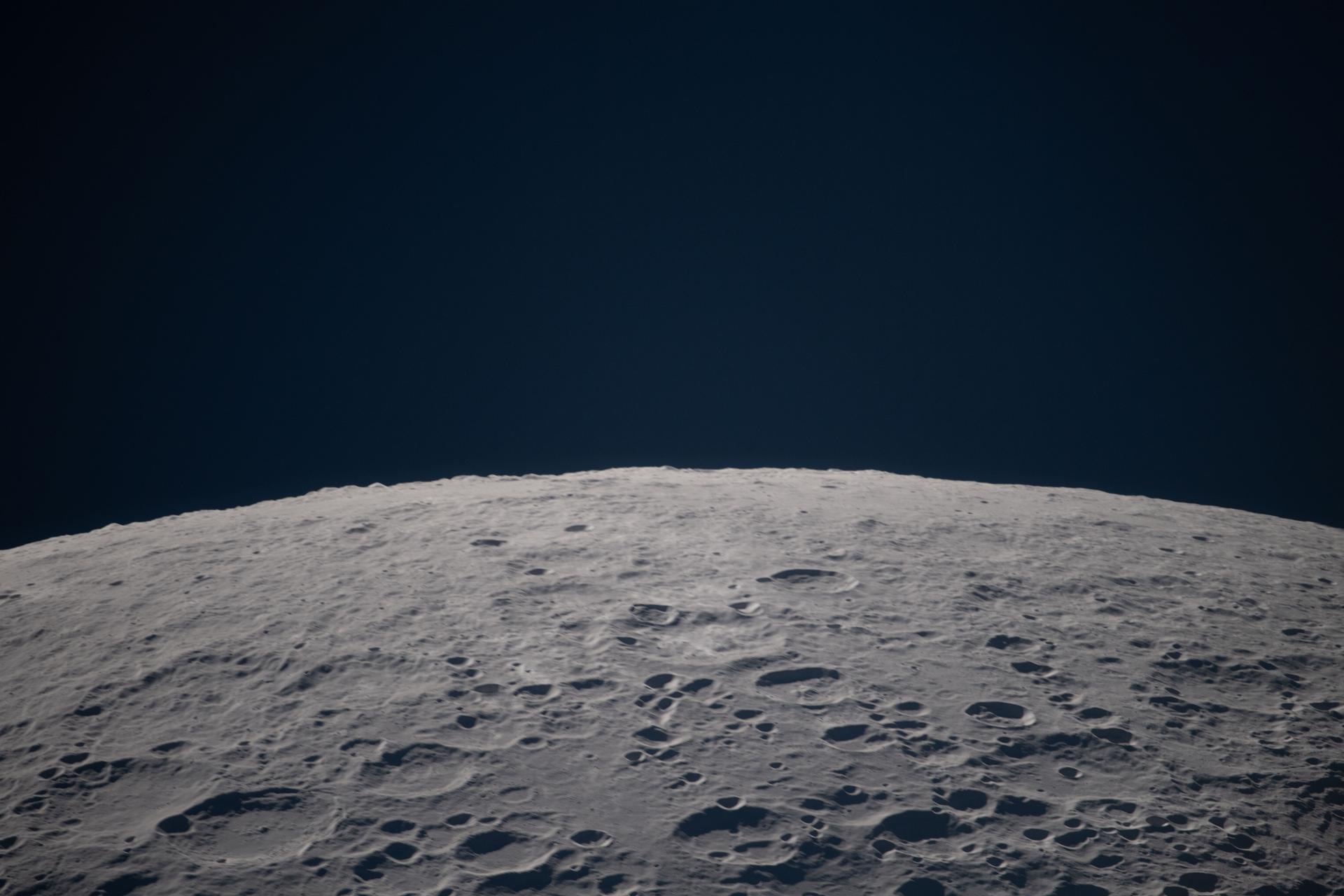
“As the Artemis II crew passes the Moon during an observation period, the lunar landscape sharpens into focus: a terrain scattered with craters and shadows stretching beneath the black expanse of space.” Credit: NASA
The return to the Moon is being organized around sustained presence, infrastructure, and continuous operations. NASA’s shift toward a surface base, its phased development model, and the validation of key systems through Artemis II indicate a program designed to operate at scale over time.
This trajectory is closely tied to geopolitical and international dynamics. Alongside the U.S.-led Artemis program, China’s lunar ambitions and the development of the International Lunar Research Station are shaping a parallel architecture of exploration. The Moon is increasingly treated as a strategic platform and a potential source of resources, while competition and selective cooperation are influencing timelines, partnerships, and priorities.
At the same time, legal frameworks remain unsettled. As resource use, “safety zones,” and competing programs take shape, current interpretations are beginning to define how access and activity will be governed in practice.
Craving more information? Check out these recommended TQR articles:
- Thinking in the Age of Machines: Global IQ Decline and the Rise of AI-Assisted Thinking
- Cleaning the Mirror: Increasing Concerns Over Data Quality, Distortion, and Decision-Making
- Quantum Governance: Can the Gap Between Technological Acceleration and Risk Management be Closed?
- Low Earth Orbit Is Becoming Structurally Unstable with Megaconstellations, Space Debris, and Governance Issues
- Digital Sovereignty: Cutting Dependence on Dominant Tech Companies
Enjoyed this? Help us improve.
Have we made any errors?
Spotted an error or want to contribute your expertise? We’d love to hear from you — reach us at info@thequantumrecord.com. The Quantum Record exists to bring researchers and curious minds together around science and technology that matters.