
How often do you ponder the concept of time? Image: olegtroino584896 — Vecteezy.
By Mariana Meneses
Our ability to measure time with unprecedented precision is changing both what we can learn about the universe and how we decide to organize time in human society.
In October 2026, the General Conference on Weights and Measures (CGPM) adopted Resolution 5, establishing that Coordinated Universal Time (UTC) will become continuous starting on May 20, 2027, effectively ending the practice of adding or subtracting leap seconds to keep atomic time aligned with Earth’s rotation. The decision responds to growing concerns about disruptions to critical infrastructure, including telecommunications, energy distribution, transportation, and digital networks, which increasingly depend on precise time synchronization.
The resolution highlights the particular concern about the introduction of a negative leap second, an adjustment never previously implemented but whose probability of occurring is estimated to reach 30% by 2035. Under the new system, the maximum permitted difference between UTC and astronomical time (UT1) will increase to 3,600 seconds, or one hour, allowing the two timescales to gradually diverge over several centuries. The CGPM also called for continued monitoring of Earth’s rotation and international cooperation to ensure a coordinated transition to the new standard.
Earlier in October, CNN reported on the proposal to eliminate the leap second. Since 1972, 27 leap seconds have been added to compensate for irregularities in Earth’s rotation, but these adjustments have caused disruptions to computer systems, telecommunications, and other critical infrastructure. The debate had become more urgent because Earth’s recent acceleration could eventually require a negative leap second, meaning that one second would be removed from official timekeeping for the first time.
While atomic clocks measure time at a constant rate, Earth’s rotation is irregular, and faster rotation means slightly shorter days, potentially requiring a second to be subtracted to keep the two aligned. Experts warned that a negative leap-second could be particularly disruptive because it has never been implemented before, and some computer systems may not be designed or tested to handle it.
While supporters argued that eliminating leap seconds would improve the reliability of digital systems, critics emphasized the scientific and cultural importance of maintaining a connection between human timekeeping and Earth’s natural cycles.
Today, atomic clocks provide a far more stable reference than Earth’s rotation, allowing scientists to measure extraordinarily small intervals of time.
Ultra-precise clocks are essential for technologies that depend on accurate synchronization, including GPS navigation, financial transactions, and global computer networks. Advanced atomic clocks can detect such extremely small differences in how time passes under different gravitational conditions, that it opens new possibilities for studying Earth’s interior, gravitational waves, and potentially even dark matter.
In October, Science Alert and others reported on how researchers at the National University of Singapore succeeded in the development of an atomic clock that sets a new record for accuracy, surpassing previous achievements by approximately four times. With results published in Nature, the team’s clock uses lutetium, an element whose atomic structure makes it particularly resistant to disturbances from temperature, magnetic fields, and motion. According to the researchers, its accuracy is equivalent to losing or gaining less than one second over 300 billion years. To verify its performance, the team built two identical clocks and compared their measurements over 200 hours, finding differences so small that they were effectively zero.
The researchers now aim to miniaturize the laboratory-scale clock into a portable device, taking advantage of lutetium’s ability to operate at room temperature to build commercially available lasers.
“I am confident that what we have now is the most accurate clock in the world,” says physicist Murray Barrett. “In the future, I just don’t see how this clock can be beat.” – Science Alert
As Joanna Thompson reported in Live Science, this breakthrough could also contribute to a future redefinition of the second, which has been based on the frequency of radiation associated with cesium-133 atoms since the 1960s. The International Bureau of Weights and Measures (BIPM) is expected to redefine the second in 2030 using more advanced atomic clock technology, and lutetium could become a candidate for this new standard. The researchers also developed a technique called hyperfine averaging to reduce the influence of environmental disturbances on the clock’s measurements. Beyond establishing more precise measurement standards, the technology could help scientists investigate whether fundamental physical constants, such as the gravitational constant, remain unchanged over time.
While researchers continue to improve the accuracy of atomic clocks, another approach to timekeeping is emerging, one that uses the atomic nucleus itself as a reference.
In October, Matteo Rini writing for Physics Magazine reported that two independent research teams, one in Europe and another in China, had developed the first operating nuclear clocks. Unlike atomic clocks, which measure time using transitions between electron energy levels, nuclear clocks rely on transitions within the atomic nucleus, potentially making them less sensitive to external disturbances. Both teams used thorium-229, an isotope whose unusually low nuclear transition energy allows scientists to control it with specialized lasers.
Although these first nuclear clocks remain less stable than the best atomic clocks, they represent a major advance in precision timekeeping. Their potential extends beyond measuring time: the European team has already used its clock to search for ultralight dark matter by comparing its frequency with that of an atomic clock. While no evidence of dark matter was detected, the experiment established competitive constraints on some theoretical models. Researchers believe that further improvements could make nuclear clocks valuable tools for testing fundamental physics and investigating phenomena not explained by the Standard Model of particles.
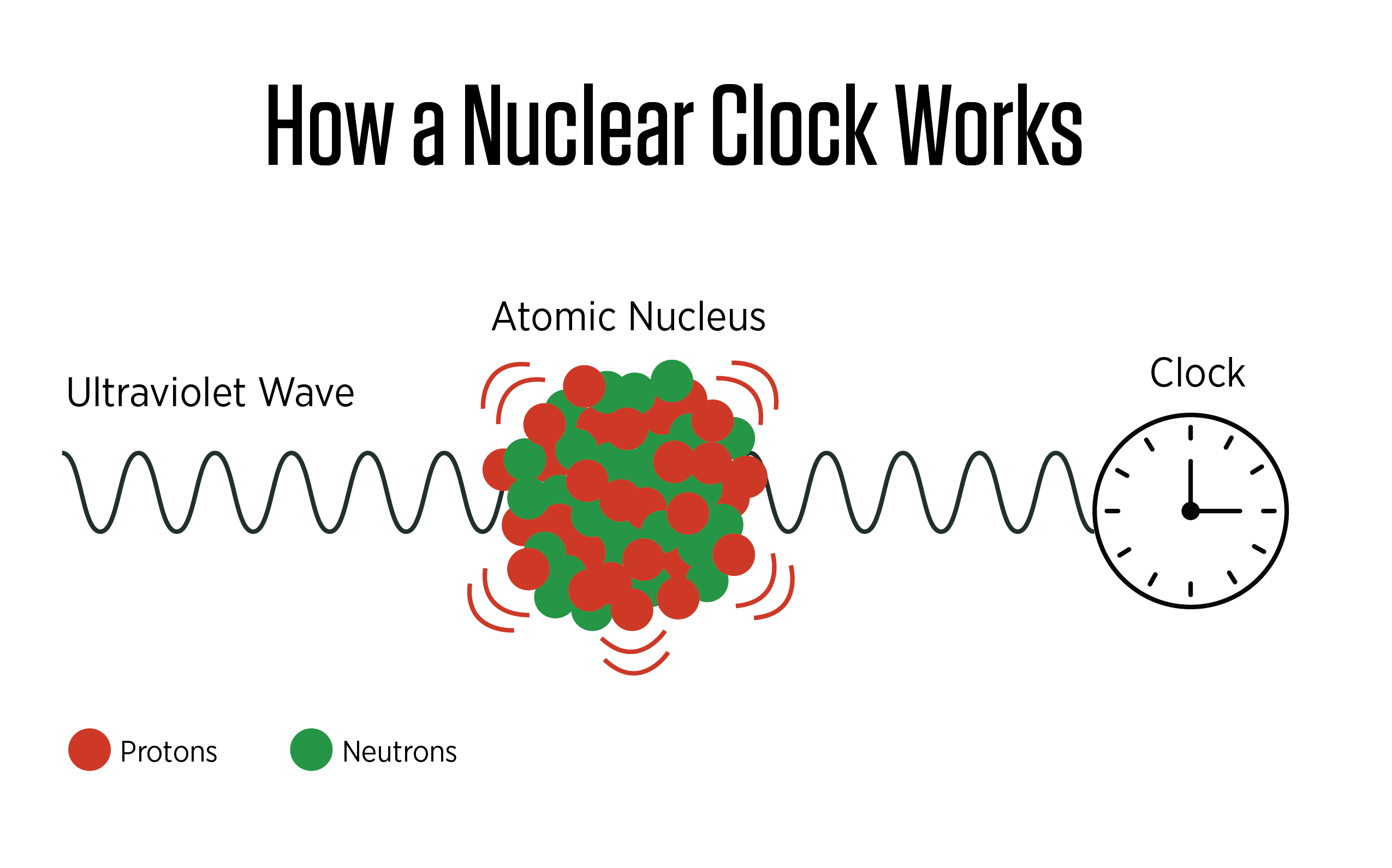
“A nuclear clock works by using ultraviolet light to excite the nucleus of a special atom, like thorium-229. When the light hits the nucleus at just the right frequency, it causes the nucleus to change its energy state, like flipping a tiny switch. By precisely measuring and counting these energy flips, scientists can create an extremely accurate timekeeping device.” Credit: N. Hanacek/NIST.
The developments in atomic and nuclear clocks illustrate how advances in measurement technology can expand scientific knowledge and create new possibilities for investigating the physical universe. At the same time, the decision to eliminate leap seconds illustrates how the ability to measure time with greater accuracy does not, by itself, determine how time should be standardized or which relationships between natural phenomena and human conventions should be preserved. These are, in the end, human choices.
And these choices reflect particular ways of understanding time. In a November episode of Brazilian journal Folha de São Paulo’s daily podcast, Indigenous leader Elber Anacé explained:
“We perceive the natural passage of time through the flight of birds, through the movement of ants. We can observe all of this. And with climate change, things become somewhat disrupted, because we use these animal movements as reference points for farming: when is the best time to plant, when the rains are approaching, which phase of the moon is best. We have these traditional technologies that we created and developed by observing nature. And then things change. Climate change completely disrupts the activities of farmers and fishers alike. Fish spawning cycles have also been disrupted.” – (Freely translated.)
Anacé’s words are a reminder that time is not only something we measure, but something we live by. As we decide to let official time drift away from Earth’s rotation, and as human-driven climate change pulls nature’s rhythms out of step, perhaps the question is not only how precisely we can measure time, but how the ways we choose to measure it shape our understanding of the world we inhabit.
Craving more information? Check out these TQR articles
- Reverse Transcriptase: The Viral Enzyme Helping Scientists Rewrite DNA
- Is the Link Between Prediction Markets and Social Media Algorithms Another Form of Human Fracking?
- Engineered for Overconsumption: The Health Risks and Regulatory Battle Over Ultra-Processed Foods
- Personal Data Tracking Is Everywhere: Why Privacy Protection Remains Uneven
- The AI Boom is Drawing Public Opposition to Data Center Expansion and Burden on Local Resources
Enjoyed this? Help us improve.
Have we made any errors?
Spotted an error or want to contribute your expertise? We’d love to hear from you — reach us at info@thequantumrecord.com. The Quantum Record exists to bring researchers and curious minds together around science and technology that matters.