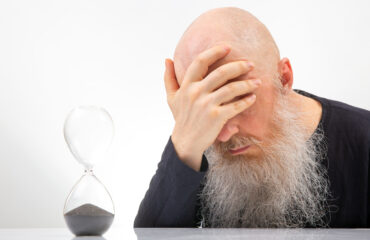

“In geometry, a figure is chiral (and said to have chirality) if it is not identical to its mirror image, or, more precisely, if it cannot be mapped to its mirror image by rotations and translations alone. An object that is not chiral is said to be achiral.” (Chiralpedia) Image: Ananyaporn Sandee, Vecteezy.
By Mariana Meneses
Henri Kagan and Kenso Soai are the winners of the 2026 Nobel Prize in Chemistry. Their discoveries in molecular asymmetry helped to solve a long-standing mystery in the chemistry that’s essential to living organisms.
Molecular asymmetry occurs when a molecule cannot be divided into identical mirror-image halves and cannot be superimposed onto its mirror image. When a molecule is asymmetric, it is typically chiral (like a pair of human hands, which are mirror images of each other but cannot be aligned thumb-to-thumb). Asymmetric chiral molecules exist in two distinct spatial forms called enantiomers: left-handed and right-handed isomers, which are molecules that share the exact same number and types of atoms, but have different arrangements of those atoms or different bonds. Because their structures differ, enantiomers often exhibit distinct physical, chemical, or biological properties.
Peter Somfai, Professor of Organic Chemistry at Lund University and Member of the Nobel Committee for Chemistry, explained in the Scientific Background for the prize, that, in nature, biological molecules are homochiral: amino acids and sugars occur in only one of their two mirror-image forms, and life as we know it depends on this uniformity. However, in the lab, chemical reactions that have nothing to favor one mirror-image form over the other generally produce both forms in roughly equal amounts, a 50/50 mixture. So how could one “hand” come to dominate in nature?
“This year’s prize shows one possibility how we create a single mirror image from nothing. And that’s probably the most fundamental question in life, because somehow that must have happened four billion years ago when life was created. And now we mimicked it in a lab today, not the way it happened four billion years ago – it’s important to stress – but we have for the first time mimicked it.” – Peter Somfai, Member of the Nobel Committee for Chemistry.
A basic puzzle about life
Still according to Somfai, in the Scientific Background of the prize, in 1953, physicist Frederick Frank proposed a mathematical (i.e., theoretical) answer: a molecule that catalyzes its own production while suppressing its mirror image could turn a tiny imbalance into near-total dominance. Frank’s model stood on three assumptions: autocatalysis, enantioselective catalysis, and mutual antagonism between the two forms. The first two were already known, but no one had shown the third (or the combination of all three) until Kagan and Soai.
In chemistry, catalysis refers to the process of speeding up a reaction with a substance, the catalyst, which takes part in the reaction without being consumed. In autocatalysis, the product of the reaction is its own catalyst: each new molecule is both the result of the reaction and a tool that speeds up the making of more copies of itself. However, copying alone does not guarantee that one mirror-image form will dominate. Even a catalyst made entirely of left-handed molecules may produce some right-handed ones.
Somfai explains by asking us to suppose that the first reaction preserves 90% of the original preference for one form. When the resulting product becomes the catalyst for the next round, that preference falls to 81%, and continues to weaken with each repetition. For Frank’s model to work, a reaction needed a mechanism that would amplify the imbalance between the two forms instead of allowing it to disappear.
In 1986, Kagan provided a crucial piece of this puzzle with the discovery of non-linear effects (NLE) in asymmetric catalysis. Chemists had assumed that a product’s enantiomeric purity scales linearly with the purity of the chiral catalyst. In other words, the proportion of one mirror-image form in the product was expected to increase at the same rate as its proportion in the catalyst. His research in the 80’s showed that this relationship does not always hold when a catalyst contains two or more components that can each exist in left- or right-handed forms. In those cases, “mixed” complexes (one left-handed ligand, one right-handed) can speed up a reaction more or less effectively than catalysts whose components are all the same form (i.e., “pure”).
Kagan’s experiment demonstrated a case when the product came out purer than the catalyst that made it, proving how chirality can be amplified. He also gave a mathematical framework to explain this. NLE have since become a standard diagnostic tool for working out reaction mechanisms. As a notable consequence of Kagan’s research, Somfai mentions that researchers at Merck later used this effect to make a key drug ingredient at 95% purity from a starting material only 70% pure.
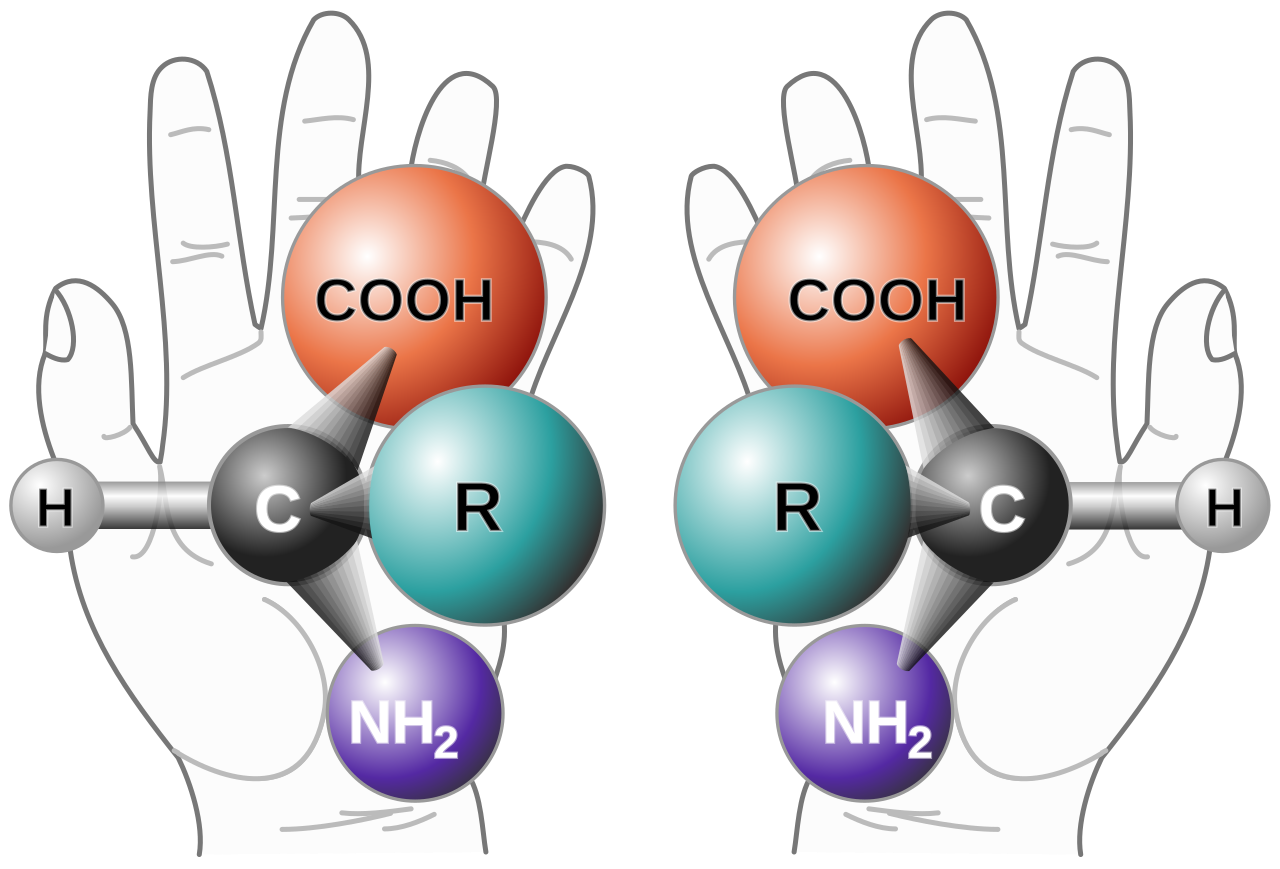
Life on Earth uses left-handed (L-) amino acids to build proteins, with the exception of glycine, which has no handedness. Similarly, DNA and RNA rely on right-handed (D-) sugars: deoxyribose in DNA and ribose in RNA. Image: Wikipedia commons.
Kagan had shown that Frank’s third criterion was chemically possible, and Soai was the one who combined all three. In 1990 Soai found a reaction in which the product catalyzes its own formation: the addition of a dialkylzinc reagent to an aldehyde. This met two of Frank’s criteria, but the purity still dropped with each cycle. In 1995, his group published a version that amplified the imbalance instead, which brought all three criteria together. Over five runs, a catalyst that began with only a 5% excess of one hand was driven to 90%. It was the first laboratory confirmation of Frank’s model. A later variant went from 0.00005% to over 99.5%. Most strikingly, Soai’s group, and independently the chemist Daniel Singleton, later showed that the reaction could break symmetry on its own, starting from ingredients with no handedness at all. Tiny random fluctuations were enough to tip the balance. In 37 trials, 18 favored one hand and 19 the other.
The committee stresses that the discovery doesn’t explain how homochirality arose on the early Earth, since the reaction can’t operate in water, but it proves the principle. The exact mechanism is still disputed. The document concludes that the two discoveries changed how chemists understand the way chirality is generated and amplified, and that they renewed the search for the origins of biological homochirality.
Time to “sink in”
“They have been working within this area for a long time. Henri Kagan, he made his discoveries that is awarded today, in 1986. So, it’s quite some time ago. And Kenso Soai made his discovery in the beginning of the 90’s. So, we had a long time for this to sink in, in the general mind of chemists. Today it’s part of our basic understanding how chemistry functions.” – Peter Somfai, Member of the Nobel Committee for Chemistry.
Kagan and Soai’s breakthroughs took decades to become part of chemistry’s fundamental knowledge. As Nobel Committee member Peter Somfai observed, the scientific community had a long time for these discoveries to “sink in.” The relevance of having time for the gradual process of collective investigation, scrutiny, and understanding is highlighted this year in a moment when AI is dramatically accelerating scientific production. AI offers significant opportunities to advance research, but also many challenges for research institutions. Journal submissions steeply increased following the introduction of ChatGPT, accompanied by declining writing quality and growing pressure on peer review.
In an October TQR article entitled “Fracking Time: The Difference Between Machine Time and Human Time, and Why We Should Be Concerned”, we argued that real understanding happens on a human timescale. People need time to reflect, link cause and effect, and fold new information into what they already know. The 2026 Nobel Prize in Chemistry committee waited decades, until the knowledge had become part of the general mind of chemists and how chemistry is understood, before public recognition. Could this be a testament to the value of human time?
Craving more information? Check out these TQR articles
- Reverse Transcriptase: The Viral Enzyme Helping Scientists Rewrite DNA
- Is the Link Between Prediction Markets and Social Media Algorithms Another Form of Human Fracking?
- Engineered for Overconsumption: The Health Risks and Regulatory Battle Over Ultra-Processed Foods
- Personal Data Tracking Is Everywhere: Why Privacy Protection Remains Uneven
- The AI Boom is Drawing Public Opposition to Data Center Expansion and Burden on Local Resources
Enjoyed this? Help us improve.
Have we made any errors?
Spotted an error or want to contribute your expertise? We’d love to hear from you — reach us at info@thequantumrecord.com. The Quantum Record exists to bring researchers and curious minds together around science and technology that matters.