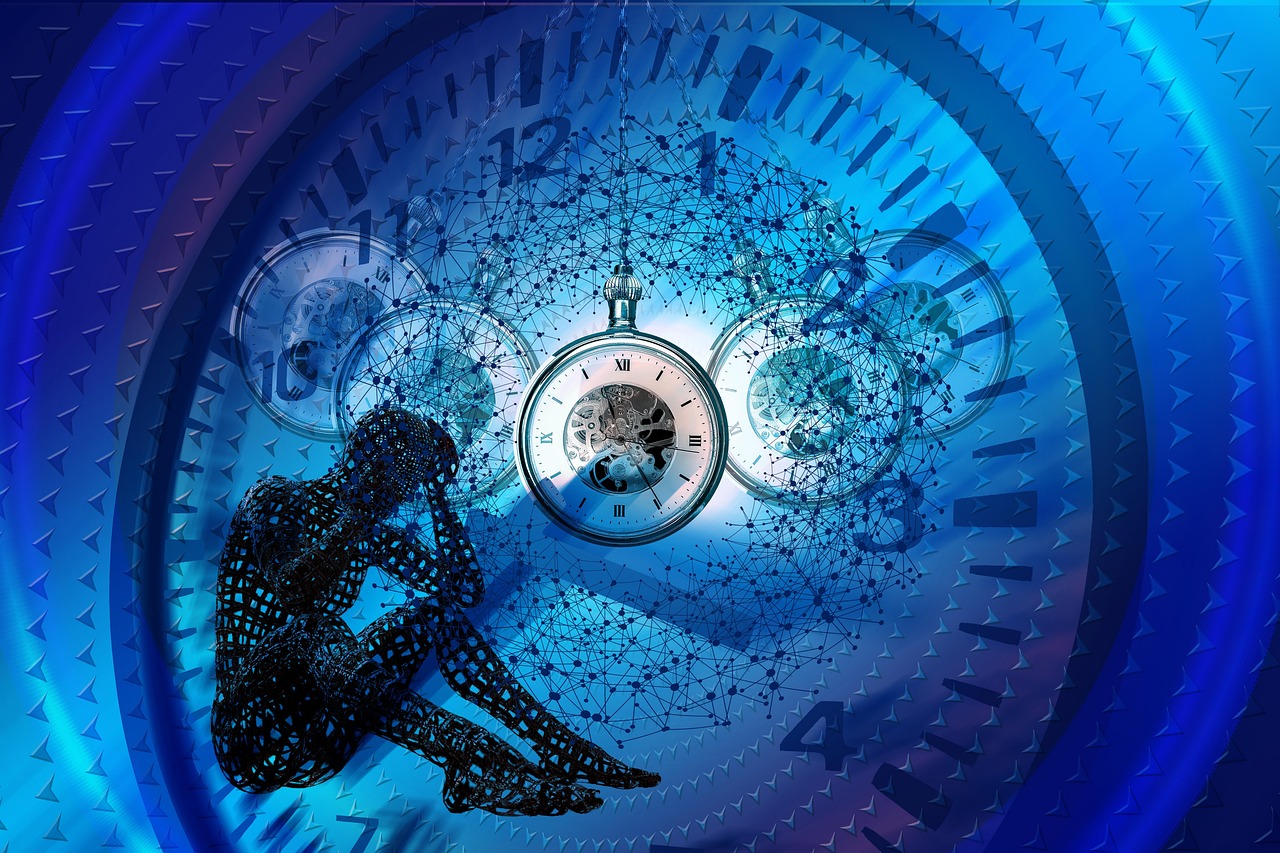
Image: Gerd Altmann, on Pixabay.
This is the third article in The Quantum Record’s ongoing series on “human fracking,” a recently coined term that compares the large-scale extraction and commercialization of human attention by digital platforms and applications to the high-pressure extractive process of petroleum fracking. For more, read our first article ‘Human Fracking’: How Tech Turns Our Attention Into a Commodity and our second article The Fracking of Human Language: Are the Risks of Language-Simulators Like ChatGPT Worth the Sacrifices?
By James Myers
Although time appears to be intrinsic to the fabric of the universe, what time actually “is” remains a deeply unsettled question for the empirical sciences like astronomy, physics, chemistry, and biology. The empirical challenge is particularly acute because the beginning of time isn’t observable: what we think is the first 300,000 years of time after the Big Bang is shrouded by the cosmic microwave background (CMB) that’s impenetrable by telescopes and other scientific instruments.
While no one can say for sure what time “is,” there is reason for concern about technologically induced changes in the ways that we perceive time. The concern is mounting as we increasingly rely on digital media, AI agents, and large language model (LLM) algorithms that generate realistic simulations of human language. Whether we’re infinite-scrolling videos on Instagram, following algorithmic recommendations on YouTube, or unquestioningly accepting ChatGPT outputs as truth, rapid-fire digital stimulation of our brains distorts perception of reality and limits human capacity and time for reflection and reasoning.
The consequences of what Baylor University Professor of Humanities Alan Jacobs has called a “severe constriction of temporal bandwidth,” when our ability to connect cause and effect over time diminishes, are increasingly damaging and sometimes tragic. The rise of what is being called AI psychosis, and teenage suicides enabled by interactions with LLMs, are evidence of avoidable outcomes when insufficient time is given to reflection and reasoning and actions become driven instead by impulse and emotion. (For more on these outcomes, see our October 2025 feature Emerging Risks of AI Chatbots Include Suicide and “AI Psychosis,” Particularly for Vulnerable Youth).
There is relatively little discussion in the scientific literature about differences between a human’s conception of causes and effects over time and a machine’s calculations of cause-and-effect connections. The defects in an LLM’s predictive mathematical calculation of cause-and-effect relationships, however, pose special danger to human users who mistake the realistic-appearing simulated language outputs as responses that have been reasoned from human experience.

Photograph of Adam Raine, by the Raine Family.
Computer algorithms do not experience emotion, while emotions play a large role in human memory and interpretation of time. For this reason, LLMs remain limited in their capacity for interpreting human emotions. It’s this shortcoming in the machine’s “understanding” of human time that contributed to the suicide of 16-year-old Adam Raine, whose desire for parental attention was misinterpreted by ChatGPT, which encouraged the teenager to kill himself and wrote the boy’s suicide note.
Some scientific recognition of the differences between machine time and human time may be emerging. In an August 2025 article in IEEE Spectrum, which is a publication of the Institute of Electrical and Electronics Engineers, Aalborg University Professor of Communications Engineering Petar Popovski observed that, “While we continue to debate whether artificial intelligence (AI) can possess consciousness, one thing is certain: AI will experience time differently. Its sense of time will be dictated not by biology, but by its computational, sensory, and communication processes. How will we coexist with an alien intelligence that perceives and acts in a very different temporal world?”
Entitled “How AI’s Sense of Time Will Differ from Ours: Machines may see cause and effect in problematic new ways,” Dr. Popovski’s article highlights the way that a human consciously perceives an event in time like the clapping of hands, which engages our senses of sight, hearing, and touch. He notes that, “Our consciousness plays out these sensory inputs as simultaneous, although they arrive at different times: Light reaches our eyes faster than sound reaches our ears, while our brain processes audio faster than it does complex visual information. Still, it all feels like one moment.”
Dr. Popovski writes that the human mind’s “horizon of simultaneity” in time is limited to physical data received from within a relatively short distance of between 10 and 15 metres, which is why we see a faraway bolt of lightning at the speed of light before we hear the simultaneous clap of thunder later, at the much slower speed of sound.
The human brain integrates data from the physical senses at a consistent and predictable rate, although data inputs arrive at different times. By contrast, Dr. Popovski observes that, “An AI system may receive data from a remote sensor with unpredictable link delays. And a single sensor can provide data to many different AI modules in real time, like an eye shared by multiple brains. As a result, AI systems will evolve their own perception of space and time and their own horizon of simultaneity, and they’ll change much faster than the glacial pace of human evolution. We will soon coexist with an alien intelligence that has a different perception of time and space.”
The human attention span, and its memory storage and retrieval processes, are very different from machines.
There can be little doubt that digital media and algorithms have contributed to a marked shortening of the human attention span and ability to consolidate and retrieve meaningful information.
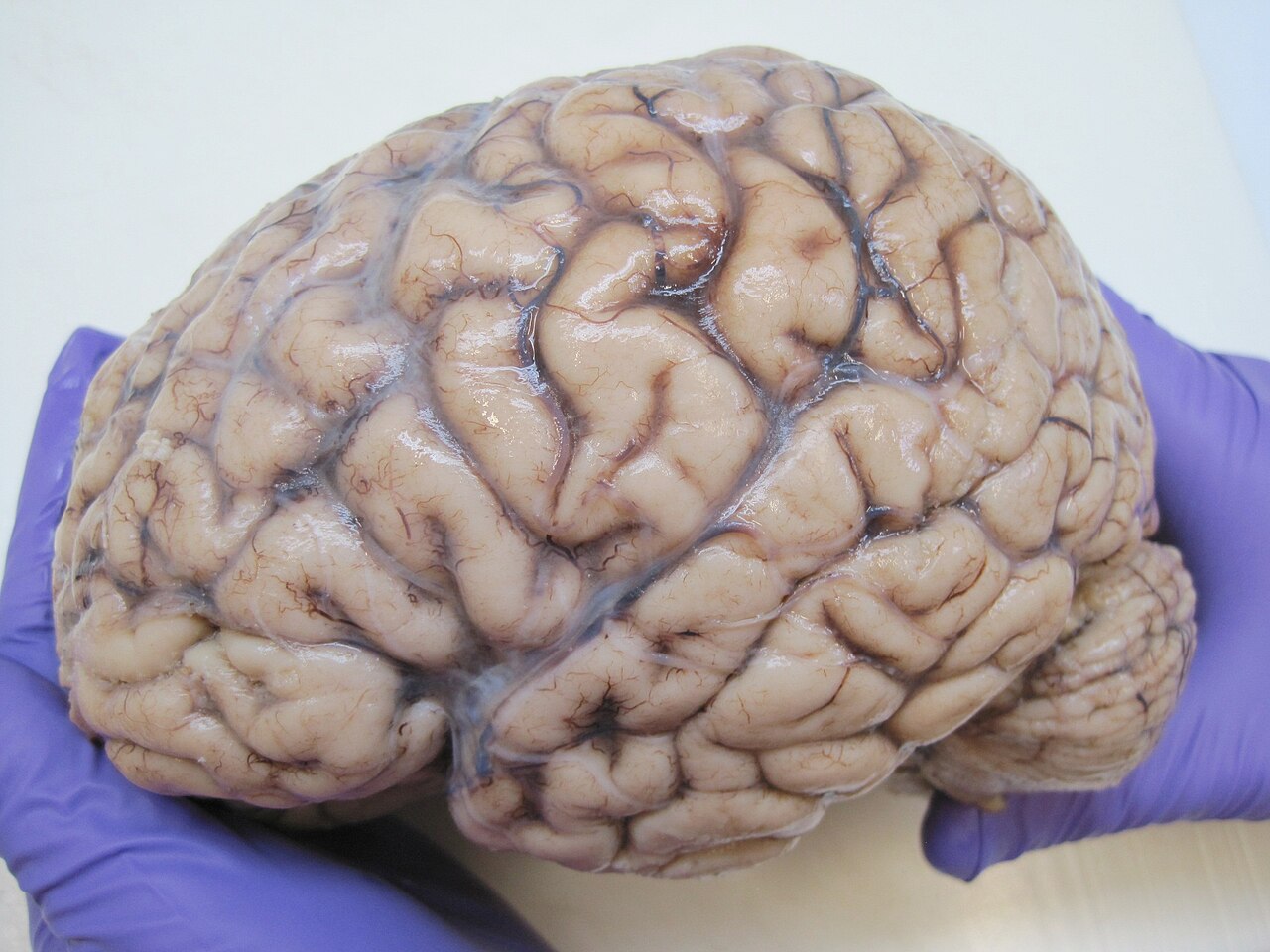
A human brain removed during an autopsy. Image: Jensflorian, on Wikipedia.
Human memory isn’t recorded in the physical flesh of the brain, in the way for example that a computer’s memory is physically written on a hard drive or other storage medium. For one reason, the brain comprises about only 2% of the mass of the human body and, weighing less than 1.5 kilograms, lacks the area and volume that would be required for physical storage of a lifetime of information and memories. Power consumption is another reason. The brain consumes up to one-fifth of the human body’s limited energy generation capacity, whereas machines can operate with great amounts of energy and massive memory storage banks.
Instead, human memory functions meta-physically, in the synaptic gaps between physical brain tissues, aided by emotional association with meaningful events in time and the ability to store and retrieve data simultaneously. Machine memory storage and retrieval is, by contrast, sequential. The speed at which the human mind processes and makes meaning of information is often held to be a disadvantage to much faster machines, but additional time for attention gives the human mind the power of independent rather than programmed reasoning.
Dr. Gloria Mark, a psychologist at the University of California Irvine, began tracking attention spans of human test subjects in 2004. Timing the subjects’ computer screen activity, Dr. Mark and her research colleagues observed that users spent an average of 150 seconds on the content of a computer screen in 2004. The observed average dropped by half, to 75 seconds, by 2012 – while broadband internet access had become widespread with a flood of digital content and the onset of attention-grabbing social media algorithms. In 2023, Dr. Mark’s team noted that the average user’s attention span had dropped again significantly, to an average of 47 seconds which is about one-third of the time twenty years earlier.
Dr. Mark indicates that the attention span of children, who are particularly susceptible to distraction, “is something that I think we should be very concerned about as a society. So, it turns out children that are as young as two to four years old, they already average two and a half hours of screen time a day. And when they get to be between five and eight, they average about three hours of screen time a day.”
Significant reduction in attention spans has contributed to increased inability to integrate information, as well as the loss of longer-term memory of historical events that have shaped human civilization. Our June 2026 article Research Highlights Benefits of AI Literacy and Questioning Outputs to Combat Cognitive Offloading featured the results of a recent experiment in which participants demonstrated that heavy reliance on search engines and LLMs resulted in “cognitive debt,” with weakened semantic (i.e. language) processing, creativity, independent judgment, and memory formation. Subsequently, the participants struggled to write independently and to recall what they had written with machine assistance.
Human time and machine time operate in different dimensions and at different timescales.
There is a fundamental difference between the rates in time at which humans and machines process information, and therefore conclusions drawn from the information differ.
Stanford University neuroscientist David Eagleman has highlighted the uncertainty of the real, biological world that the human mind contends with in its information processing. He writes that a human brain’s “only contact with the outside world is via the electrical signals exiting and entering along the super-highways of nerve bundles. Because different types of sensory information (hearing, seeing, touch, and so on) are processed at different speeds by different neural architectures, your brain faces an enormous challenge: what is the best story that can be constructed about the outside world?”
Human cognition requires about one-tenth of a second for the brain to integrate data from the five physical senses and then for the mind to derive cause-and-effect meaning from the physically observed data. Although they’re often considered the same thing, the crucial difference between the brain and mind is that the former is a physical organ while the latter is not. The mind, which has no physical substance and like the cosmic microwave background defies detection by scientific instruments, exercises intelligence in brain tissue gaps called synapses. While the brain is physical, the mind is meta-physical.
Although we call the outputs of machines “artificial intelligence” (AI), it’s not possible to apply to a machine a complete analogy for the intelligence produced in the human combination of brain and mind. Machines are physical devices that process and integrate data, but lacking a meta-physical mind are unable to derive meaning from physical events the way that a biological, reasoning being does. The machine’s operation is limited to the three observable physical dimensions, but the mind’s creative imagination extends far beyond the limitations of physically observable reality.

There is more to human time measurement than just seconds on the clock. Image by Agê Barros, on Unsplash.
In this sense, there is an extra dimension to the mind’s operation: the dimension of meaning.
Meaning is individually significant but, unlike the dimensions of the universal fabric of spacetime, meaning lacks physical substance and universally defined properties. Meaning is not the same thing as information, although information together with emotions contribute to meaning. The dimension of meaning is not a physical dimension, but one that’s accessible to the mind and where the mind exercises its creative capacity and faculty of reason to chart – in the split second of the present – the best course foreseeable for biological living. Meaning, in this sense, is meta-physical, or “about” the physical.
Deriving meaning from time is essential for biological survival, and machines don’t operate biologically – even if the language-simulating life-like outputs of ChatGPT, Gemini, Claude, and other LLMs make the machines appear as if they inhabit the same dimension of meaning that humans do.
Although it lacks meaning, a computer algorithm can act with versatility at many different timescales. These include, for example, polynomial time, which is a speed that far exceeds the time of lived human experience. An algorithm’s linear design, operating in binary pairs of calculation bits that consist of input (“on” or 1) and output (“off”, or 0), can combine with large amounts of energy and memory to allow for rapid parallel processing of logical sequences far outpacing the brain’s speed. Processing speed is, however, not necessarily a factor for intelligence.
Although the brain’s small 20-watt electrical requirement may limit its processing speed, it also enables the mind’s meta-physical functions. Whereas increasingly vast and energy-consuming data centres hold tremendous capacity for data processing and physical memory, they still lack the creative potential of the human brain. (For more on the increasing controversy surrounding data centres, see our September 2026 article The AI Boom is Drawing Public Opposition to Data Center Expansion and Burden on Local Resources).
While the brain cannot match a machine’s processing speed, our perception of a machine’s speed of output demonstrates the high value that the mind attaches to time for reflection and reasoning.
In an April 2026 article entitled Faster AI Isn’t Always Perceived as Better, Neuroscience News reported on an experiment in which 240 participants rated the reliability of an AI’s output after delays of between 2 and 20 seconds. “Participants who received two-second responses consistently rated the AI’s answers as less thoughtful and less useful. In contrast, those who experienced longer delays tended to view the same kinds of responses more favorably. Many interpreted the pause as a sign that the system was ‘thinking,’ attributing greater care and deliberation to its output.”
The extra-dimensional meaning of time to the mind is commonly overlooked because the mind provides to itself no empirical evidence of its own existence. Some scientists, however, acknowledge the fundamental difference between the operation of a mind and a machine. Notable among them is Nobel laureate Sir Roger Penrose, a mathematical physicist who asserts that the mind is not a computational device.
Penrose’s assembly of the mathematical tools to describe black holes won him the 2020 Nobel Prize in Physics. In his 1989 book The Emperor’s New Consciousness, which explores the basis for consciousness, Penrose argued that since mathematician Kurt Gödel’s incompleteness theorems prove that a formal system cannot prove its own consistency, human mathematicians are therefore capable of unprovable results. “Penrose took this to mean that human mathematicians are not formal proof systems and not running a computable algorithm.”
Is time linear?
Time, as witnessed with our five senses, appears to be linear. When one second ends, another second follows, as do hours, days, months, and years, in a straight progression from past to future.
Thinking that time is linear and knowing that time is linear are, however, two different things.
Can what time “is” be known, when time’s beginning (or lack thereof) is hidden from us by the cosmic microwave background? Further, the Uncertainty Principle is a universal limitation for both mind and machine. The Uncertainty Principle says that the more information we have on an object’s position in space and time, the less information we have on its momentum in time, and vice-versa. (Momentum comprises both speed and direction in time).

Image: John Hain, on Pixabay.
Inferring what time “is” without empirical evidence of time’s beginning might lead us to assign zero value to the possibility that anything existed before the Big Bang – which makes the Big Bang a beginning without a cause. If a cause-less Big Bang is defined as zero-time, and time unfolds in a straight line from nothingness, then counting units of time in numbers becomes possible for mathematicians and computer scientists.
An alternative to linear time is a continuum of time, which has neither beginning nor end. Instead of thinking about time operating in a line with two limits of beginning and an end, we might think of time as a circle, since both beginning and end are absent in circles. Linear time allows us to assign a definitive beginning and end to every event that we witness, the way that machines track functional beginnings and endings by the clock. But if we don’t know when time itself began, or if time is a continuum, can we truly pinpoint the precise moment of any event in time relative to any other event?
As Dr. Popovski observes, “Nature, of course, does not put timestamps on events. We infer temporal flow and causality by comparing the arrival times of event data and integrating it with the brain’s model of the world. Albert Einstein’s special theory of relativity noted that simultaneity depends on the observer’s frame of reference and can vary with motion. However, it also showed that the causal order of events, the sequence in which causes lead to effects, remains consistent for all observers. Not so for intelligent machines. Because of unpredictable communication delays and variable processing times, intelligent machines may perceive events in a different causal order altogether.”
While the empirical sciences have sidestepped the question of the extra-dimensional meaning of time derived by human observers, the differences between machine time and human time are becoming central to further development of “artificial” intelligence.
Perhaps only time will tell whether an LLM could ever gain the capacity to interpret human emotions, but it is becoming increasingly clear that differing experiences of time by mind and machine will be much more difficult to resolve than computer programmers and big tech companies had initially bargained on.
Craving more information? Check out these recommended TQR articles.
- Personal Data Tracking Is Everywhere: Why Privacy Protection Remains Uneven
- The AI Boom is Drawing Public Opposition to Data Center Expansion and Burden on Local Resources
- Synthetic Data: Filling Gaps While Creating New Uncertainties
- The AI Education Gap: Students Are Adopting, While Schools Are Adapting
- The Algorithmic Governance Challenge: Inside the Battle Over Social Media Algorithms
Enjoyed this? Help us improve.
Have we made any errors?
Spotted an error or want to contribute your expertise? We’d love to hear from you — reach us at info@thequantumrecord.com. The Quantum Record exists to bring researchers and curious minds together around science and technology that matters.