
One of the two new approaches for quantum entanglement uses microwave fields to counter environmental interference with circuits. Image: Supachai Promrit
By James Myers
Major quantum companies like IBM, Quantinuum, and Google have pledged to deliver fault-tolerant quantum computers within 3 years, by the end of 2029. The road to that goal, when the speed and accuracy of quantum computers will far surpass today’s supercomputers, stretches back four decades. That’s when physicist Richard Feynman and mathematician Yuri Manin independently theorized that hardware operating with quantum mechanics would make computer simulations more efficient and effective – and now that’s where we are, very nearly.
The goalpost for the advent of quantum computers is moving toward us and rapidly accelerating, with large financial commitments from governments around the world, major commercial investment from a burgeoning ecosystem of companies, and academic research and collaboration among a growing cohort of quantum technology teachers and students.
Two new approaches for connecting quantum circuits, one using the sun’s energy and the other using microwave fields, have moved the quantum computing goalpost even closer.
Circuits in quantum computers are notoriously fragile, and the biggest challenge in perfecting the technology has been to overcome environmental disturbances like heat and electricity that disconnect quantum circuits in a problem known as decoherence. Significant progress has recently been made in creating “fault-tolerant” quantum computers that can compensate for circuit errors, and two new discoveries have given a boost to the quest for reliable quantum error correction.
One of the discoveries demonstrates that quantum connections can be maintained by sunlight, and the other shows that a microwave field can be perfectly tuned to protect circuits against the “noise” of decoherence errors. The processes add to the growing number of possibilities for sustaining coherent quantum circuits in which quantum connections remain entangled.
A quantum is the tiniest bit of energy in the universe that can be involved in a change, such as an increase or decrease in a physical mass. The exceptional power and versatility of quantum computers, as we are seeing from prototypes now under development, comes from two peculiar properties of quantum mechanics: superposition and entanglement. Unlike today’s computer bits that can exist in only one of two states (“1” or “0”) at any time, a single quantum contains the entire range of probabilities for change to all possible states of energy – which is called superposition. The other quantum property, entanglement, describes the instantaneous, zero-time connection between one quantum and another.
Among the unsolved mysteries of the quantum realm is entanglement, the phenomenon by which one quantum connects with another quantum – possibly across vast distances – so that whatever happens to one of the pair happens instantly to the other quantum. There is no time delay in the entanglement, regardless of whether the quantum pair is separated by a galaxy or by a speck of dust. Two entangled quanta (the plural of quantum), each existing in a superposition of all possible states and sharing instantaneous communication, can combine with many others to provide incredible speed and processing power to quantum computers. The machines will be superior for computationally intensive tasks like simulating the folding of proteins for development of new medicines.
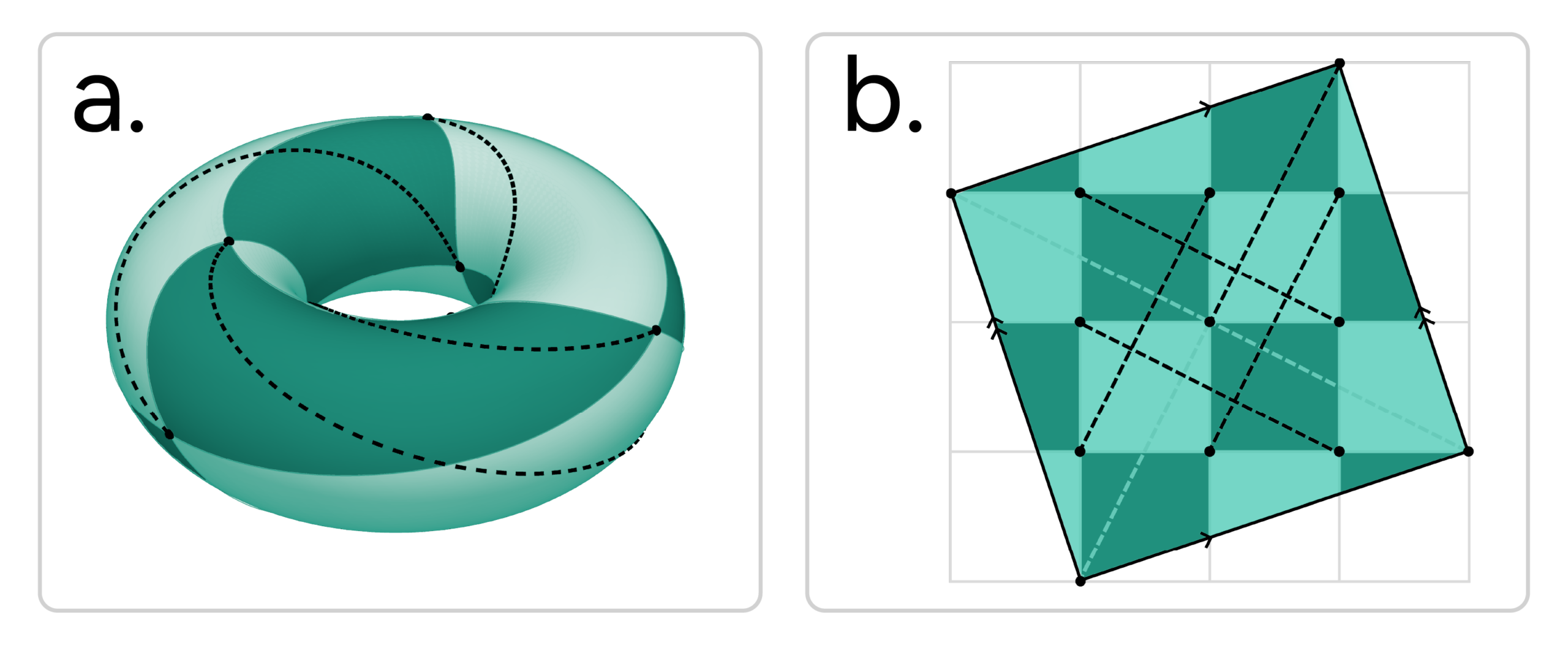
This image illustrates one current approach to qubit entanglement by major quantum computer developer Quantinuum, which explained its new Helix code for entangling qubits in a September 2026 blog posting. The Helix code maps logic-controlling qubits onto a torus, depicted on the left, the geometry of which provides the company’s qubits with longer-range capacity than if the code were mapped on a two-dimensional plane, depicted on the right. The logical qubits are shown as black dots and the dashed lines are their connections. Image: Quantinuum
Dr. Robert Boyd, a Professor in the Department of Physics at the University of Ottawa, collaborated with physicist Dr. Hanieh Fattahi, who heads the femtosecond fieldoscopy research group at the Max Planck Institute for the Science of Light, to show how sunlight can be used to entangle photons. A photon is a quantum of light energy, and a significant advantage of sunlight-induced photon entanglement is that it would eliminate the need for laser equipment and laser energy now used to maintain circuits in photonic quantum computers. Photonic quantum computers use quanta of light to transmit computing signals, but there are other types of quantum computers under development, including those that transmit signals between trapped ions.

Dr Robert Boyd (University of Ottawa)
Photonic quantum computers now require highly precise coordination of light waves and laser power to generate a sufficient energy level (“density”) to entangle photons. The researchers explain that the broad spectrum of sunlight has long been overlooked as an alternative to laser beams because sunlight is “largely incoherent and difficult to collect in concentrations comparable to that of lasers.” As explained in Physics World, the team of Dr. Boyd and Dr. Fattahi found a way to exploit free solar energy by creating “a new system that uses sunlight to fuel a process called spontaneous parametric down-conversion (SPDC). In this process, a pump beam – usually a laser but replaced here with solar light – interacts with a nonlinear crystal, splitting individual photons into entangled pairs.”
Dr. Fattahi’s team helped to create the specialized and finely tuned equipment necessary to capture and focus sunlight on the crystal in the way that it would split one quantum light particle into two. In spite of the challenge that cloudy skies and other atmospheric factors posed to obtaining a steady sunlight source, the research group achieved a 94% fidelity rate photon entanglement, exceeding by 27% the level (called “Bell’s inequality”) at which quantum entanglement occurs.
Physics World reports that “Fattahi and her team intend to develop a field-deployable version of this system, with a focus on greater integration which should ‘significantly improve mechanical stability, efficiency and overall practicality’.” Mobile systems could be particularly helpful in quantum sensing devices, which measure with incredible precision tiny quantum energy fluctuations in the surrounding area and are of particular interest for military, natural conservation, medicine, and other applications.
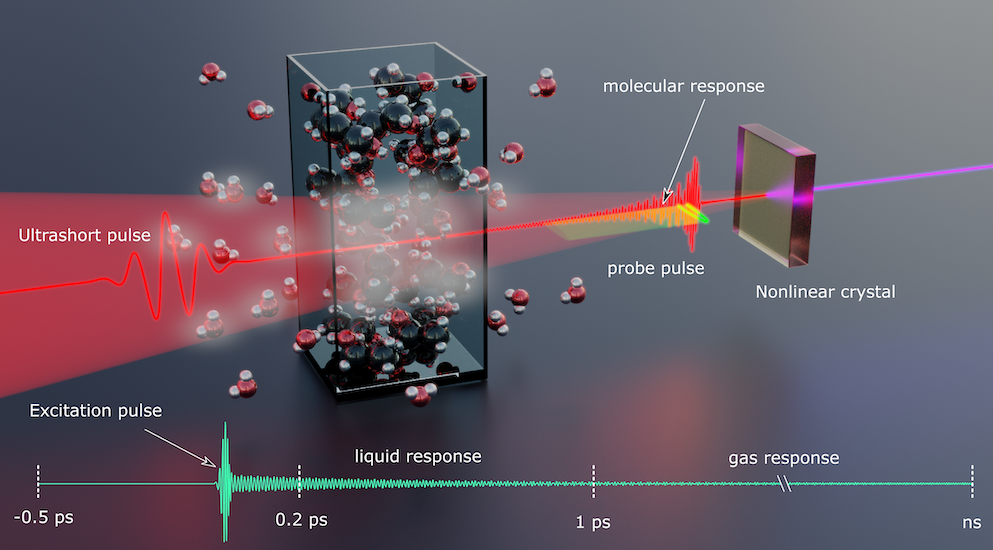
Dr. Fattahi’s femtosecond fieldoscopy research group at the Max Planck Institute for the Science of Light developed technology for collecting sunlight with sufficient energy density to split one quantum of light into an entangled pair of photons. Femtosecond fieldoscopy “allows for the direct measurement of light-matter interactions with attosecond precision in a sub-cycle regime, capturing both amplitude and phase information.” (An attosecond is one-quintillionth of a second). In the image, the molecules for a particular sample are in the container surrounded by atmospheric water vapour, and the pulse of light transmitted through the container contains information about the sample molecules. Image: fieldoscopy.de.
The paper entitled Generating Quantum Entanglement by Sunlight, by Boyd, Fattahi, and collaborators published this year in the Journal Optica, explains that their system “presents the possibility of eventual superior overall power efficiency compared with state-of-the-art laser-based quantum light sources. More importantly, it shows that an entangled-photon source can be achieved with much less complexity and thus fewer points of potential failure.” The researchers conclude that removal of a laser light requirement “could significantly reduce the need for local energy supply, thereby removing the electrical-to-optical power conversion process and associated waste heat management.”
A new entanglement technique fights noise with noise.
First proposed in 2004, dissipation engineering describes a category of approaches for entangling quantum bits (“qubits”) by using energy fields rather than directed energy from lasers. Scientists at the Institute of Science and Technology Austria succeeded in entangling qubits by using a microwave field that was tuned to the frequency of qubits experiencing disruption from the surrounding environment. This July, researchers A. Andrés-Juanes, J. Agustí, and collaborators published a paper in the journal Physical Review X, entitled Distributing Stationary Qubit Entanglement through a Nonlocal Squeezed Reservoir, that explains the process.
By matching the frequency of the environmental disturbance that was causing decoherence, the microwave field provided an area of consistency into which the qubits settled and became entangled. Energy from photons that qubits absorbed from the microwave field was cancelled by the energy of photons that were emitted into the field, a process of destructive interference that left the entangled qubits untouched.
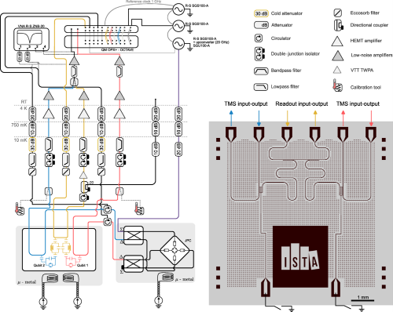
The complexities of the experimental setup by A. Andrés-Juanes, J. Agustí, and collaborators are evident in this diagram. The grid on the lower right is a computer-generated simulation of their quantum chip. Image: Distributing Stationary Qubit Entanglement through a Nonlocal Squeezed Reservoir, in Physical Review X, used under Creative Commons licence.
The researchers demonstrated how detrimental noise from the surrounding environment can be transformed into an advantage for entanglement. If the method proves to be scalable, the achievement could help to eliminate the significant cost of shielding quantum computers from heat and electromagnetism, which typically requires super-cooling. The new technique does, however, require low temperature for operation of the microwave field at a frequency where it can shield qubits. The necessity for microwave cooling has so far limited the range of qubits entangled by this method to 30 metres.
Many entanglement processes begin with a laser pulse sequence, the effects of which are captured by a detector that indicates when two qubits have entangled. This setup would be eliminated with the new technique. Additionally, since the microwave field protects the entangled qubits for as long as the field remains on, avoiding decoherence would eliminate the need for continual re-establishment of entangled states.
The process demonstrates that the two decade-old theory of dissipation engineering is practically achievable, although with modest effectiveness at this early stage. In addition to the distance limitation, the connected qubits obtained only one-tenth of the entanglement information that was carried by the microwave field. However, the proof-of-concept success makes it likely that more researchers will begin experimenting with dissipation engineering, aided by continually improving precision technology that will help to find ways of increasing the information transfer efficiency.
Efficient information transfer could lend further potential to the development of a quantum network. Existing quantum computer prototypes operate on their own, and science has yet to develop a reliable quantum mechanical method for connecting them. (For more on advancements toward a quantum internet, see our May 2026 article Quantum Internet Potential Strengthens With Teleportation Record Between Different Quantum Sources).
At scale, entangled qubits that are protected from decoherence by a microwave field could provide major impetus for further quantum technology development. Stable, microwave-shielded quantum circuits could lead to incredibly accurate quantum sensors, the ability to connect multiple quantum processors, and technology for quantum repeaters for long-distance quantum information transfer. Unlike ordinary signals, a quantum signal cannot be copied or amplified, making repeaters necessary.
In their Physical Review X paper, the scientists express confidence that efforts to overcome early-stage problems with the process “can be readily improved and extended in the next generations of experiments,” and they suggest three promising lines of inquiry. They note that research already underway on microwaves and microwave technologies holds promise for one of the three possible solutions.
The question “how?” will soon be replaced by the question “why?”
The question of how to create stable quantum circuits may soon disappear as the other question looms: are we prepared for the consequences when the finish line soon reaches us? The line is clearly in sight, and some major institutions are accelerating efforts to secure their sensitive data against decryption by quantum computers. A very prominent warning sign was Google’s March 25, 2026 blog post announcing that the company has committed to secure all of its data with post-quantum cryptography (PQC) by 2029.
PQC is a new and not yet fully developed process for encrypting data that will be essential when quantum computers achieve fault-tolerance. Fault-tolerant quantum computers will be able to break current encryption methods, exposing sensitive data like banking passwords, e-mails, the keys to hospital, government, corporate, and public utility systems, and any other encrypted information circulating online. Over a number of years in a scheme often referred to as “store now, decrypt later,” criminals have been gathering and storing large amounts of sensitive data knowing that while it can’t be decrypted now, quantum computers will soon (they hope) reveal the secrets.
NIST, a US government agency that is a major global standard-setter, isn’t forecasting the need for full PQC until 2035. The fact that Google is advancing its own deadline by 6 years is a prominent statement of the company’s belief that the need to protect data from quantum computers is more urgent than the world thought only a year ago.
As observed by the journal PostQuantum, “This is not a company hedging its bets or issuing vague guidance about ‘starting to plan.’ This is Google, which operates the world’s most widely used browser, one of the two dominant mobile operating systems, and a major cloud infrastructure platform, announcing a hard target for completing one of the most complex cryptographic transitions in computing history. And it’s doing so while simultaneously running one of the world’s most advanced quantum computing research programs – a detail that deserves far more scrutiny than it has received.”
The year 2029 is looming – after all, we’re only two months away from the beginning of 2027 with a sea of data growing by the day that has yet to be catalogued or protected with PQC. Whether fault-tolerant quantum computers arrive because of sunlight entanglement, microwave fields, or some other method won’t make a difference to the outcome for data as it’s currently encrypted.
Should the world prioritize the PQC problem, like the world successfully prioritized and conquered the Y2K problem in 1999? Or is it safe to wait a while to find out which way the winds of change are blowing?
Craving more information? Check out these recommended TQR articles.
- Personal Data Tracking Is Everywhere: Why Privacy Protection Remains Uneven
- The AI Boom is Drawing Public Opposition to Data Center Expansion and Burden on Local Resources
- Synthetic Data: Filling Gaps While Creating New Uncertainties
- The AI Education Gap: Students Are Adopting, While Schools Are Adapting
- The Algorithmic Governance Challenge: Inside the Battle Over Social Media Algorithms
Enjoyed this? Help us improve.
Have we made any errors?
Spotted an error or want to contribute your expertise? We’d love to hear from you — reach us at info@thequantumrecord.com. The Quantum Record exists to bring researchers and curious minds together around science and technology that matters.