Around the globe, high schools are beginning to prepare young minds for a future in quantum computing. Image: Gerd Altmann, Pixabay
By James Myers
Although major companies like IBM and Quantinuum expect to deliver fully functioning quantum computers before the end of 2029, public knowledge of the technology and its potential remains low. A research team at MIT Sloan School of Management surveyed 1,375 U.S. adults in October 2024 and found that 25% had no familiarity at all with quantum computing. But as the powerful machines come online, with an increasing possibility of joining forces in a quantum internet as we reported in May, there should be little doubt that innovation and commercialization will lead to significant demand for a host of skilled workers in the near future.
The importance of preparing high school students for future quantum technology leadership can’t be underestimated. As the era of quantum computing comes to life in four years, or possibly less, today’s high schoolers will be entering university and training for a variety of related careers. These will include quantum technicians, quantum algorithm designers, computer scientists, and physicists and mathematicians who will be called on to advance the science of quantum mechanics that’s fundamental to the new technology’s operation.
Increasing numbers of high school students around the globe are being introduced to the principles of quantum computing, even as the scientific community continues to grapple with the problems of creating stable quantum circuits and resolving mysteries of quantum mechanics like the observer effect, in which the simple act of measuring a quantum state destroys the state. Some nations have recently adopted quantum strategies that include a focus on raising student and teacher awareness of the unique complexities of quantum computing, like entanglement and superposition, that will give the machines a powerful advantage of speed and accuracy in medical research, biotechnology, aerodynamics, finance, and many other fields.
As secondary school courses are being adapted to include topics in quantum computing, questions are beginning to surface whether these efforts will be sufficient for what could be an explosion of demand for skilled professionals in only a few years. Also in the spotlight is the ongoing question of a global digital divide, in which students from wealthy, industrialized nations will have an advantage over students from the poorer regions like the global south where access to quantum knowledge leaders, technological hardware, and educational resources is more limited.
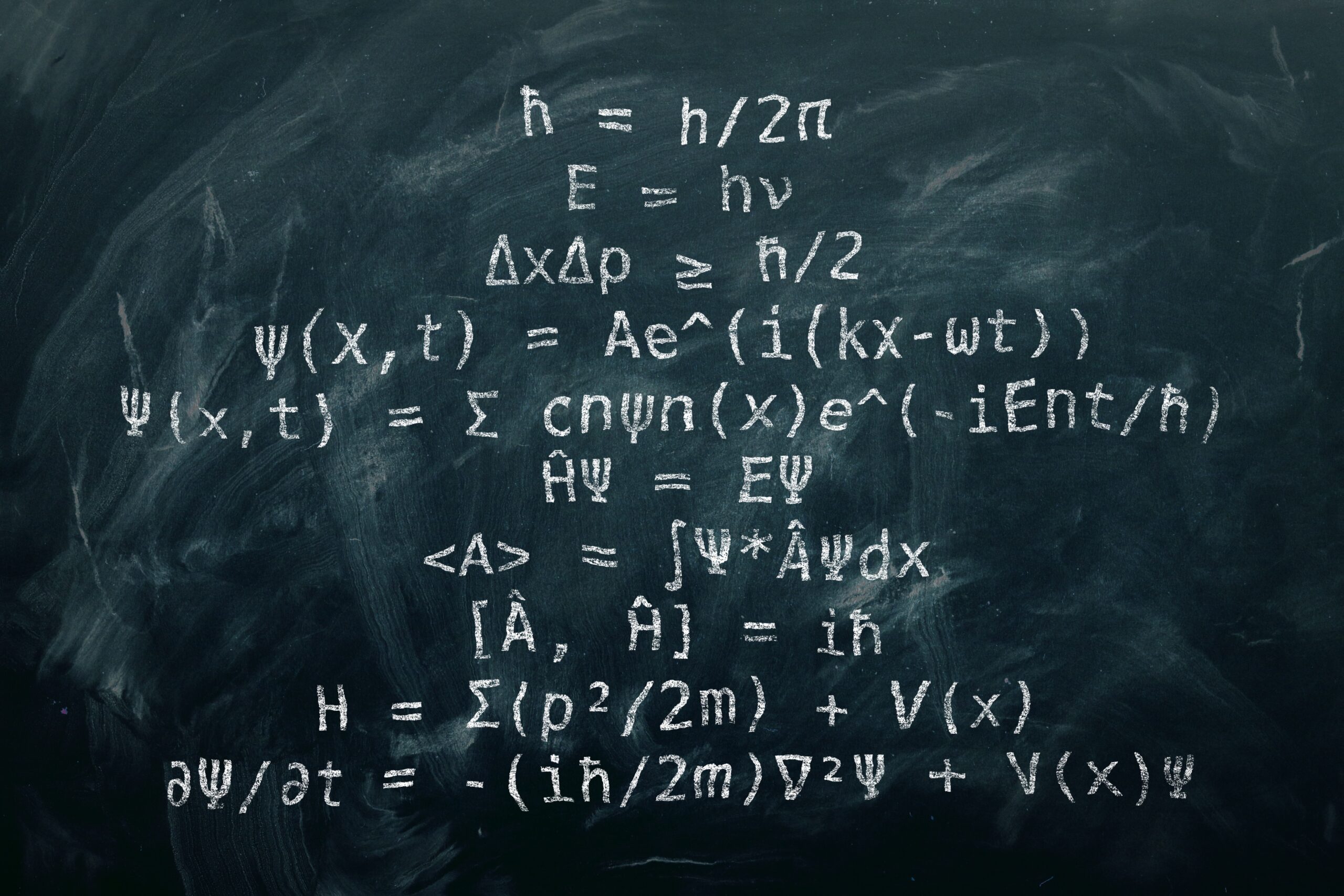
High school students will require specific concepts in mathematics and physics, like knowledge of the Uncertainty Principle shown in the third mathematical expression above, to prepare for work in the era of quantum computing that is expected to be unleashed before the end of 2029. Image: Gerd Altmann, Pixabay
A May 2025 study entitled Introducing Quantum Computing to High-School Curricula: A Global Perspective, by Maria Gragera-Garces from the University of Edinburgh and co-authors, observes that while governments, industry, and universities are ramping up investments in creating a quantum-ready workforce, “quantum computing remains largely absent from high-school curricula, hindering efforts to prepare the next generation of researchers.” The authors note that “many students, especially in under-resourced regions, are unaware that the field of quantum computing exists.”
The study outlines the core knowledge requirements of quantum computing for high school students, which include the mathematics of linear algebra, probability theory, and complex numbers. Students also require foundational knowledge in the physics of quantum mechanics, materials science, and thermodynamics, as well as concepts in computer science that include system architecture, programming, and data representation. The authors advocate for a modular approach for teaching these topics to high school students, incorporating them in subjects that students are already learning rather than creating standalone quantum computing courses.
Gragera-Garces and co-authors highlight the global disparities in high school curricula for core quantum computing knowledge. For example, while the U.S. was a leader as early as the 1960s with high school computer science courses, the subject was introduced in Brazilian and Chilean high schools only in the past decade. The high school curriculum in South Africa provides limited exposure to linear algebra and probability theory while omitting complex numbers entirely, whereas in the U.S. these key concepts in mathematics are typically offered only in advanced high school courses to which many students have little or no exposure.
While coverage of fundamental concepts in physics is common in wealthier nations, the focus and priorities differ from country to country with the result that some students don’t acquire problem-solving skills in particular areas and others learn formulas without fully grasping the underlying principles.
In this interview at QuantumBasel Symposium 2023, Elisa Torres Durney explains her initiative in founding Girls in Quantum, a student-led group that is now active in 68 countries.
After briefly comparing national and regional quantum education initiatives in the U.S., U.K., EU, and Canada, the report highlights additional options for teaching and learning quantum computing at the high school level, particularly in regions lacking the advanced quantum educational infrastructure of wealthier nations. The options include educational use of open-source software like IBM’s Qiskit, open-access educational texts and materials, and participation in student-led initiatives like Girls in Quantum. (In 2023, The Quantum Feedback Loop podcast hosted Girls in Quantum founder Elisa Torres Durney).
The study concludes that, “Ultimately, preparing the next generation to engage confidently with quantum technologies is about cultivating thoughtful, scientifically literate citizens who can navigate and shape the technological challenges of the future. With modest but intentional steps, high-school education can become the foundation for a more equitable and sustainable quantum future.”
Governments, businesses, and universities are leading the way to our quantum future. Will high schools adapt quickly enough to meet the needs of tomorrow?
There are clear signs that governments, corporations, and universities are investing heavily for the impending launch of the quantum era. For example, the MIT Sloan School of Management analyzed over 58,000 public announcements by companies between 2022 and 2024 and observed in its Quantum Index Report 2025 a “marked increase in the discussion of quantum computing” over the two-year period. An analysis of corporate quantum computing references, including those made in earnings calls, reveals a mean of around 200 quarterly mentions at the beginning of 2022 that nearly doubled to as many as 379 quarterly mentions in 2024. Interest continues to mount, as evidenced by the surge at the beginning of 2026 in the number Google searches on the term “quantum computing.”

National quantum strategies are recognizing the importance of preparing young minds for a future in quantum computing. Image: Gerd Altmann, Pixabay
In the past five years, more countries have established national quantum strategies since the U.S. launched its National Quantum Initiative in 2018.
Canada published its National Quantum Strategy in 2022, and in the next year the U.K. and Australia both introduced their own National Quantum Strategies. In 2024, the EU contributed 264 million euros to the creation of Quantum Delta NL, a project to fund and catalyze the growth of quantum computing, a national quantum network, and quantum sensing applications in the Netherlands. Meanwhile, post-secondary institutions like MIT, the University of Oxford, University of Waterloo, and University of Science and Technology of China have established large and internationally significant hubs for quantum research.
Realizing the commercial potential of quantum computing, companies like IBM freely offer online resources for teachers that include complex topics like quantum teleportation. Learning modules on subjects like these include video presentations, hands-on use of IBM’s Qiskit quantum sotware, and teacher guides. Users who create an account with IBM Quantum can run applications on IBM’s real quantum computers.
With a goal to “increase the capabilities and number of students who are ready to engage in the quantum workforce,” the U.S. National Q-12 Education Partnership is a cooperative effort between the federal government, industry, professional societies and the education community to advance the introduction of quantum concepts in primary and secondary schools. Launched in 2020 by the White House Office of Science and Technology Policy and the National Science Foundation, commercial partners now include IBM, Microsoft, Google, Quantinuum, Boeing, AWS, and Intel.
Q-12 provides a wealth of free educational resources on its site for teachers in computer science, physics, chemistry, and math. These include comprehensive teacher guides and frameworks for incorporating quantum concepts into course material, lecture notes for subjects such as the Mathematics of Quantum Mechanics, and hands-on projects and classroom activities like the use of a laser pointer, thin copper strand, and electrical tape to demonstrate light’s wave-particle duality. Q-12’s site also offers a textbook, interactive tools, quantum games, and a quantum colouring book and posters.
In this National Q-12 Education Partnership video, high school computer science teacher Jessica Klauser-Zimmerman describes how she created a quantum education curriculum for her students.
Free educational resources are available elsewhere too. For example, George Mason University’s Quantum is Elementary initiative provides lesson plans, instructional slides, graphics useful for conveying complex ideas, student activities like stacking polarizers to observe quantum effects, and classroom games like Quantum Chutes and Ladders. The site also provides materials to increase teacher knowledge of quantum concepts.
The costs of teacher training and opening expensive quantum computing infrastructure for access at the high school level will require sustained government funding commitments.
The looming and urgent need for quantum computing researchers, algorithm designers, technicians, computer scientists, physicists, mathematicians, and other skilled professionals to support the quantum era that is now at our doorstep is clear. What is not at our doorstep, however, is the time required to equip teachers and students with the knowledge needed to take quantum computing to the next level in its evolution.
Public policies around the globe are moving to recognize the importance of investing in time by strengthening high school students’ core knowledge of quantum computing principles and operations and even extending the learning to elementary schools. Armed with fundamental knowledge of quantum mechanics and technology, students might be inspired to consider quantum computing as a path for their post-secondary careers, whether they become researchers, teachers, or policy makers, or they end up working in the burgeoning number of quantum computing companies or in industries that use quantum computing applications.
There’s no time like the present to equip young minds for the future potential of quantum computing. The powerful technology promises speed and accuracy that can in theory, and soon in practice, far outpace the most sophisticated computers on the planet today. Realizing the full potential of quantum technology will require increased global cooperation and investment in preparing youth for the era of quantum computing that they will face as high school graduates by the end of this decade.
Craving more information? Check out these recommended TQR articles:
- Fraudulent Data Influencing Decision-Making: AI, Fake Respondents, and the Future of Public Opinion Research
- Research Highlights Benefits of AI Literacy and Questioning Outputs to Combat Cognitive Offloading
- The Algorithmic Governance Challenge: Inside the Battle Over Social Media Algorithms
Enjoyed this? Help us improve.
Have we made any errors?
Spotted an error or want to contribute your expertise? We’d love to hear from you — reach us at info@thequantumrecord.com. The Quantum Record exists to bring researchers and curious minds together around science and technology that matters.