

Image: Gerd Altmann, Pixabay
By James Myers
As the climate crisis deepens and nations around the globe continue to breach greenhouse gas reduction targets, new technologies are offering hope for restoring some health to the environment. Green chemistry is an increasingly popular field of scientific research that has spurred development of industrial applications and technologies that offer “creative and innovative ways to reduce waste, conserve energy, and discover replacements for hazardous substances,” according to the American Chemical Society (ACS).
The ACS highlights a number of achievements in green chemistry, including a significant reduction in the chemicals and fossil fuels required to manufacture a computer chip. Making a single computer chip in the early 2000’s required 630 times its weight in chemicals and fossil fuels, an environmental burden that was significantly reduced after scientists at the Los Alamos National Laboratory discovered a process using “supercritical” carbon dioxide that also decreases energy consumed by chip manufacturers.
Green chemistry is advancing pollution reduction efforts by replacing petrochemical-based products like plastic. Microplastic pollution has become a major human health issue as the tiny particles increasingly enter our bloodstreams and disrupt brain functions, and ocean life is threatened by vast clusters of waste petrochemical products like plastic bottles, bags, and Styrofoam that wash out into the sea and are driven together by the tides. Greener alternatives to plastic are being developed by an increasing number of companies like NatureWorks, which employs a chemical process for creating a biopolymer that replaces petrochemical plastic.
A polymer is a collection of molecules in a particular repeating chemical structure, and a biopolymer is polymer that is produced by the cells of living organisms – human DNA, for example, is a biopolymer.
The company states that its Ingeo biopolymer, “made from renewable biobased feedstocks, is a low-carbon alternative to petrochemical-based plastics and fibers that makes the products we use every day safer and more sustainable.” The company is now researching bacterial reactions with carbon dioxide and methane that could be used to create its Ingeo biopolymer as a substitute for plastic in making coated cups, films and cards, fibres for diapers, paints, and more.
NatureWorks explains the process it uses to capture carbon dioxide and create its biopolymer called Ingeo.
Can continued improvements in cellulose production provide significant relief from plastic pollution?
Consisting of chains of glucose molecules, cellulose forms the cell walls in plants, trees, and many forms of algae and is the most abundant biopolymer on Earth. The high tensile strength and flexibility of cellulose combines with its versatility, biodegradability, insolubility in water, and digestible non-toxic nature to make it a plastic substitution candidate. A paper entitled Cellulose: A comprehensive review of its properties and applications, by Dr. Elina Marinho, an organic chemist from the Centre for Textile Science and Technology at the University of Minho in Portugal, notes that cellulose acetate has emerged as a widely used derivative of cellulose in applications like textile manufacturing, 3D printing, medical supplies, and environmentally friendly packaging.

Microscope image of cellulose by Alexander Klepnev, on Wikipedia.
While further research is required to decrease the cost of extracting cellulose – including more efficient processing and recycling, genetically engineering plants for higher yields, and the use of agricultural waste as fuel for production – cellulose from plant sources such as bamboo, cotton, flax, hemp, jute, ramie, and sisal is already an attractive alternative to replace petrochemicals like plastic. Significant industrial investment has already been made in cellulose production, and Dr. Marinho explores the chemical properties of cellulose for its potential uses in light-sensing applications and the production of biofuels, construction, cosmetics, and food.
Dr. Marinho indicates that development of nanocellulose, which is cellulose at the tiniest scale, “is an exciting area of research. Its strength, lightweight properties, and biodegradability make it suitable for use in composites, electronics, and advanced materials.”
Green chemistry is speeding the transition from fossil fuel-intensive chemical production processes.
A focus of research in green chemistry is reduced reliance on fossil fuels for chemical production processes. For example, in a paper entitled “Plasma catalysts for decarbonizing the chemical industry: opportunities, limits, and commercialization pathways,” in the Royal Society of Chemistry’s weekly Green Chemistry journal of August 3, 2026, authors Md Monir Hossain and Ruigang Wang propose a method for reducing the amount of fossil fuel used for heat in chemical production.
The authors note that “The chemical industry stands at a critical crossroads: it is essential to modern civilization yet responsible for substantial environmental impact.” They state that while daily life depends on chemical products for things like fertilizers, pharmaceuticals, and fuels, “The big trade-off is that this essentiality comes with an enormous carbon footprint. For example, the primary chemical sector (ammonia, methanol, ethylene, propylene, benzene, toluene, and mixed xylenes) accounts for 2.5% of global CO2 emissions.”
Almost all – 98% – of the energy for producing these chemicals is derived from fossil fuels. The authors indicate that as much as 200 million tonnes of ammonia produced annually, for agricultural fertilizers, synthetic fibres, plastics, and explosives, is responsible for about one-half of the chemical sector’s carbon dioxide emissions.
Practically all ammonia is produced using the Haber-Bosch process, developed in the early 1900s, which converts nitrogen in the atmosphere to ammonia in a high-pressure reaction with hydrogen that uses iron as a catalyst (a catalyst increases the rate of reaction) and heat as high as 520 degrees Celsius. The paper explores the replacement of fossil fuels in the reaction of nitrogen with hydrogen by using non-thermal plasma (NTP). NTP consists of an ionized gas and electrons that are maintained in a vibrating state by electric fields that raise the electron heat far above the gas temperature. The disequilibrium in heat between the two NTP components, which can be fuelled by electricity from renewable sources, could be sufficient to catalyze ammonia production and other chemical processes. Further research is required to establish technical and economic feasibility.
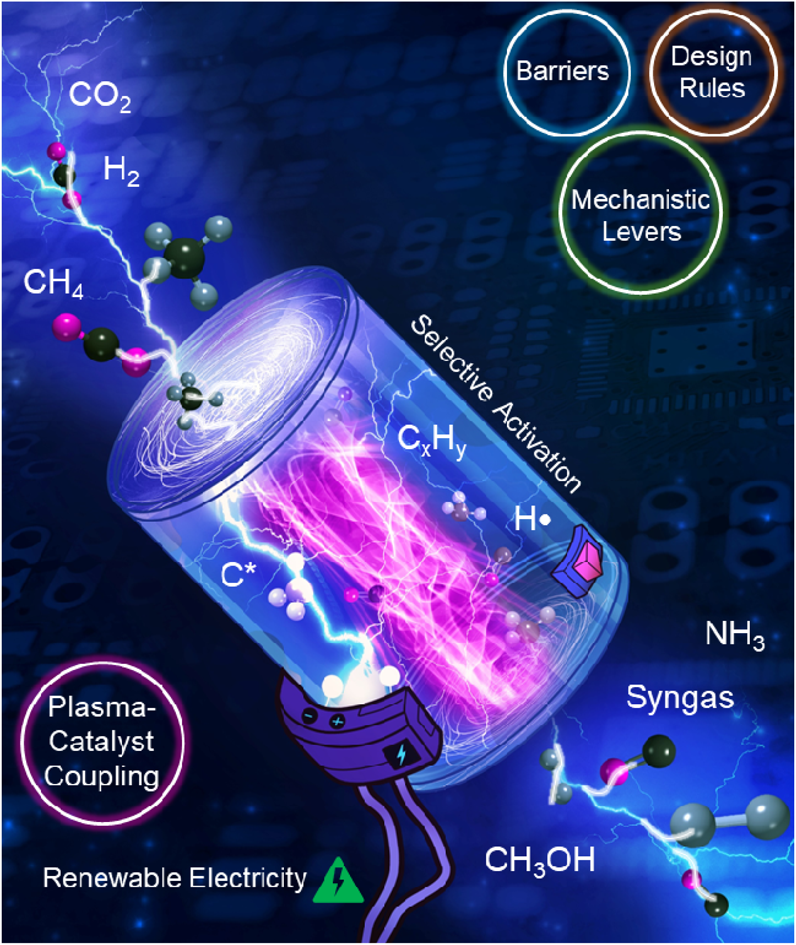
Illustration of chemical reaction catalyzed by non-thermal plasma with the use of renewable electricity that could synthesize ammonia (NH3). Image: Plasma catalysis for decarbonizing the chemical industry: opportunities, limits, and commercialization pathways, by Md Monir Hossein and Ruigang Wang, used under Creative Commons licence.
What does the future hold for green chemistry?
A November 2025 publication entitled Green chemistry: Six key trends to watch, by scientists at the Chemical Abstracts Service (CAS) division of the American Chemical Society, highlights the current areas of focus for green chemistry research and development. These include the development of magnetic materials that would replace the need for rare earth metals now under heavy demand for manufacturing and are increasingly the source of geopolitical tension and environmental damage from mining.
Chemists are researching the use of abundant elements like iron and nickel to make high-performance permanent magnets for use in motors, electric vehicles, semiconductors, generators, and a wide range of consumer electronics. CAS cites a recent success in which scientists discovered that adding phosphorus to an alloy of iron and nickel produces tetrataenite, “a powerful magnet found in meteorites that normally takes millions of years to form. This green chemistry breakthrough makes the material in seconds and provides a powerful alternative to rare earths, particularly neodymium magnets.” Neodymium magnets are the most widely used type of rare-earth magnet.
Finding alternatives for PFAS is another focus of green chemistry. PFAS (pre- and poly-fluoroalkyl chemical compounds) have attracted significant concern as “forever chemicals” that accumulate in the human body and other living organisms with significant health risks. First synthesized in 1934, thousands of PFAS variations are in wide use for products such as waterproof fabrics, carpets, shampoo, mobile phone screens, paint, food packing, electrical insulation, and cosmetics.
Other promising paths for green chemistry research and development in include methods for chemical reactions that don’t require solvents to produce things like pharmaceuticals, the use of AI for modelling and designing effective and environmentally friendly reactions, processes to extract metals like gold, lithium, and rare earths from electronic waste, and the creation of chemical reactions with a paradigm-shifting use of water as a solvent. Progress is being made on all fronts, and an example of success is the development of silver nanoparticles in water using plasma and electricity.
Better living, through chemistry?
In 1935, chemical company DuPont adopted the advertising slogan “better living through chemistry” (or, more precisely, “Better Things for Better Living…Through Chemistry”) during an era when heavy industry was beginning to flourish globally and science was held as a means to solve practically all human problems. DuPont dropped the “through chemistry” part of the slogan in 1982, as concerns about the environmental and health effects of industrial production were becoming prominent.
University of Pennsylvania Chemistry Professor Eric Schelter discussed chemistry’s public relations problem as well as its promising future in a November 2021 interview by the university’s arts and sciences publication Omnia. Schelter noted that, “When I have discussions with the general public or people I meet at cocktail parties—when I go to cocktail parties—and tell them I’m a chemist, there’s always a visceral response to it. It’s often kind of negative. People have a sense of what chemistry is about, but I think that they don’t necessarily have an appreciation of just how much it touches their lives.” Schelter explained that the negative feelings were often associated with the unintended consequences of chemical development and use, such as plastic pollution.
Professor Schelter concluded that “Solving the sustainability problem is the challenge of the 21st century, and chemists are going to be the ones working with engineers to develop the solutions that are going to make our civilization sustainable.” His prediction may be achievable, with lessons learned and the promising future of green chemistry.
Craving more information? Check out these recommended TQR articles.
- Personal Data Tracking Is Everywhere: Why Privacy Protection Remains Uneven
- The AI Boom is Drawing Public Opposition to Data Center Expansion and Burden on Local Resources
- Synthetic Data: Filling Gaps While Creating New Uncertainties
- The AI Education Gap: Students Are Adopting, While Schools Are Adapting
- The Algorithmic Governance Challenge: Inside the Battle Over Social Media Algorithms
Enjoyed this? Help us improve.
Have we made any errors?
Spotted an error or want to contribute your expertise? We’d love to hear from you — reach us at info@thequantumrecord.com. The Quantum Record exists to bring researchers and curious minds together around science and technology that matters.