
- According to the entropic gravity theory, the exchange of information between quantum systems is encoded in two dimensions and holographically projected to a three-dimensional volume of space. Image: Gerd Altmann, on Pixabay.

By James Myers
A study published in June 2023 in the Journal of Physics Communications (open access) provides an unconventional and potentially revolutionary perspective on the nature of matter, space, and time. The study’s authors, Dr. Andreas Schlatter and Dr. Ruth Kastner, from The Quantum Institute and University of Maryland, propose that the fabric of space and time is not fundamental to the universe. In their view, spacetime is not a container for energy and matter – which we can measure empirically – but instead, spacetime forms from quantum interactions.
In their paper entitled “Gravity from Transactions: Fulfilling the Entropic Gravity Program,” Schlatter and Kastner demonstrate how both space and time can emerge from quantum interactions. Most other theories have the order of creation the other way around, with spacetime appearing first and quantum interactions second; in that way of thinking, spacetime would be a container. The theory of Drs. Schlatter and Kastner says spacetime is the product of quantum interactions, which therefore come first in the order of time.
The quantum is the smallest unit of energy in the universe that can interact and result in a change in energy and its equivalent mass. A photon is a quantum of light energy that has no mass, and the authors propose that spacetime is the result of interactions between quantum systems (i.e. groups of quantum particles) that emit photons and other quantum systems that absorb the photons. They call these emission and absorption events “transactions.” Since the combinations and configurations of many transacting quantum systems vary, the resulting fabric of spacetime extends and bends in differing measures from one localized area to another in space and time.
In this perspective, spacetime is a permanent “invariant” output of quantum transactions, and because of this invariance the speed of light’s photons is constant. Once it’s created, an area of spacetime becomes a fixed record or “storage device” for the outcomes of quantum emission and absorption transactions. For this reason, the authors refer to spacetime as the “null” interval, where no further transactions are possible and all potential outcomes are represented.
Dr. Andreas Schlatter discusses quantum transactions and entropic gravity on the DemystifySci podcast.
Schlatter and Kastner propose that, instead of spacetime, what they call a “quantum substratum” is fundamental to the universe. Consisting of a quantum field with potential for interaction, the substratum underpins the fabric of spacetime. A strange property of quantum mechanics is that measurement of a quantum system’s state destroys the system, so the quantum substratum could never be measured directly. The outputs of transactions in the substratum could, however, be measured by quantum information that has been imprinted in the boundaries of what we perceive to be “empty space.”
The authors ask “whether there is some measure for the information content of space independently of specific material systems,” and conclude that it is “possible to allocate information content to spatial regions” that map the range of possible events generated by quantum transactions occurring before spacetime’s formation.
They support this view by quoting Albert Einstein, who stated, “There is no such thing as empty space, i.e. a space without a field. Spacetime does not exist on its own, but only as a structural quality of the field.” The proof that Schlatter and Kastner provide in a series of 69 steps refers to emitting and absorbing photons as “clocks” that measure the “rhythm of becoming” of matter and space. They state that their proof is consistent with Einstein’s field equations that underpin the famous conclusion that E=mc2, which the authors characterize as “synchronizing” the photon clocks.
This view also supports the idea that that the still mysterious forces of dark matter and dark energy are equal and opposite products of the photon clocks. Dark matter appears to cause galaxies to cluster instead of fly apart, while dark energy causes the universe to expand.
Schlatter and Kastner indicate that their theory is consistent with the holographic principle, an idea of universal memory pioneered by physicist Gerard ‘t Hooft and expanded by Leonard Susskind. The holographic principle holds that a three-dimensional volume of space is encoded on a two-dimensional boundary that exists at the spacetime limit, which is called the “event horizon,” of a black hole. There is a black hole in the middle of our Milky Way galaxy, and black holes appear to exist at the centre of all other galaxies. As Susskind stated, “The three-dimensional world of ordinary experience—the universe filled with galaxies, stars, planets, houses, boulders, and people—is a hologram, an image of reality coded on a distant two-dimensional surface.”
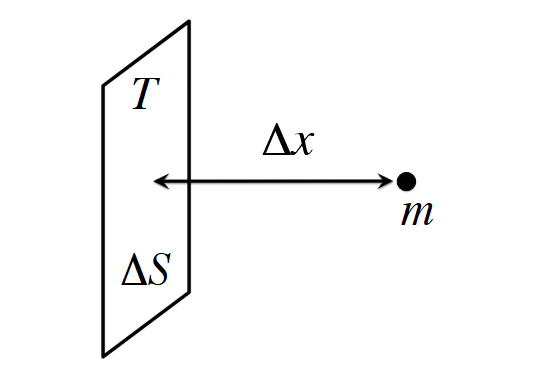
- Representation of a holographic screen, or surface, that forms the boundary of an emerged region of spacetime. A particle with mass (m) approaches the screen that “stores data that describe the part of space that has not yet emerged, as well as some part of the emerged space.” Image: Erik Verlinde in On the Origin of Gravity and Laws of Newton.
So how does gravity, the phenomenon that attracts smaller masses to greater masses, emerge from quantum transactions? According to the authors, the answer relates to entropy. Entropy is a measure of disorder that reflects the number of possible particle configurations within a system, and as entropy increases so does the possible number of photon emission and absorption transactions.
Entropy is key to the second law of thermodynamics, a bedrock principle of physics that says the ordered state of all physical masses will over time decay, with entropy, into a state of maximum disorder. As they form, or come-into-being, physical masses are composed of energy, and the continuous interaction of energetic particles in matter causes varying amounts of heat that dissipates during the process of entropy. Thermodynamics is the study of heat, and Schlatter and Kastner use mathematics and physics to equate bits of transactional information among emitting and absorbing quantum systems with the thermodynamic entropy of newly formed matter.
As Dr. Kastner explained to Advanced Science News, “Objects with mass, being composed of transacting components, provide ‘fuel’ for transactions. When we quantify that transactional fuel in terms of temperature, and the possible positions for masses, the gravitational potential is the result.”
In the theory of Schlatter and Kastner, a quantum system that emits photons encodes the sum of the system’s entropies on a spherical boundary. The number of entropic information bits on the emitting system’s boundary, and differences among those bits (referred to as the entropy-gradient), determine the system’s capacity for absorbing photons. The thermodynamic properties of photons transacting in this way is perceived as the physical force of gravity.
“The concept of spatial information and transactions leads, together with the thermodynamic equivalence principle, to the existence of gravity as an entropic force, emerging from the coming-into-being of empirical reality,” Schlatter and Kastner write.
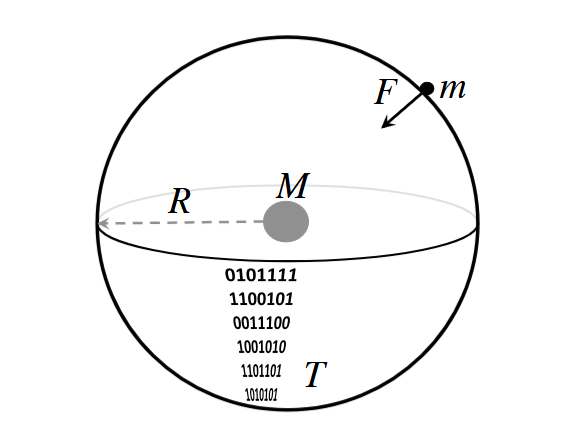
- “A particle with mass m near a spherical holographic screen. The energy is evenly distributed over the occupied bits, and is equivalent to the mass M that would emerge in the part of space surrounded by the screen.” Image and caption by Erik Verlinde.
Theoretical physicist Erik Verlinde was a pioneer in developing the theory of entropic gravity. Verlinde’s 2010 paper On the Origin of Gravity and the Laws of Newton declared “the end of gravity as a fundamental force” and argued that “the central notion needed to derive gravity is information. More precisely, it is the amount of information associated with matter and its location, in whatever form the microscopic theory likes to have it, measured in terms of entropy. Changes in this entropy when matter is displaced leads to an entropic force,” which is expressed as gravity. According to Verlinde, the information contained in a region of space obeys the holographic principle when the three-dimensional spatial volume is encoded on and emerges from a two-dimensional surface referred to as a “screen.”
In the interpretation of Schlatter and Kastner, “the holographic screen can be thought of as the boundary between the quantum substratum and the newly emergent region of spacetime.” They state that the notion is consistent with Verlinde’s original idea “in which he noted that such a screen can be thought of as containing data about what is on the not-yet-emergent side of it.”
Tests of entropic gravity are theoretically possible, although experiments haven’t yet been designed that could rule out other possibilities. Acknowledging this, Schlatter and Kastner conclude, “We don’t know, at present, whether transactions describe correctly what nature actually does, and there are consequently different approaches to explain gravity. The beauty of our approach lies in the fact that gravity, including dark energy and dark matter, can very elegantly be derived as a consequence of the existing formalism of quantum physics together with principles of thermodynamics.”
The Quantum Record recently wrote about another theory called Quantum Memory Matrix (QMM), that also explains how dark matter and dark energy are related in a similar fashion, through quantum emission and absorption events. QMM is predicated, however, on spacetime coming first in the order of time and acting as a container for quantum events.
Work on the theory of entropic gravity continues. Schlatter and Kastner are examining the idea in the context of gravitational waves, the product of black hole collisions that shake the fabric of spacetime throughout the universe. Others are investigating different formulations of entropic gravity. In June 2025, Quanta Magazine reported on the collaboration of physicists Daniel Carney, Manthos Karydas, Thilo Scharnhorst, Roshni Singh, and Jacob Taylor who have developed two alternative models for the source of entropic gravity. One involves a grid of quantum bits and another correlates quantum bits across vast distances.
Until the many questions are resolved, gravity remains the mystery that stands in the way of unifying quantum mechanics with Einstein’s theory of general relativity. Does the answer lie in entropy and the second law of thermodynamics, with spacetime being the product of quantum transactions? The transactional model of Dr. Andreas Schlatter and Dr. Ruth Kastner offers an intriguing probability for untangling, finally, the universal power of gravity.
Craving more information? Check out these recommended TQR articles.
- Synthetic Data: Filling Gaps While Creating New Uncertainties
- Youth Activists Call for Online Data Regulations
- ‘Human Fracking’: How Tech Turns Our Attention Into a Commodity
- The Algorithmic Governance Challenge: Inside the Battle Over Social Media Algorithms
- The AI Education Gap: Students Are Adopting, While Schools Are Adapting
Enjoyed this? Help us improve.
Have we made any errors?
Spotted an error or want to contribute your expertise? We’d love to hear from you — reach us at info@thequantumrecord.com. The Quantum Record exists to bring researchers and curious minds together around science and technology that matters.